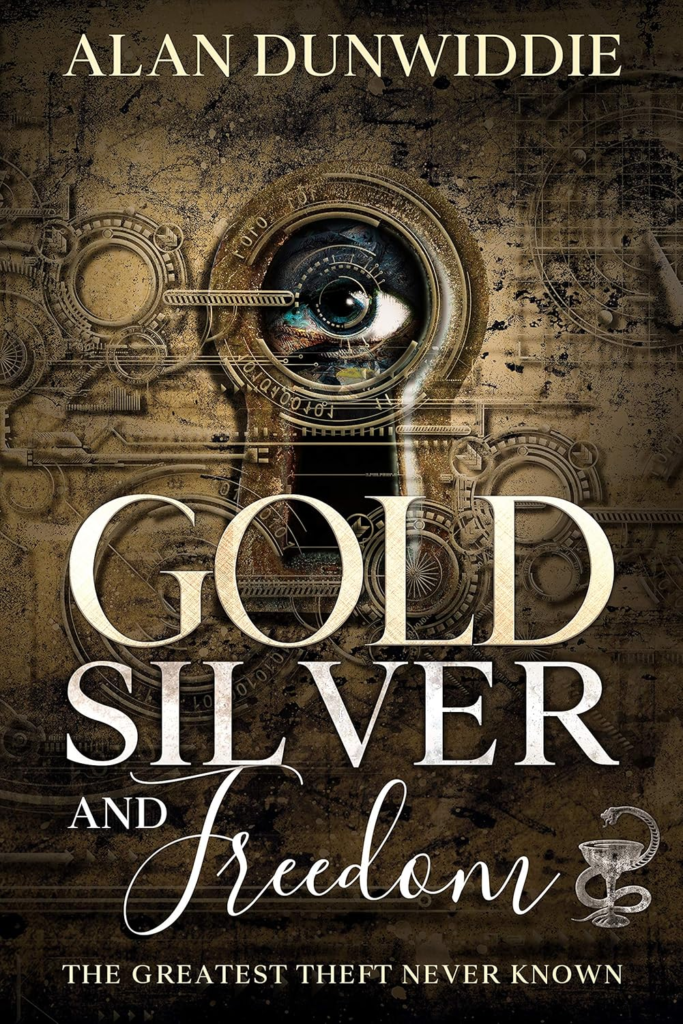
Gold, Silver and Freedom was written in 2020 as I tried to make sense of a world changing direction at speed.
Very early on, it became clear to me that COVID-19 was not just a health event. It was being used — deliberately or opportunistically — to accelerate digital control, population tagging, and behavioural compliance at scale. What interested me most was not the virus itself, but what was being built around it.
I saw the period as the opening phase of a broader financial and societal reorganisation.
The core premise of the book was that people were being steered into increasingly fragile, devaluing fiat systems — now digital by design — while the underlying foundations of the real economy were shifting elsewhere. In parallel, precious metals appeared poised for renewed relevance as protection against a coming monetary reset.
Alongside this, I explored the likelihood of a sharp rise in commodity prices, driven by:
- expanding digital surveillance infrastructure
- electrification and electric vehicles
- exponential growth in power consumption
- and the reality that while “data may be the new oil”, oil remains oil, and always will
The book argued that control over money is control over people — and that gold and silver, by their nature, resist that control. Where paper money once diluted sound money, digital money completes the loop.
Hence the title: Gold, Silver and Freedom.
The deeper thesis was simple but uncomfortable: that forces far removed from everyday life had replaced money rooted in physical reality with abstractions they fully control — and that this shift carries profound consequences for personal autonomy.
As with my earlier work, the book was written primarily for clarification, not persuasion. It helped me organise what I believed was unfolding and consider how best to position myself — financially and mentally — for what might follow.
The book also identified likely geopolitical flashpoints arising from this transition, including Ukraine and Taiwan, as pressure points where financial, technological, and strategic interests would collide.
Commercially, it was modest. That was never the measure of success.
The real value was internal: it marked a point of clarity. It fixed a framework in place at a time when noise was high and honest discussion increasingly constrained.
Like the others, the book served its purpose.
It helped me see the direction of travel — and decide how much of it I was willing to accept.