Twenty-eight and a half years ago, in that city, I had an MRI scan that resulted in me being told I might never walk again. Some sentences do not fade. They divide a life. There is the man before them, and the man after.
I wanted to stand again where that fracture began. Not for closure. I have no use for that word. I wanted to look back at the man who heard it, and at the road he took afterwards, with all that followed from it, for better and for worse.
Ireland can do that. It can alter the course of a life without warning, and only decades later do you see the full shape of the turn.
I visited a few places in Limerick, but took no photographs. It seemed wrong somehow. Not every place should be converted into an image. Some are better left as encounter.
And yet Limerick, appropriately enough, also gave me a limerick:
There once was a man from Hobro Who knew it was time to go, And start a new life Without all that strife, And so he went off to Wicklow.
A joke, obviously. But not only a joke.
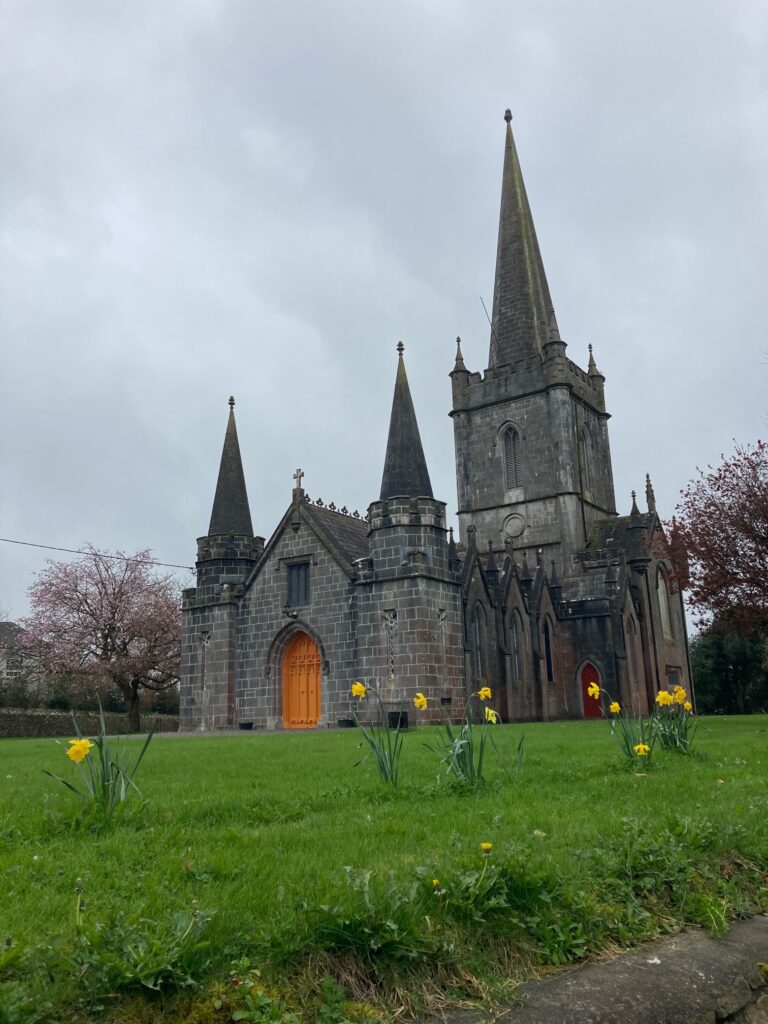
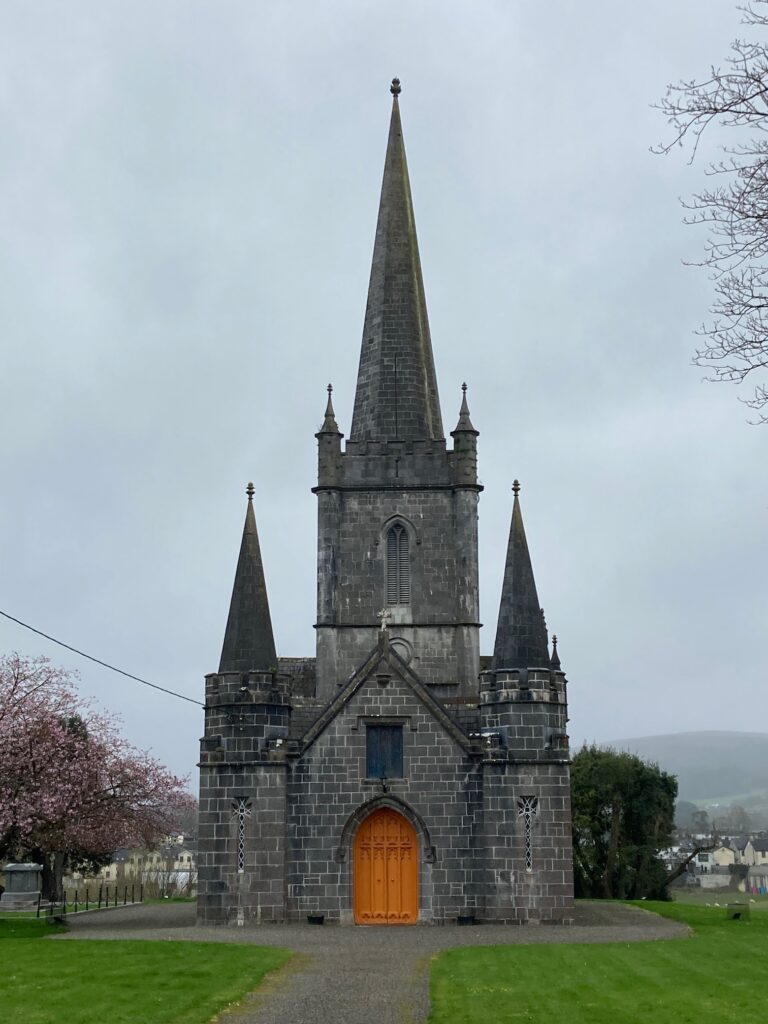
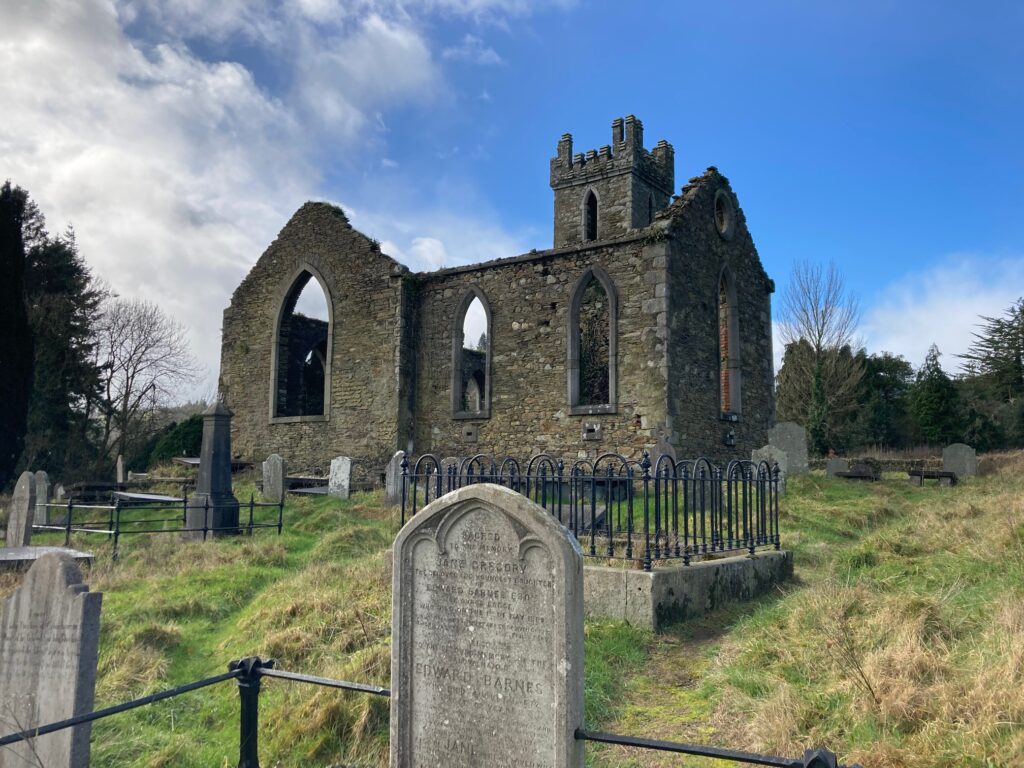
From there I drove on, meaning to see Cahir Castle, and instead found myself halted by something else: one of the most beautiful churches I have seen in Ireland.
You could see it from far off. Protestant Gothic. Intact, solid, self-possessed. Built in 1818 and designed by Nash, it immediately pulled me toward the age I so often meet in the earth and on the beaches: the late Georgian and Regency world, the world of old copper, worn silver, and the coins that still surface beneath the grass and sand. Then there was the door, painted a challenging orange. In Ireland, orange is never merely orange. History still speaks through colour.
Then Dungarvan.
A beautiful seaside town, but one marked by subtraction. You can feel the railway’s absence in the place. The town remains handsome, but the old line still haunts it. The Greenway now runs through that lost corridor, with so much railway architecture still standing that the old movement has not entirely gone. It has only changed form.
Then Waterford.
The energy shifted again. Medieval, certainly, but not trapped in its own past. Some towns feel burdened by memory. Waterford did not. It felt old, but still open. Less weighed down by what it had been. More alive to what it may yet become.
That, perhaps, was the shape of the journey.
Limerick was reckoning. Cahir was surprise. Dungarvan was beauty marked by loss. Waterford was old stone with forward motion still in it.
Tomorrow I will head home. But first there is Waterford city centre, and perhaps, if the weather opens, a new beach or two to detect. I have already identified them.
Then Passage East, literally. A rarity now: a car ferry between Irish places. After years in Denmark, I like the thought of that more than I should. Driving onto a boat, crossing a stretch of water, and letting it put me down elsewhere. Not exile. Not escape. Just passage.
And then home.
And perhaps that is enough for now: not answers, but movement.
I’ve come to realise that much of the history we are taught is little more than a convenient story. Yet the real clues sit quietly around us, waiting to be noticed. Often all it takes is looking up, or down, to see that the world is not quite what we are repeatedly told it is.
Baltinglass is a good place to begin.
You will not find it in many guidebooks. It is not promoted as a destination. Yet a chance video on YouTube suggested the valley may hold one of the largest Bronze Age landscapes in Europe, certainly one of the most significant in Ireland.
While tourists head for Newgrange, the officially presented megalithic site, I chose the opposite direction and drove south into the Wicklow Mountains.
The mountains feel older than the road that crosses them. Clear water cuts through the valleys. Strange stones appear where you would not expect them. Hills rise in shapes that seem deliberate rather than accidental. It is the kind of landscape that makes you slow down and pay attention.
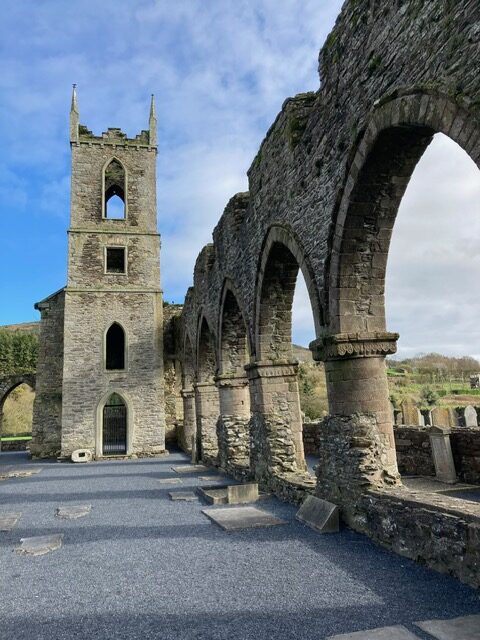
My first stop in Baltinglass was the abbey.
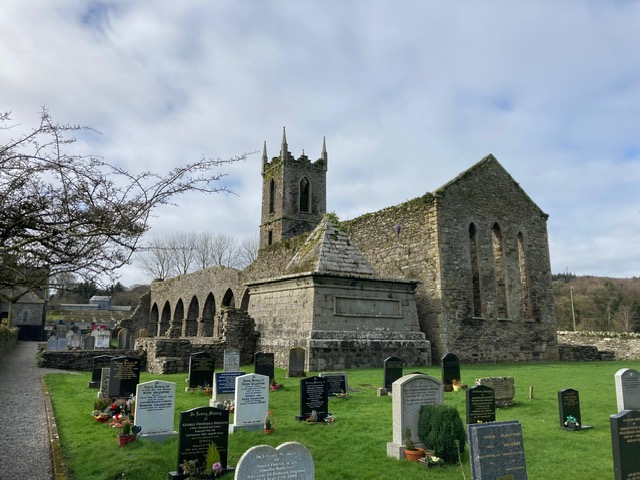
It stands ruined now, but inside the walls sits another building — a Protestant church constructed within the remains of the medieval structure, and now itself also abandoned. Layers of occupation. Different groups arriving centuries apart and choosing the same place to build.
That alone tells you something about the location.
Walking through the grounds I came upon a tomb structure topped with a pyramid. The tomb itself is now empty. There was no chequerboard pattern here, but the symbolism still brought to mind the same geometric language that appears elsewhere — pyramids, grids, and repeating forms that surface again and again across different cultures.
It makes you wonder what ideas sit behind those symbols, and how old they really are.
Looking out from the abbey, the surrounding hills have strange shapes.
They reminded me of Penshaw Hill near Sunderland and the old story of the Lambton Worm winding itself around the hill before it was slain. Today that hill is crowned with a Greek temple. Another structure placed on top of something older, as if each generation feels compelled to mark the same point in the landscape.
The pyramid above the abbey tomb seemed to belong to the same instinct.
I walked toward the largest of the hilltop forts overlooking the town. There are several scattered around the valley.
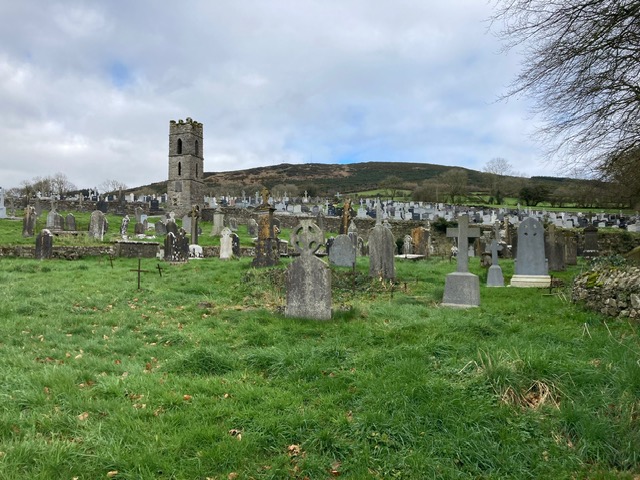
The slope of one hill has become a vast cemetery. At its centre stands a tower that feels older than the graves surrounding it. Beside it sits Ireland’s national brain injury hospital, another modern institution that has somehow found its place on this same ground.
Places with long histories seem to keep attracting new occupants.
Later I walked down into the town itself.
I stopped at the butcher and bought some local lamb. It felt right to eat something raised in the same valley I had been walking through. If places carry energy, perhaps the animals raised there do too.
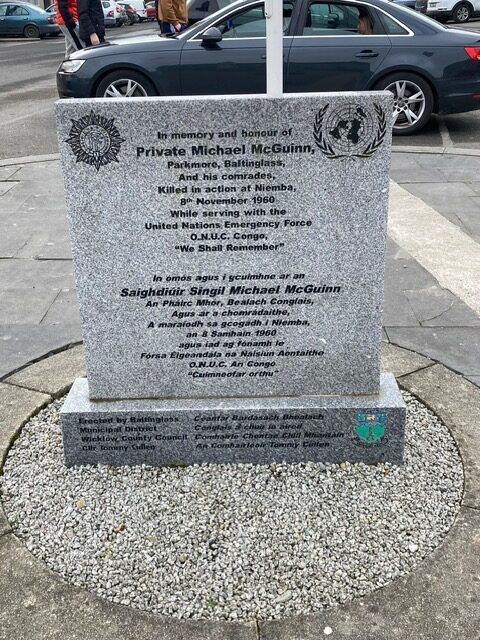
Nearby I came across something I had not expected at all — a United Nations memorial.
It commemorates Irish soldiers killed in the Congo during the UN operations of the early 1960s. I knew little about the incident before seeing the memorial, but one discovery always leads to another. Research tends to follow later.
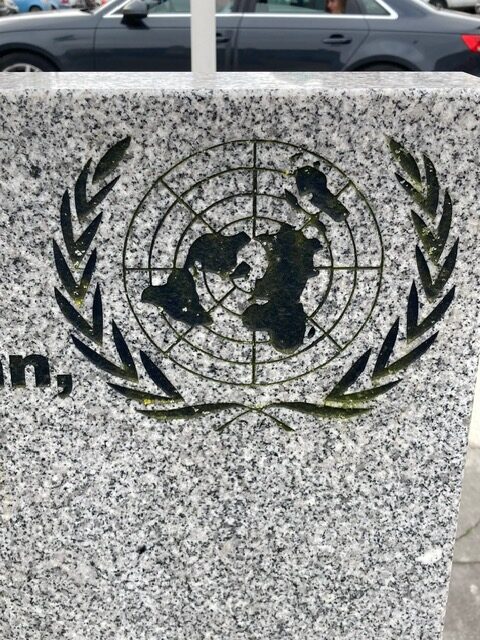
What caught my attention most was the map carved into the monument — the familiar UN world projection surrounded by a laurel wreath. A symbol most people see without ever looking closely.
It took me many years myself before I began noticing how many narratives are quietly constructed for us.
Eventually I returned to the car.
There was one last thing I wanted to see — the old railway station.
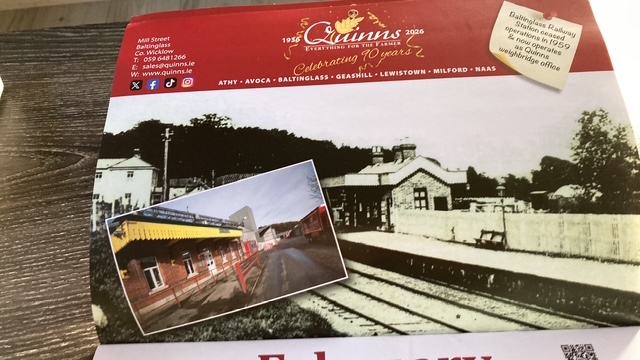
To my surprise the building still exists. It now sits inside an agricultural retail yard belonging to Quinns. I was about to leave after taking a quick look when someone knocked on the car window and asked if I needed help with anything.
When I explained I had only come to see the station, I was suddenly being given a private tour.
Inside the old office the station still has its safe, the kind of heavy metal vault you would expect in a historic house, Montana had one too. The place felt frozen in time. It was a quiet day, so perhaps that made the difference, but the generosity was appreciated, as was the company calendar I was given.
Encounters like that happen now and then to me.
Once in Georgetown a local gave me a full tour of a colonial cemetery. Another time in Newcastle someone walked me through the history of the village church and the old castle nearby. Some people still care about preserving these stories.
And that matters.
Now it really was time to head home.
There was just one final stop.
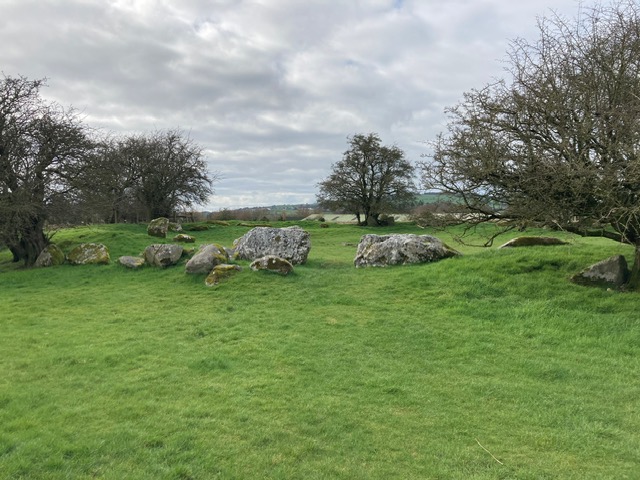
A stone circle standing quietly in a field outside the town.
Officially the circle is dated to around 2,500 years ago. Perhaps that was the last time it was used. Personally I suspect the site is far older.
When I stepped inside the circle my legs shivered slightly. Cold wind perhaps. Or something else.
What I did notice were threads and ribbons tied to nearby branches. Someone had been here before me, leaving small offerings or tokens. Even now people feel that places like this hold something.
Stones carry a presence modern culture tends to ignore.
Our ancestors may have understood that better than we do.
When I arrived home YouTube suggested another video for me.
The subject was Larry Murphy — Ireland’s notorious serial killer, often called the Beast of Baltinglass.
The valley clearly holds its share of darker stories too.
What was open weeks ago is now half-sealed. Large stretches are silent again. Only selected corridors of exposed sand remain workable — thin veins between stone.
You can feel the closing.
I moved further up the coast than usual. A stretch I hadn’t worked properly before. The signals were immediate. Dense. Layered. The kind of day that makes you realise how rare the conditions have been.
Storms strip. Tides expose. Then the sea takes it back.
What is available now may not be available again for years. And if it opens again, will I even still be here to walk it?
That isn’t sentiment. It’s timing.
So I am recording this day properly.
The depth of finds. The spread. The density. My assessment of the ground while it is still readable.
I have yet to see a metal detecting video with this level of single-day intensity.
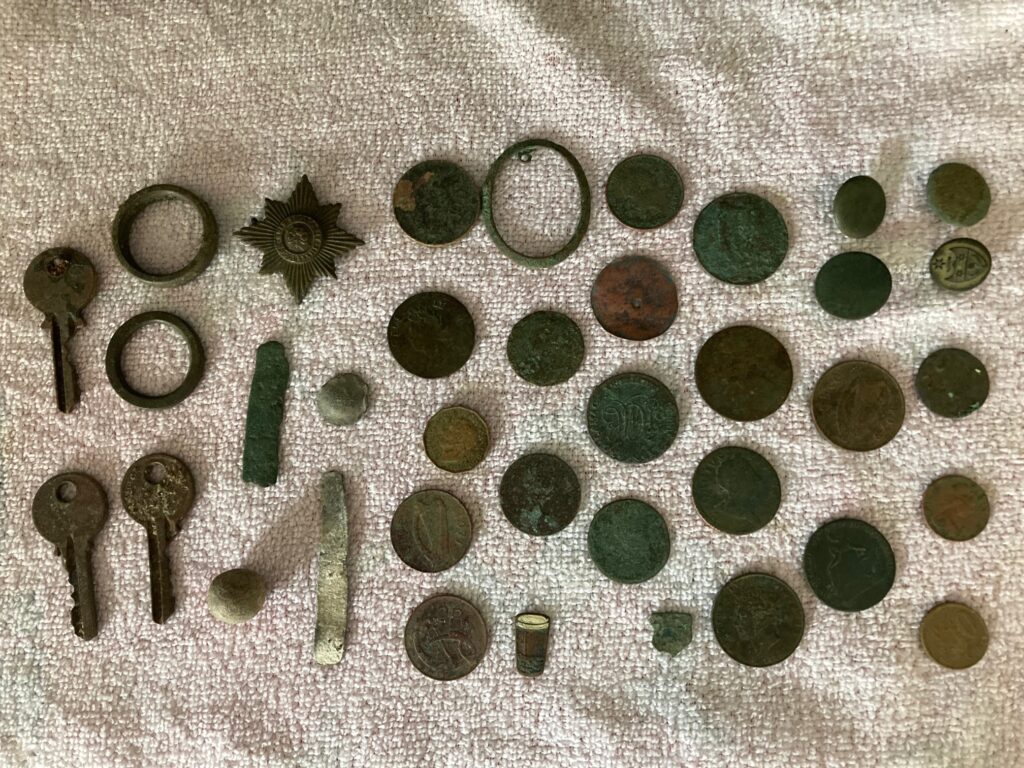
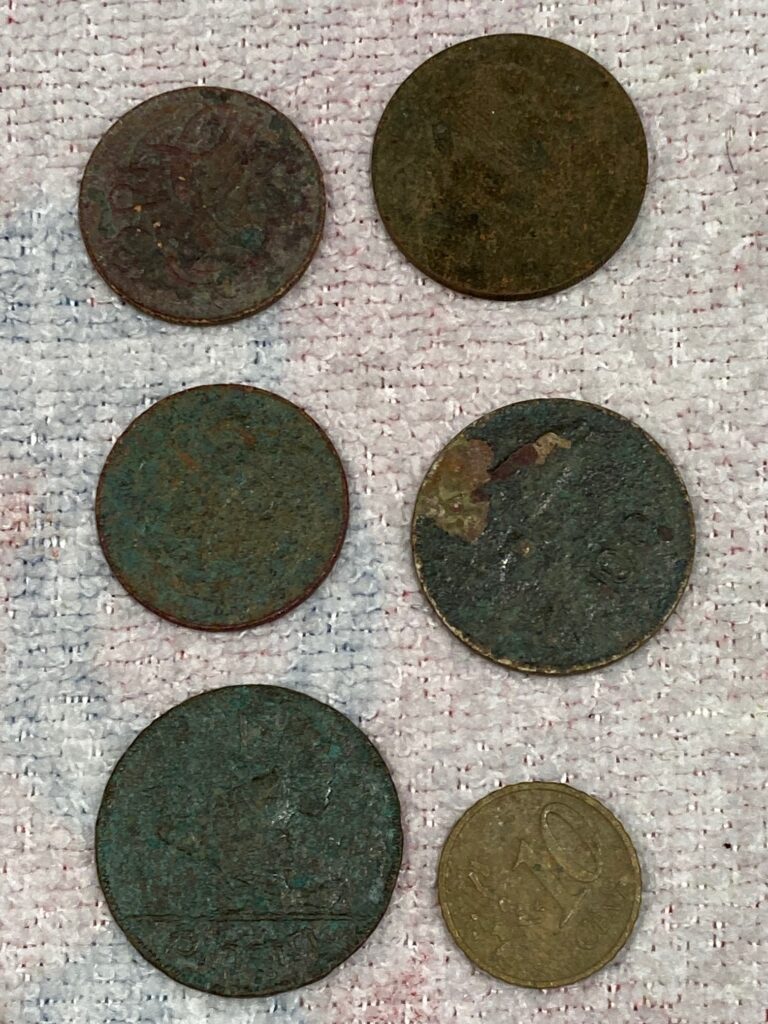
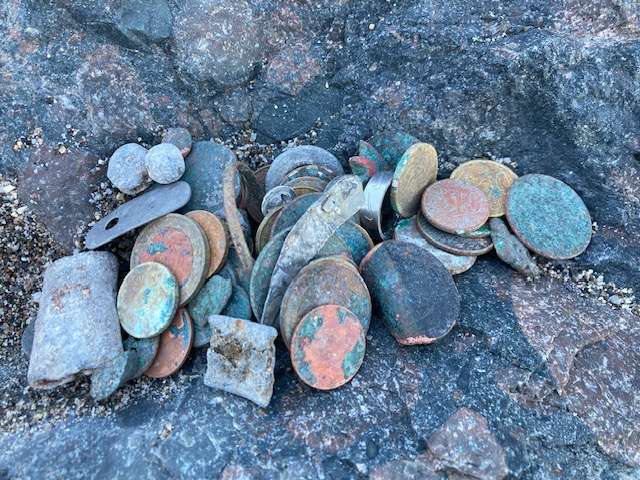
The photograph above is everything recovered in one session.
I will go through them in turn.
The Georgian Layer — George II, III, IV
Before coming here I had barely handled a Georgian coin.
Now the album thickens.
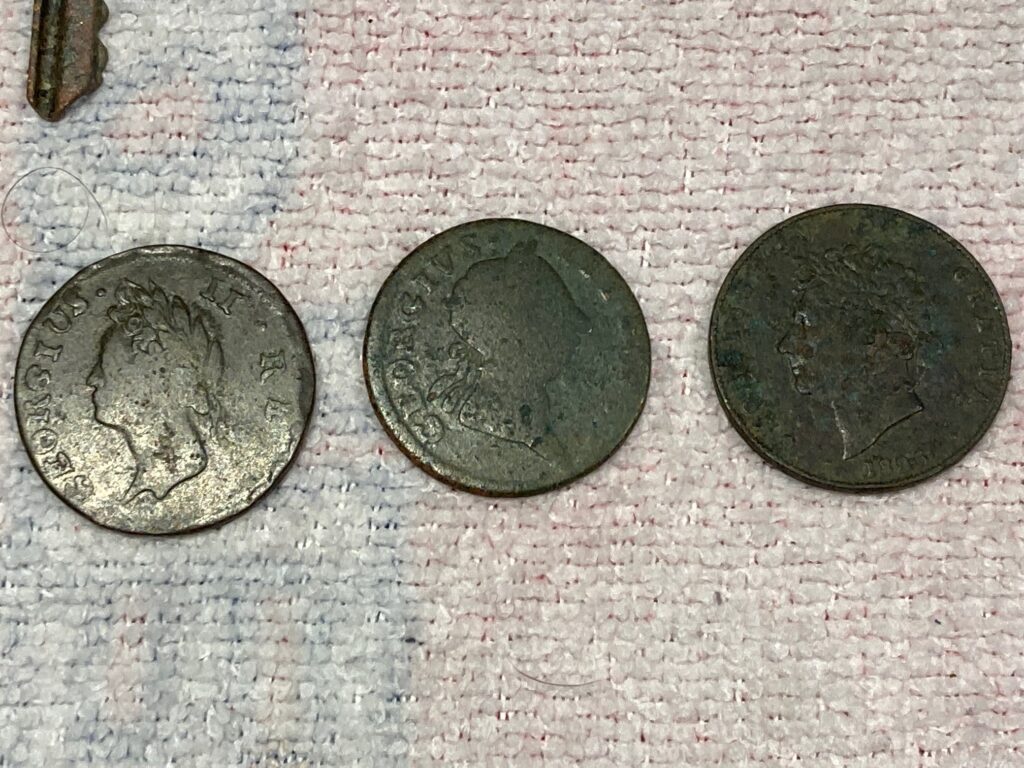
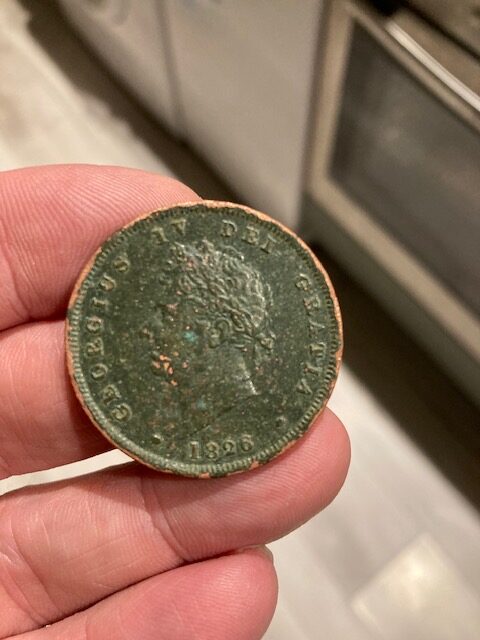
Yesterday I lifted three in one tide — George II, George III, George IV. Three reigns from one strip of sand.
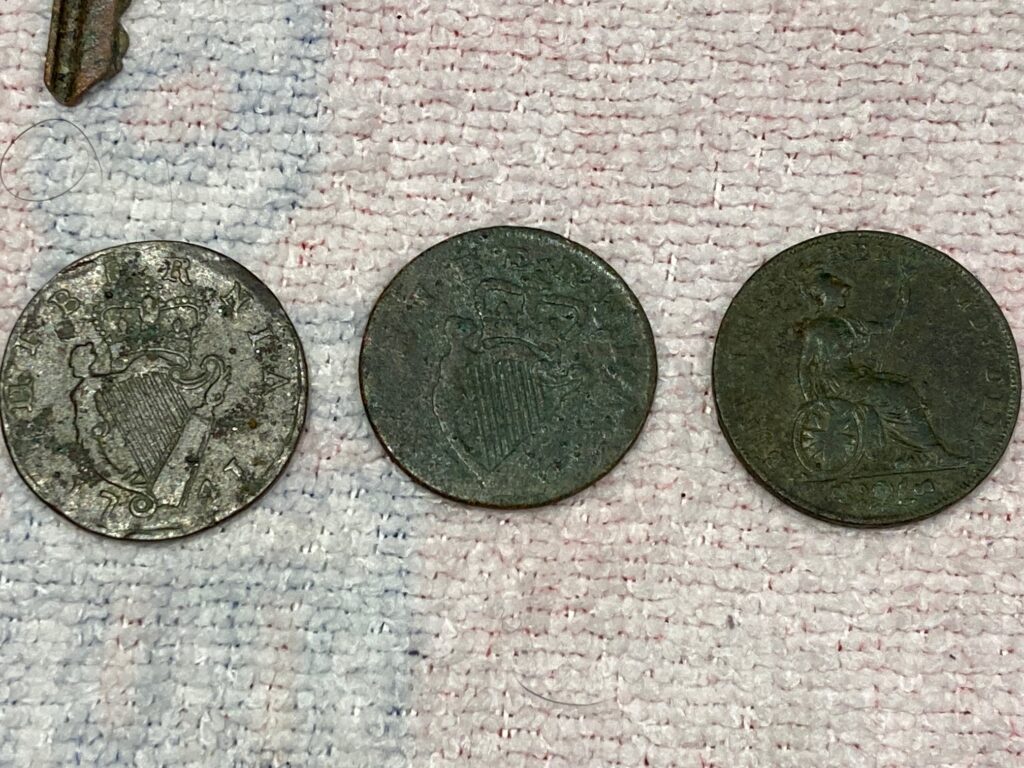
The George II is 1747. Hibernia, the harp. Mid-18th century confidence. Protestant ascendancy intact. Parishes full. Structures certain of themselves.
George III follows — longer reign, longer shadow. Revolution in America. Union with Ireland. Empire consolidating even as strain increases.
Then George IV. Factory-milled. Cleaner edges. Sharper strike. Hardly worn. Dropped close to new. It did not travel far before the sand took it.
That detail stays with me.
Some coins pass through decades of hands. Others fall almost immediately. History is not evenly circulated.
George II appears more often here than III or IV. That suggests density — of trade, of settlement, of mid-18th century movement along this coast. The beach offers hints, not conclusions.
Three kings. Nearly a century. All reduced to copper discs surrendered to tide.
The sand does not rank reigns.
It records loss.
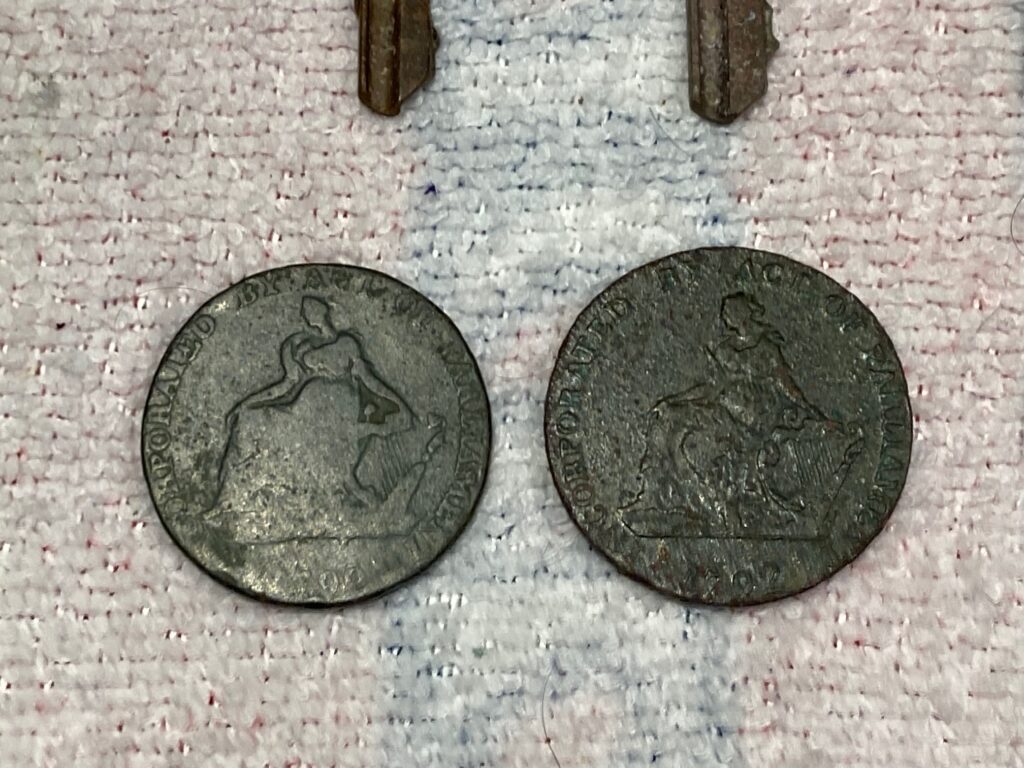
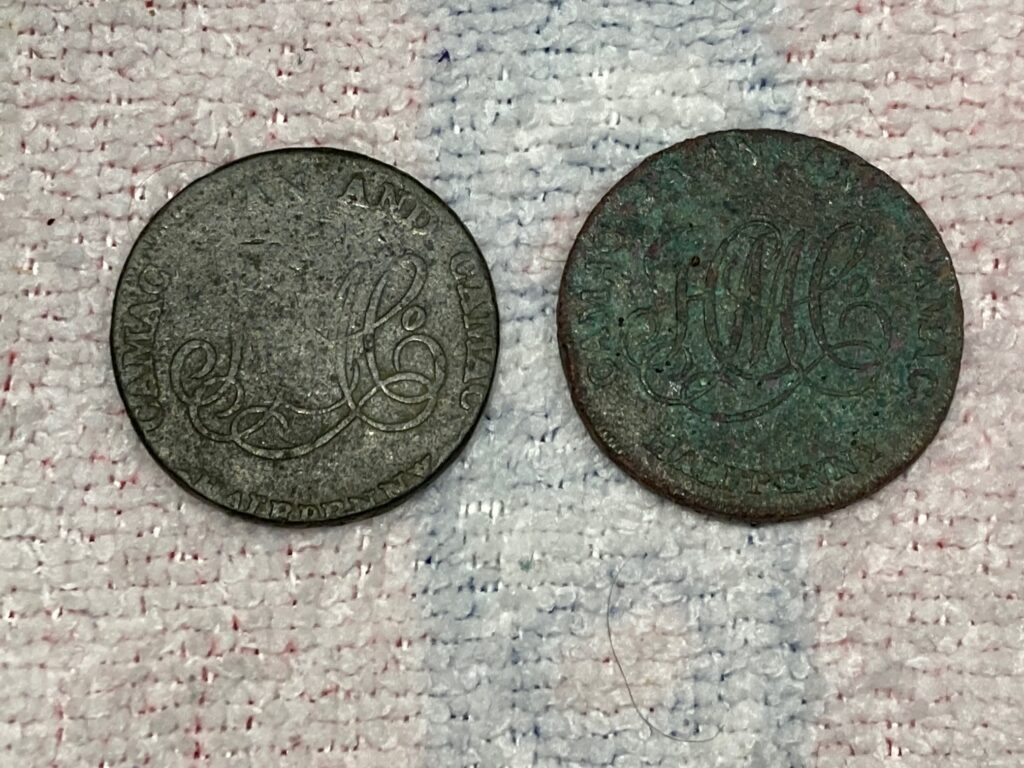
Private Money — Camac, 1792
Two more from the same stretch.
Both dated 1792. Both Camac.
Not royal issues. Merchant tokens. Private money struck in Dublin when official copper ran thin.
When the state cannot supply enough small change, commerce improvises.
These pieces often carry more copper than the crown’s own issue. Heavier. Honest metal, struck to keep exchange alive.
Shortage precedes adaptation.
Barter yields to token. Token fills the gap the state cannot.
The year matters. 1792 sits just before fracture — before 1798, before rebellion. Monetary improvisation often arrives before political rupture.
The beach makes no distinction between crown and merchant.
It receives both.
And returns them centuries later without preference.
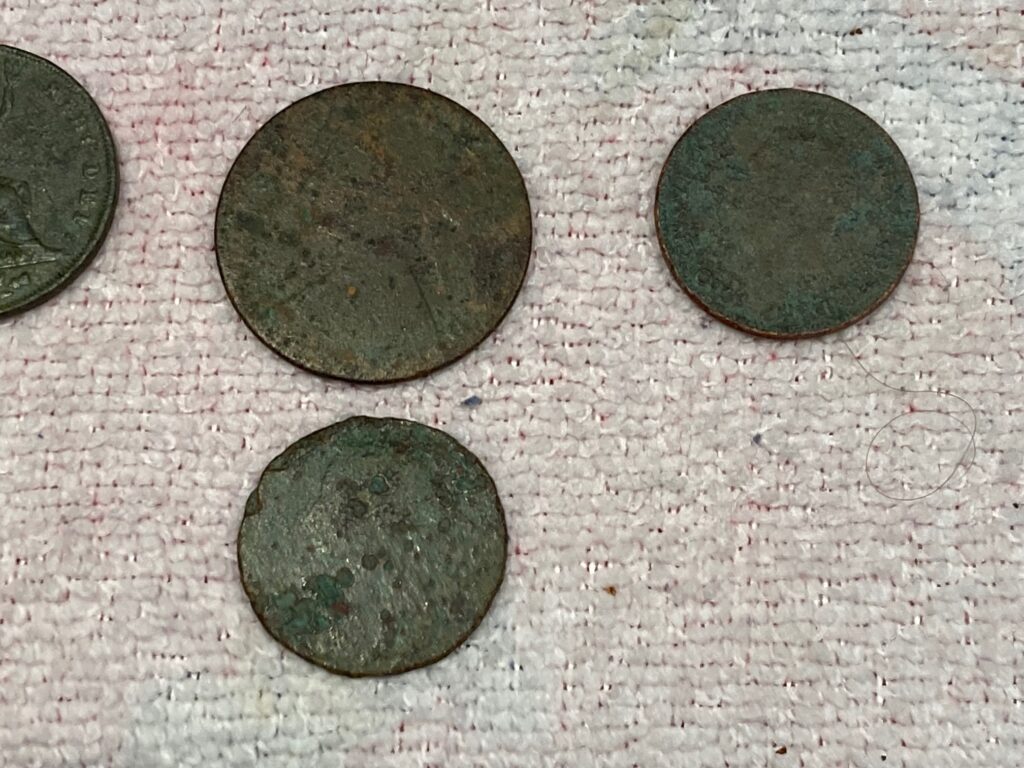
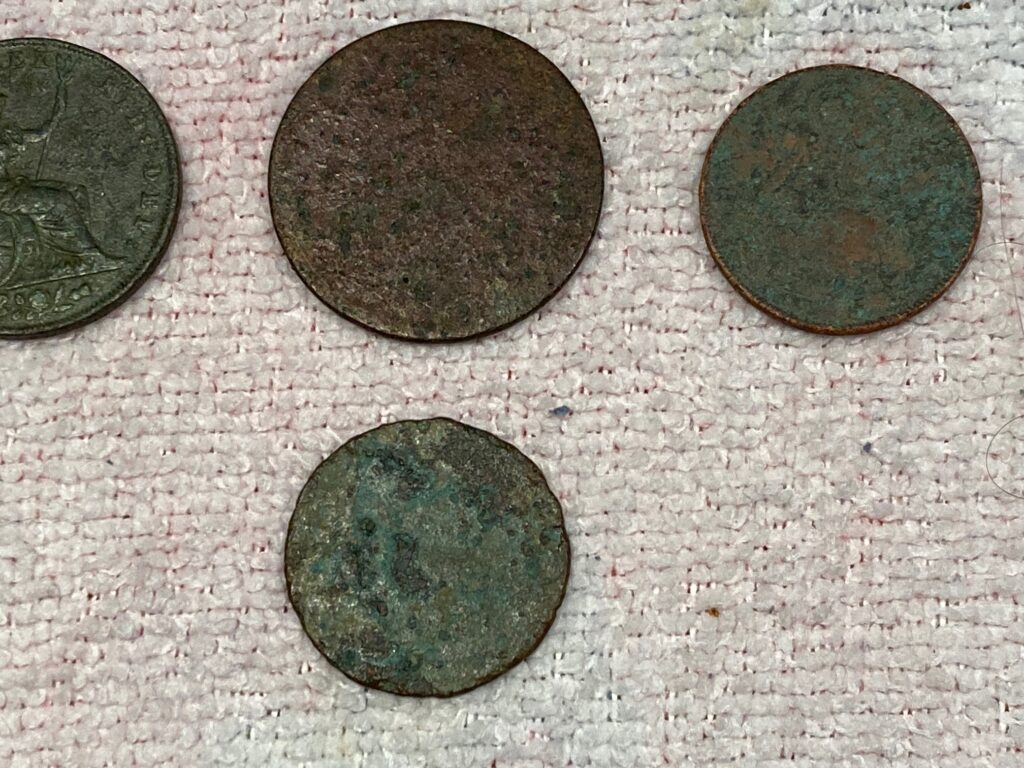
Empire Copper — Victoria and George V
These are not the thick Georgian discs of mid-eighteenth century Ireland.
They are imperial copper.
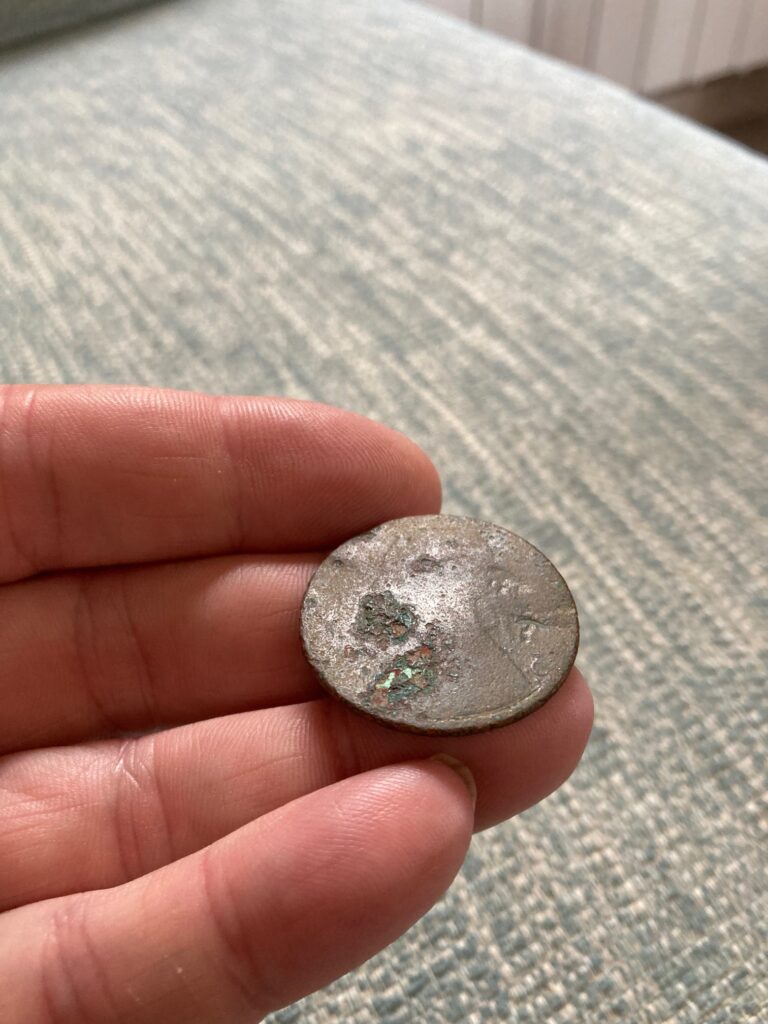
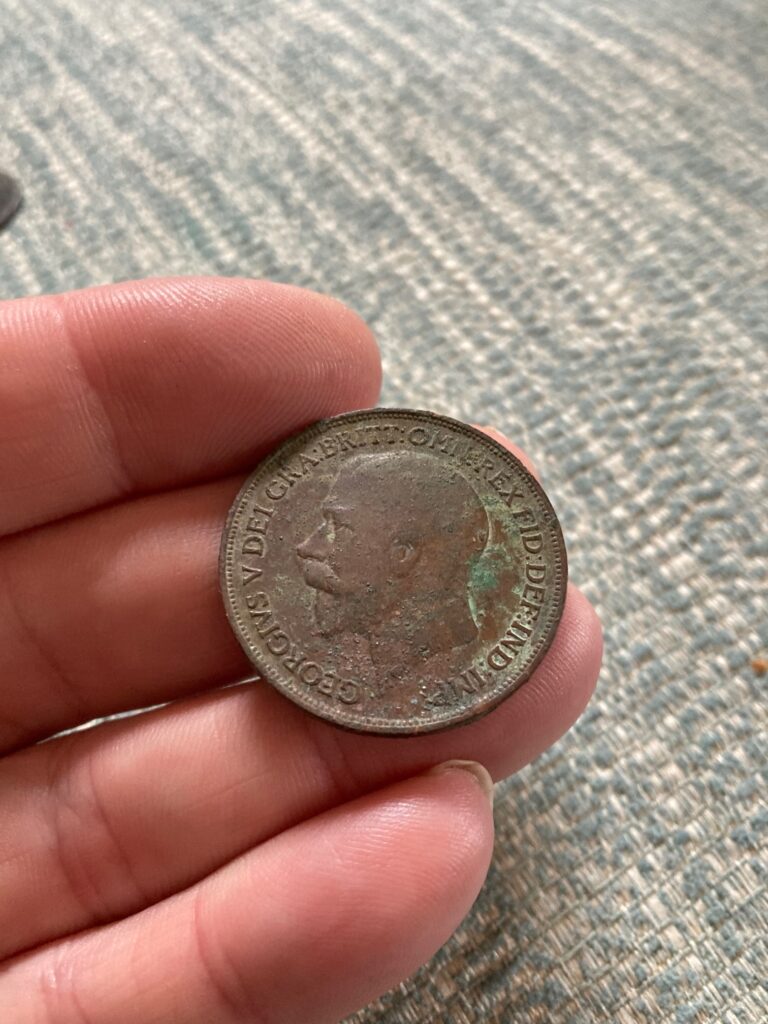
Victoria. George V.
By now Ireland is no longer semi-separate in coinage. There is no distinct Hibernia seated in quiet autonomy. The designs align fully with London. The empire standardises.
One currency. One monarch. One system.
On the surface, it suggests strength.
And yet these coins feel different in the hand.
They are thinner. The relief softer. The surfaces seem less resilient than the Georgian pieces — despite being a century younger. They have not endured the salt in the same way.
Mass production replaces solidity.
The Victoria is administration. Industry. Railways. Bureaucracy. Expansion at scale.
The George V carries another weight entirely.
I found it among brass.
Fragments of shell casing. Twisted scrap. Repeated false signals. I had to dig through war to reach coin.
This stretch of coast feels militarised. A training ground once. Drills before embarkation.
George V was struck in a time of mobilisation, not confidence.
Did it fall from the pocket of a young man practising here before being shipped to France?
Perhaps.
The detector cannot answer that.
But the layering is undeniable:
Copper. Brass. Empire. War.
The Georgian coins feel rooted in land and trade.
The Victorian and George V pieces feel industrial — faster, thinner, more uniform.
Peak empire often looks secure.
Its metal sometimes looks strained.
Lead and Brass
After copper comes lead.
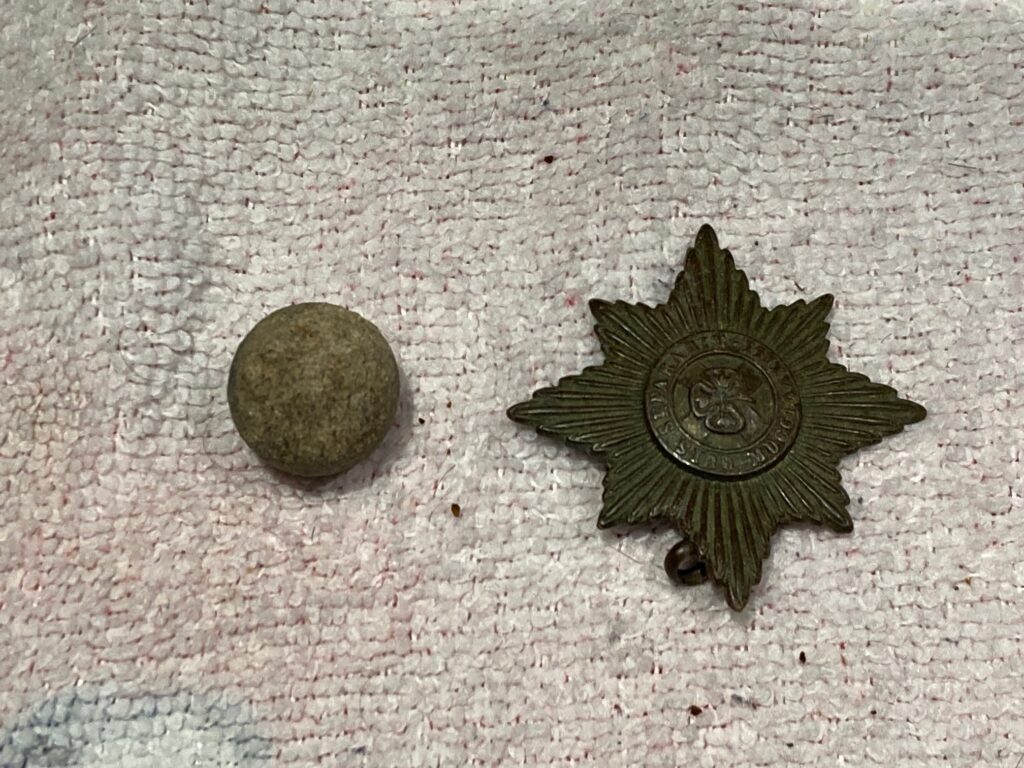
A musket ball. Unused.
It was cast to fly and never did.
No flattening. No impact scar. Just intention, suspended.
Eighteenth century? Early nineteenth? The coast has seen volunteers, militia, watchful men facing outward across the Irish Sea. Days of Napoleon. Days of fear.
Not far from where I found the Napoleonic button.
Preparedness without discharge.
Then brass.
A star.
Pre-1922 Irish Dragoons.
Cavalry. Imperial Ireland in saddle and sabre.
Now the layers tighten.
Musket lead. Georgian copper. Victorian administration. George V war coin. Shell fragments in the sand.
Was it one man who lost the halfpenny and the badge? One pocket shedding pay and insignia in the same wind?
Or are we forcing coherence on a beach that collapses centuries into one afternoon?
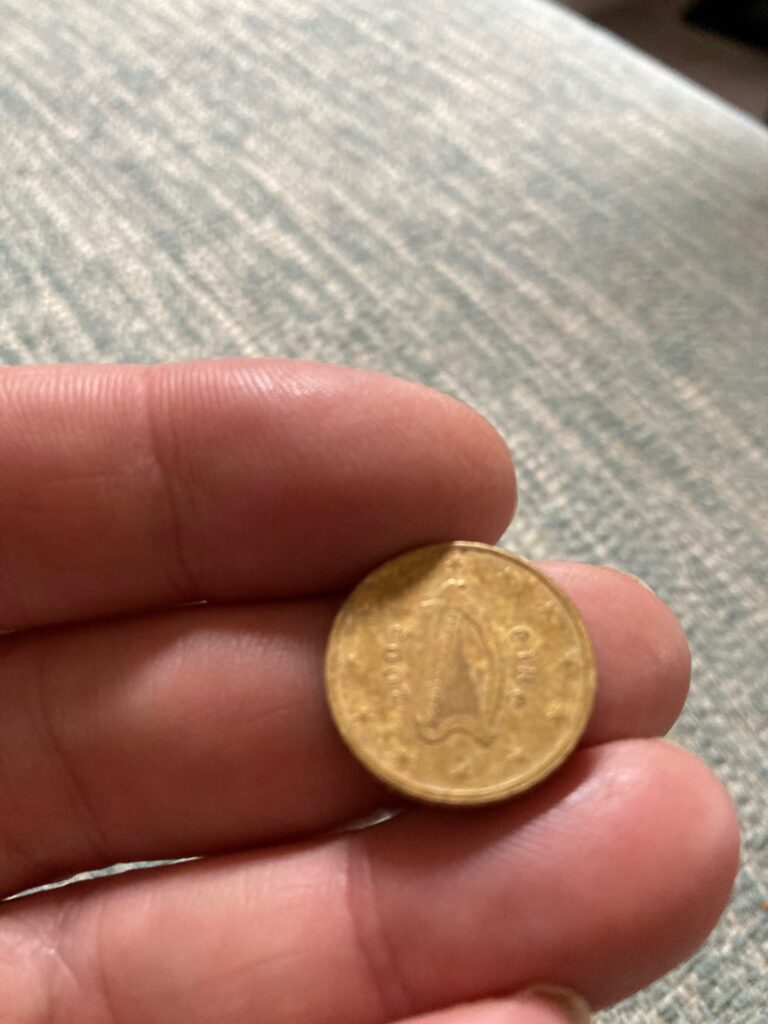
Imperial penny. Free State imitation. Decimal prelude. Euro coin.
Three stages of independence. Then absorption into something wider.
Empires change form.
Copper remains.
The harp survives on some pieces. Disappears on others.
The tide is indifferent.
Buttons — The Smallest Losses
Coins speak of systems.
Buttons speak of people.
I have a jar full of them now.
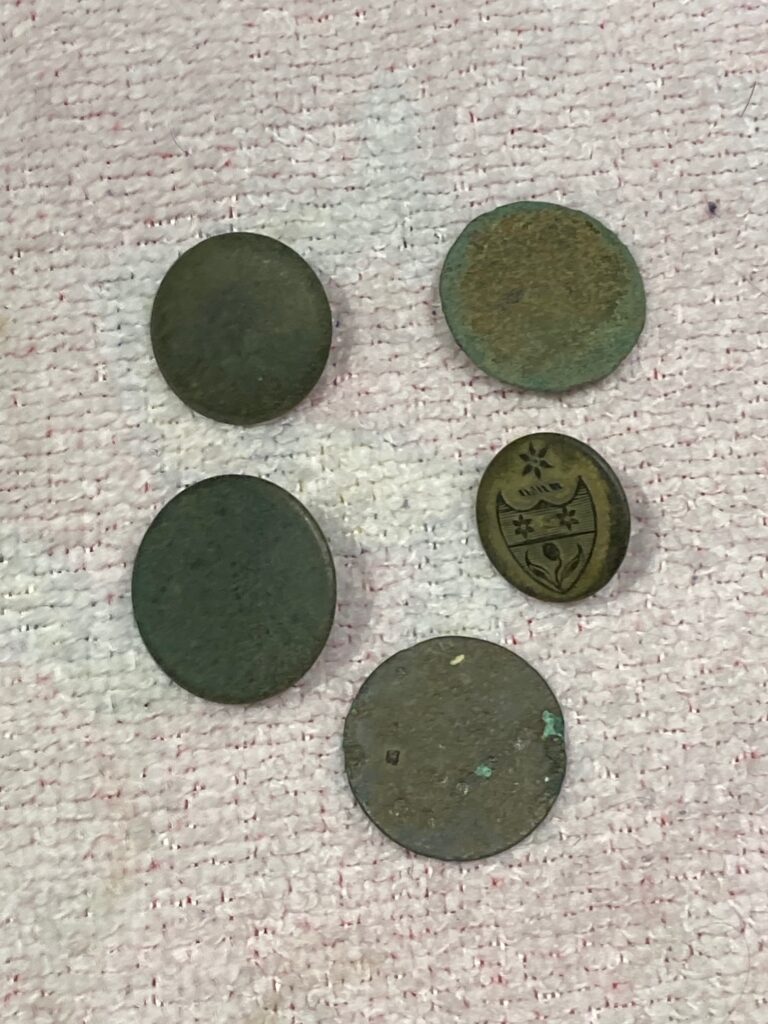
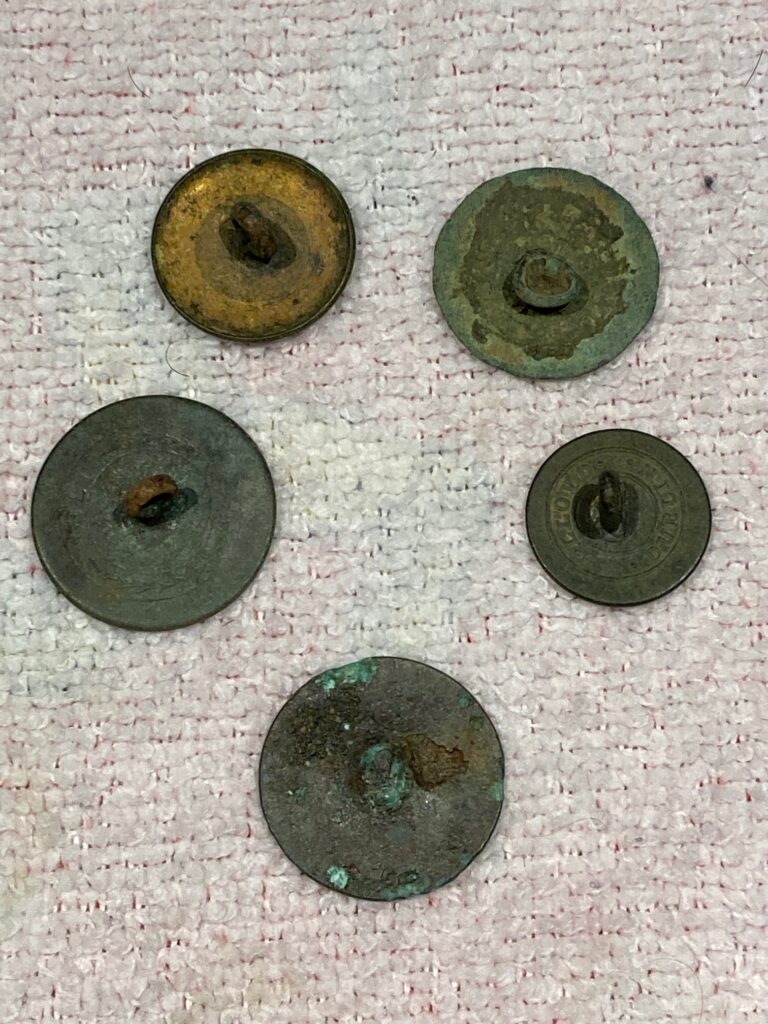
Not modern plastic. Not disposable moulded convenience. These are metal. Cast. Pressed. Sometimes lathe-turned. Some clearly handmade. Imperfect. Individual.
Many likely date to the 1700s. Some perhaps earlier. The shanks are hand-soldered. The backs show tool marks. The fronts still carry faint crests, simple patterns, the geometry of another century’s clothing.
They are beautiful.
We underestimate how much craft once went into small things.
A button was not trivial. It secured coat against wind. Cloak against rain. Shirt against exposure. On this coast, that mattered.
I imagine a travelling man walking the strand in the 18th century. Long coat. Salt air. Wind pulling at cloth. A button gives way. Falls into shingle. Gone.
No easy replacement. No shop on every corner. No cheap packet of ten.
Loss meant inconvenience. Repair required skill.
Each button here represents a small moment of irritation. A pause. A hand patting at a coat and finding absence.
Some are plain. Some carry regimental markings. Some are decorative, worn on civilian jackets. One bears the mark of a manufacturer long vanished.
They outlasted the garments they once held together.
The fabric rotted. The wearer died. The empire shifted. The tide moved.
The button remained.
There is something deeply human about them.
Coins are circulation. Badges are allegiance. Musket balls are intent.
Buttons are daily life.
A jar full of minor inconveniences from three centuries.
The beach gives them back one by one.
And I keep them.
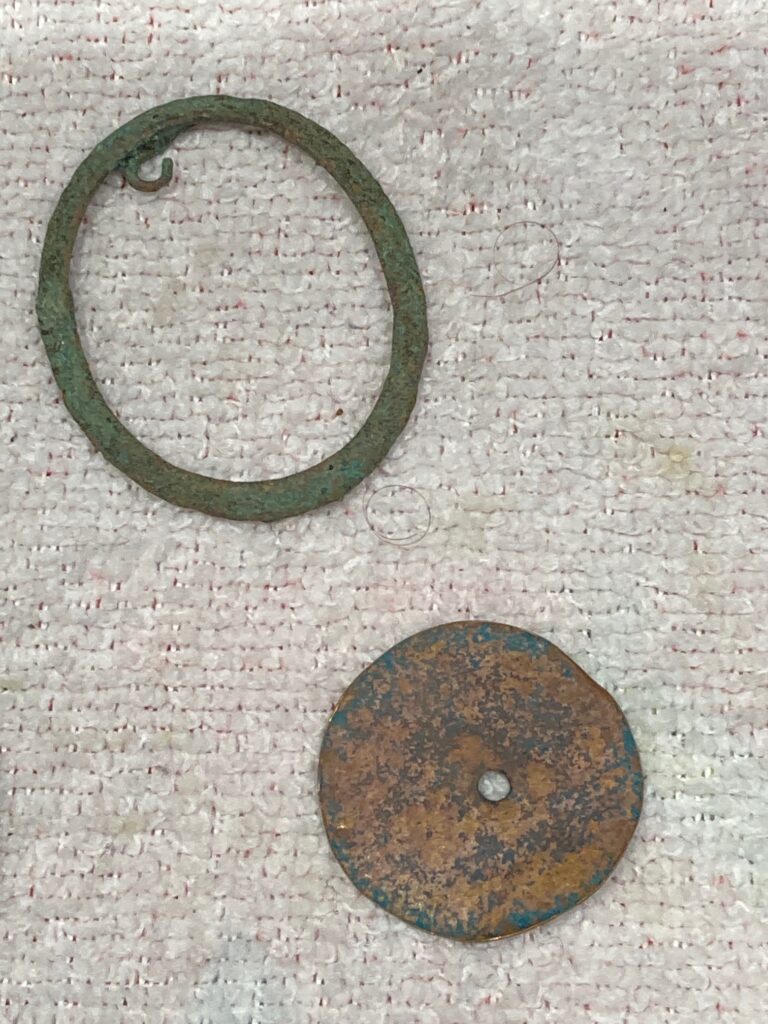
The Copper Disc and the Cameo Frame
Not everything lost here was currency or service.
Some pieces were intimate.
A simple copper disc. No inscription. No monarch. Just a worked circle with a central pierce.
Was it a makeshift token? A washer repurposed? Or part of something decorative — perhaps once polished, perhaps once mounted?
Copper oxidises beautifully. Even now, it carries colour.
And then the frame.
Oval. Delicate. A small suspension loop still intact.
Almost certainly Georgian.
A cameo once sat within it. A miniature portrait. A profile. A lock of hair. A loved face carried close to the chest.
The glass is gone. The image gone. The sentiment gone.
Only the surround remains.
It is the opposite of coinage.
A coin is designed for circulation. A cameo is designed for closeness.
Someone wore this.
Someone fastened it in the morning.
Someone lost it — perhaps without knowing until much later.
There is something unsettling about finding only the frame.
The empire fades. The copper endures. The portrait disappears.
What we carry closest is often the first thing surrendered to time.
The beach does not prioritise power.
It preserves fragments.
A disc with no name. A frame with no face.
And yet they feel heavier than some of the coins.
The Penknife and the Fragments
Not all finds are symbolic.
Some are simply tools.
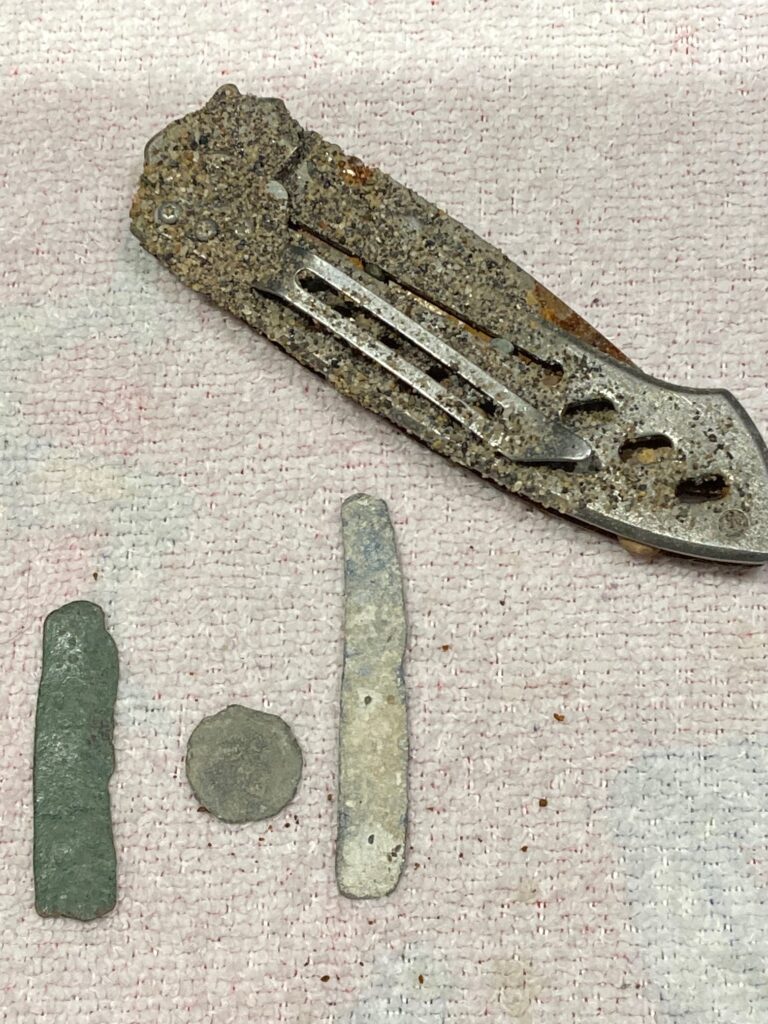
A penknife.
Modern by comparison. Steel still recognisable beneath the sand. Hinges stiff with salt. Once carried in a pocket, opened for rope, twine, food, small repairs.
A working object.
It does not belong to empire or rebellion. It belongs to habit. To hands. To ordinary days on the coast.
Someone used it. Someone dropped it. Someone replaced it.
Even here, the layers compress. Georgian copper lies metres from stainless steel.
Time folds.
Then the scraps.
A flattened strip of copper alloy. Another narrow blade-like piece. A small round disc, lead or pewter perhaps.
One fragment could be the broken tip of a lead spoon. If so, it once stirred porridge or broth in a cottage not far from here. Lead spoons were common. Cheap. Soft. Repairable until they were not.
The coastline keeps the leftovers.
The broken end. The snapped piece. The part no longer useful.
Coins are deliberate loss.
Fragments are accident.
Yet they tell as much.
A civilisation is not only its crowns and crests.
It is also its cutlery.
Its pocket tools.
Its worn-out metal repurposed until it fails.
The penknife reminds me of something simple:
Every era believes it is modern.
Every era leaves rust.
The Keys
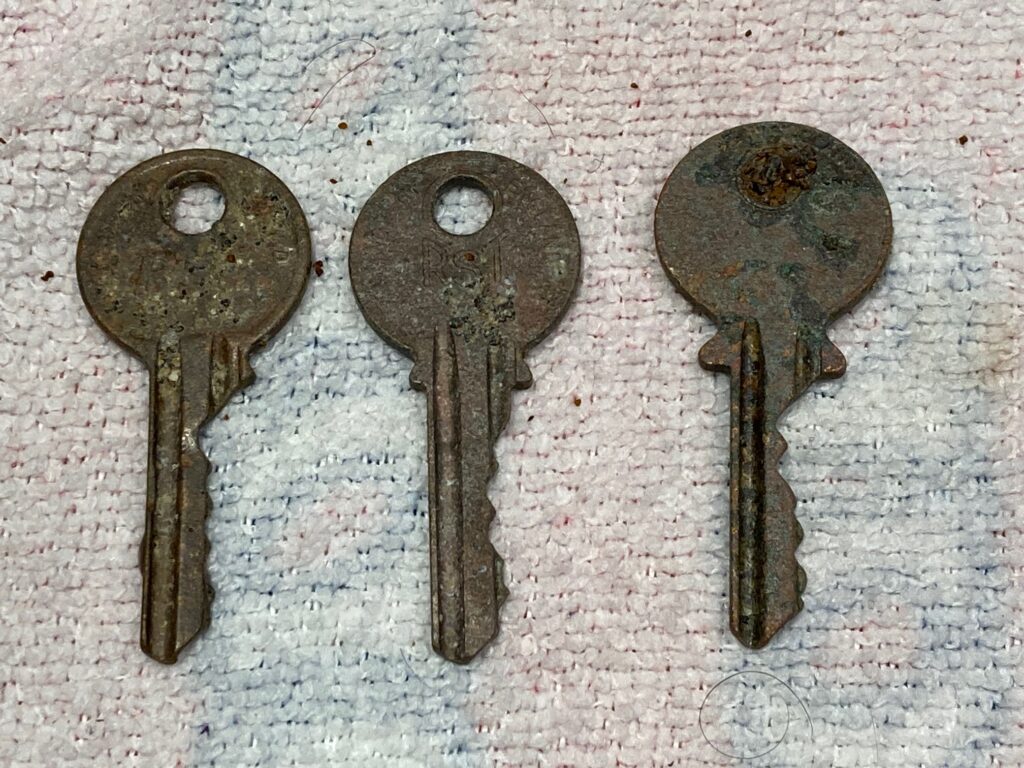
I find so many keys.
Almost as many as coins some days.
Three here alone. All different teeth. All once precise.
Each one cut to open a specific door.
A cottage. A barracks room. A shed near the dunes. A rented house by the sea.
A key is intimate authority.
It is trust made metal.
Someone carried these daily. Slipped them into a pocket. Felt their weight without thinking. The small reassurance of access. Of entry. Of belonging somewhere that closed against the wind.
And then — loss.
A fall from a pocket. A hole torn in lining. A moment of distraction in sand.
The door remained.
The key did not.
There is something stark about that.
Coins can be replaced. Buttons can be resewn. Badges reissued.
A lost key means exclusion.
Somewhere along this coast a man returned to a locked door and felt the cold certainty of inconvenience — or worse.
These are not ceremonial keys.
They are ordinary.
Mass-cut. Functional. Twentieth century perhaps. No romance.
And yet they speak loudly.
Keys are about control. About ownership. About territory defined by a lock and a threshold.
Empires issue currency.
Homes issue keys.
I find them in clusters.
Sometimes I wonder how many of those doors still stand.
The sand has no use for access.
It receives the instrument of entry and leaves the door behind.
The Unknown Coin
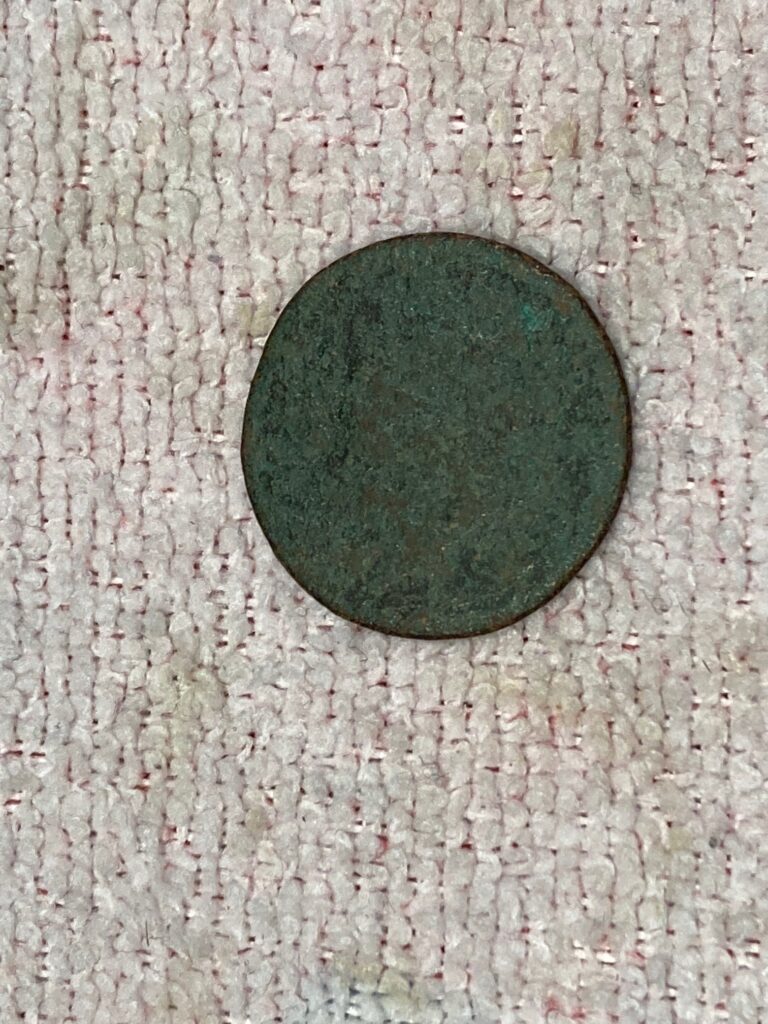
And then this.
A coin with no face.
No monarch. No harp. No date.
Time has erased it.
The outline remains. The weight remains. The diameter tells me it once mattered enough to be struck deliberately.
But its allegiance is gone.
It might be Georgian. It might be Victorian. It might be local token or foreign drift.
It resists classification.
And there is something fitting about that.
I have spent the day assigning eras.
George II. George III. Victoria. George V. Free State. Euro.
Each coin neatly slotted into a chapter of history.
This one refuses.
It has been in the sea long enough to forget.
The face worn smooth. The message dissolved. The authority flattened into anonymity.
Perhaps that is the final stage of all currency.
First it commands.
Then it circulates.
Then it corrodes.
Then it becomes simply metal.
The unknown coin is honest.
It does not carry narrative. It does not wave a flag. It does not argue sovereignty.
It is just copper that survived.
There is something almost liberating in that.
Empires insist on inscription.
The tide insists on erosion.
In the end, everything becomes an unknown coin.
And perhaps that is the most truthful state of all.
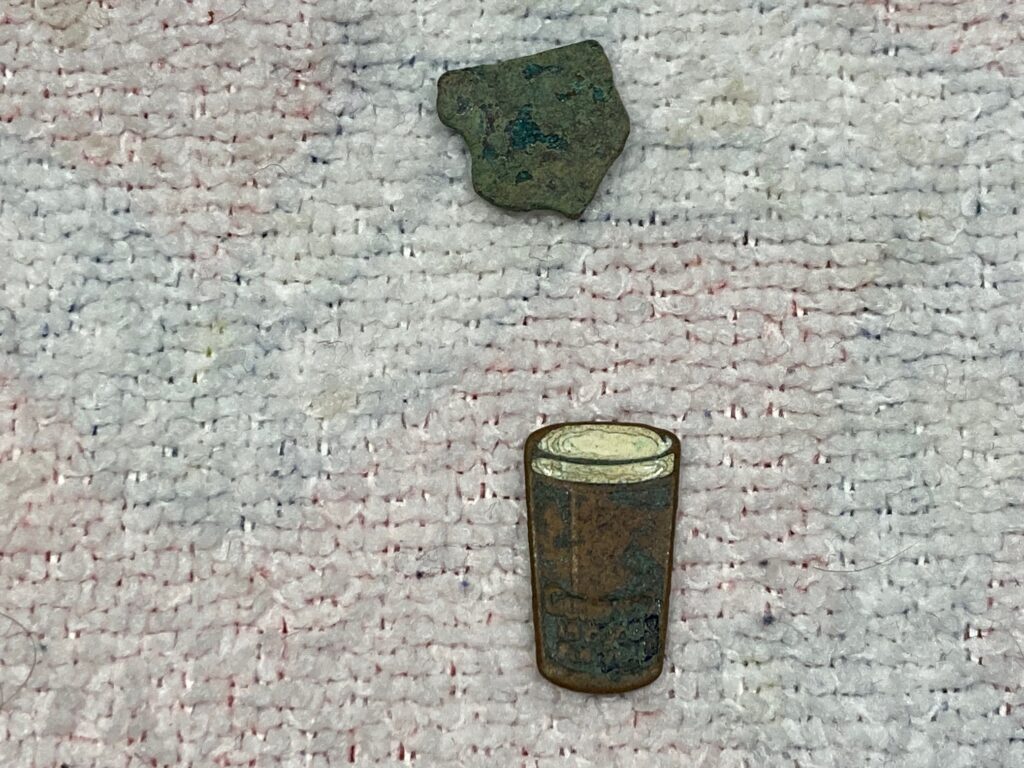
The Guinness Badge
And finally, this.
A small enamel badge. Guinness pint still visible beneath corrosion. The glass upright, white head intact in miniature.
Likely 1930s to 1950s.
Not ancient. Not imperial. Not revolutionary.
Just Irish.
By then the empire was gone. The Free State had become the Republic. Flags had changed. Allegiances redefined.
But Guinness endured.
It is almost comic in its steadiness.
Kings fade. Currencies shift. Empires dissolve. Rebellions harden into administrations.
The pint remains.
This badge was once pinned to a lapel. Worn with quiet pride perhaps. Or simple affiliation. A night out. A railway platform. A coastal stroll after work.
It speaks not of conquest, nor mobilisation, nor monetary union.
It speaks of habit. Of culture. Of something rooted enough to survive regime change.
There is something grounding about ending the day with it.
After Georgian copper. After private tokens. After Dragoon brass. After Free State imitation and euro alignment.
A pint.
Not ideology.
Not sovereignty theory.
Just continuity of a different kind.
Commercial. Cultural. Familiar.
The tide does not care.
But I do.
Because this badge feels like the most honest artefact of the lot.
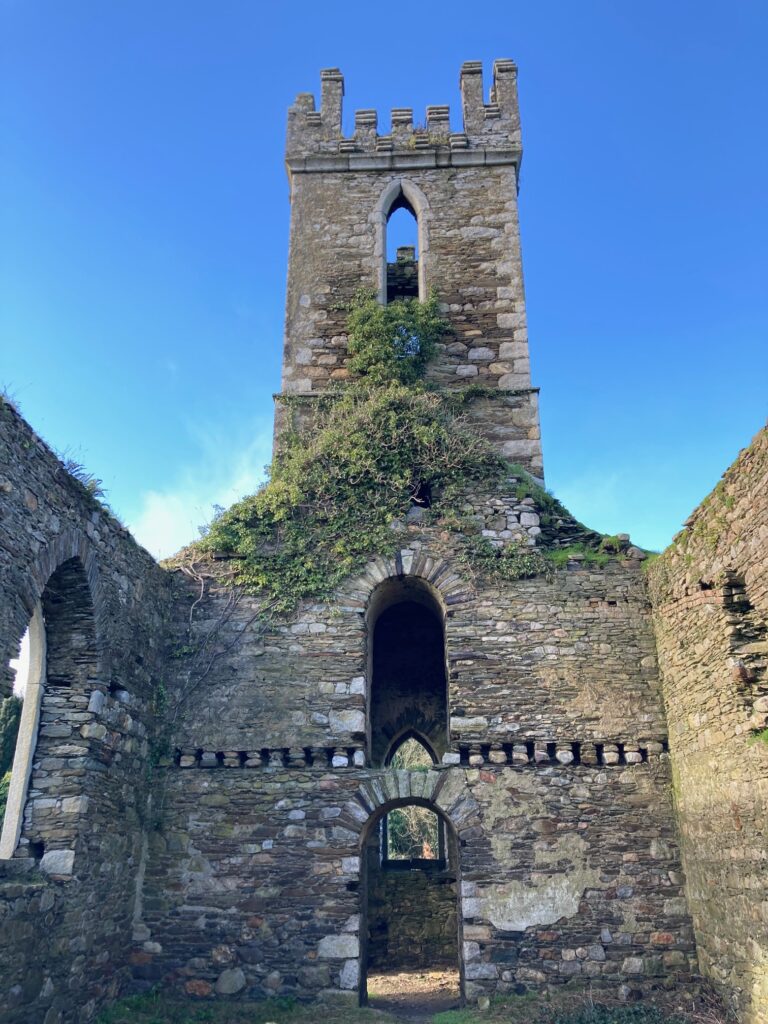
Yesterday I stood inside the ruins of Castle MacAdam Church near Avoca.
Georgian stone. Tall, empty lancets. Gravestones from the 1760s leaning into Wicklow grass.
It is not romantic. It is posthumous.
Once it held a Protestant parish certain of its continuity — baptisms, marriages, burials, sermons absorbed into timber and lime. The structure assumed endurance. The families who filled it assumed the same.
They are gone. The walls remain.
Standing there, the pattern felt older than Ireland.
Confidence. Consolidation. Moral certainty. Demographic thinning. Repurposing or abandonment.
No dramatic fall. Just erosion.
I thought of Consett. The church where my own family passed through its rites still stands, but the density has changed. Attendance narrows. Conviction competes with comfort. Ritual competes with distraction.
Across Europe, Christianity contracts.
An underused sacred space does not remain underused for long.
Capital enters first.
Active churches — not only deconsecrated chapels — now host candlelit concerts and pop retrospectives. ABBA lyrics about casual intimacy rising into vaults built for penitence. A Rolling Stones tribute singing Sympathy for the Devil would not feel implausible.
The acoustics remain. The geometry remains. The symbolism remains.
And something else remains — the accumulated imprint of prayer. If repetition imprints atmosphere, then centuries of petition are not erased by lighting rigs and ticket scanners. Stone stores more than sound.
When I saw the chequerboard floor at Notre-Dame Cathedral, especially in the wake of the fire and restoration, I became conscious of how symbols intensify in moments of weakness.
Black and white geometry is ancient. Medieval. It is also associated with later initiatory traditions, including Freemasonry. I make no declarative claim. But I notice timing. After fire. After fracture. During reconstruction. Perhaps Nostradamus was right?
Subconscious signs matter most when institutions falter.
Is that occult takeover? I do not assert it as fact. I consider the possibility that when conviction weakens, form becomes available for reinterpretation. Not through theatrical conquest, but through vacancy.
Belief drains. Form persists. Meaning shifts.
Other energies move in.
The Roman Empire followed its own arc. Its temples once carried incense and oath. When conviction thinned and power shifted, those temples were stripped, repurposed, abandoned. Their gods did not vanish in a day; they eroded across generations.
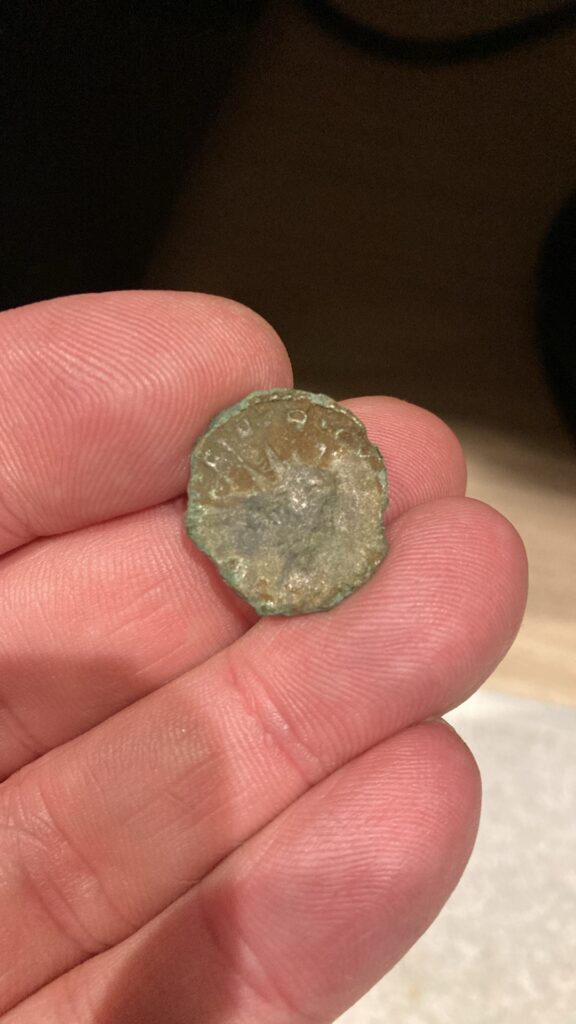
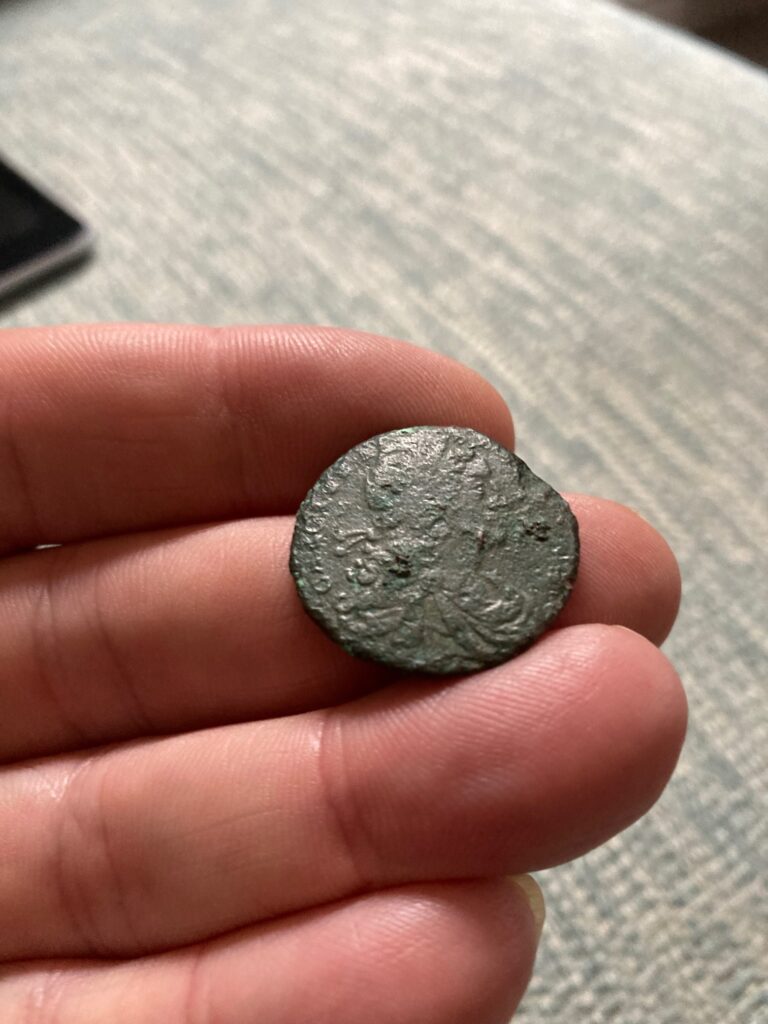
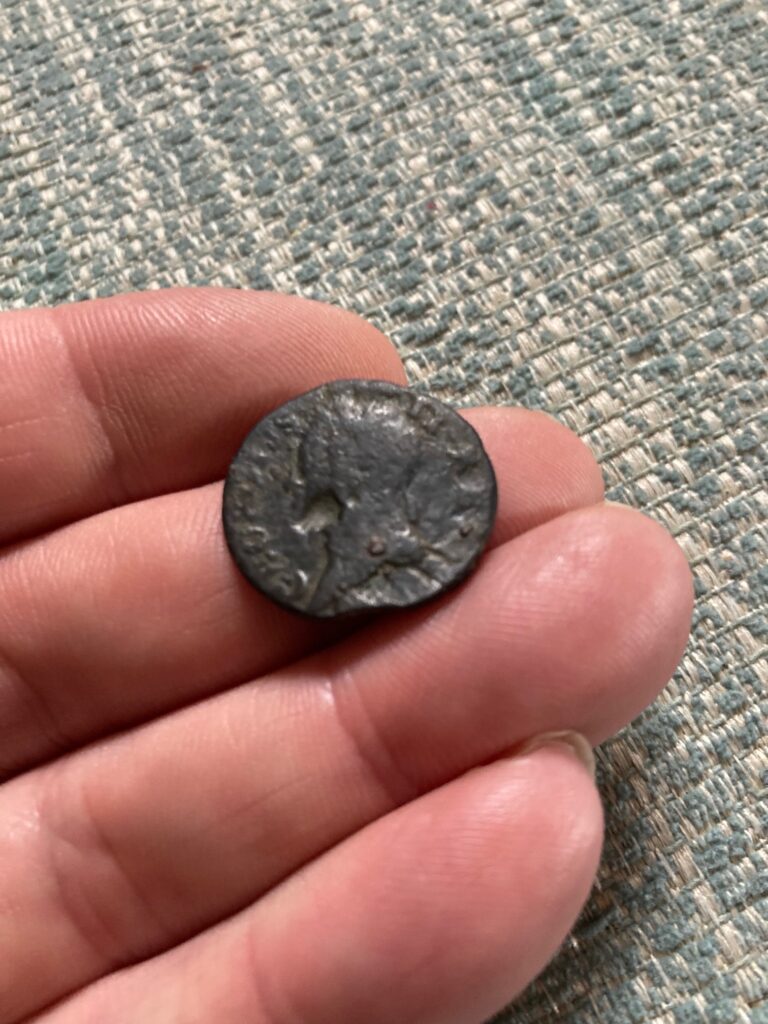
A Roman coin surfaced in my detector this week — thin, worn, carried across centuries before settling in Wicklow sand. Empire leaves residue. It does not preserve intention.
Christian churches in Mogadishu, in Tunis, in parts of Turkey once served confident congregations. Some are ruins now. Some are museums. Some are other things entirely.
Every civilisation believes its sacred architecture is immune to reversal.
History suggests otherwise.
The ruin at Avoca is simply further along the curve.
No concerts. No reinterpretation. No congregation.
Just stone admitting the demographic arithmetic.
What unsettled me was not anger. It was pattern recognition.
Institutions outlive belief for a time. When belief thins, monetisation begins. When monetisation cannot sustain coherence, abandonment follows. When abandonment completes, something else inherits the ground.
If Protestant Ireland travelled that road, Protestant England may be mid-journey.
Every structure eventually reveals whether it was built on conviction or habit.
Castle MacAdam stands as evidence that once conviction drains, the walls may remain — but the force that justified them does not automatically return.
The question is not whether churches survive.
The question is whether the civilisation that built them still believes what they were built to hold.
If not, the stone will endure.
And history will write over it, as it always does.
Yesterday, under a grey sky, it let five coins surface from the shingle. Five small discs. Five centuries. I walked the line of tide, sand and stone alone, detector humming low. Each signal was brief. Each recovery deliberate.
When I laid them out in my palm, they formed a quiet chronology.
Charles II of England — Seventeenth Century
Copper. Thick. Dark with age.
A halfpenny from the late 1600s. The outline of the king still there if you angle it to the light.
This coin moved in a century of upheaval and rebuilding. Markets in mud. Ale traded for labour. Ships coming and going from harbours that were older than the crowns stamped into metal.
It passed from hand to hand without commentary.
A farmer settling a small debt. A dockworker paid at week’s end. A woman measuring grain behind a wooden counter.
No one carrying it needed a theory of empire. They needed acceptance. A coin either worked or it didn’t.
It worked.
Until it fell. Or was dropped. Or slipped from a pocket on a windy day much like this one.
George II of Great Britain — Eighteenth Century Silver
Silver changes the mood.
A Hibernia sixpence. Smaller. Sharper. Still carrying a trace of brightness beneath the tarnish.
Silver carries intent. It stores effort in a way copper does not. It might have crossed a market table in Dublin. Paid for cloth, for passage, for tools. It might have been saved for a week before being spent.
The word Hibernia sits there — neither defiant nor submissive. Just naming.
Metal does not argue politics. It records authority at the time of minting and then submits to circulation.
This one travelled. It did not live an idle life.
Queen Victoria — Nineteenth Century Penny
This penny is worn almost flat.
The face has softened into memory. The edges are tired.
It worked for decades.
It passed through repetition. Bread. Coal. Ferry fares. Wages broken into smaller parts. It might have travelled to Liverpool and back. It might have crossed the Atlantic in a coat pocket and returned years later in another.
The wear is the story.
You do not get that smoothness from one dramatic moment. You get it from thousands of ordinary exchanges.
It would have bought newspapers carrying declarations and denials. It would have paid for a drink in rooms where loyalties were debated. It may have sat in the pocket of someone who believed the future would look different from the past.
Political reality changes in bursts.
Coins change more slowly.
The head remains until a new one is struck.
Euro — Twenty-First Century
A ten-cent piece.
Light. Exact. Identical to millions of others.
The harp stands alone now. No monarch. No crown.
For a time Ireland held its own currency again. Small. Distinct. Entirely national.
Then came another choice.
Not conquest. Not invasion. Alignment.
Monetary authority sits elsewhere now — in institutions beyond the shoreline. Policies shaped in distant rooms. Interest rates determined far from this stretch of shingle.
It is not empire in red coats and ships.
It is coordination. Framework. Structure.
Shared stability when things hold. Shared exposure when they don’t.
Allegedly. The Irish are the largest per capita contributors to the new empire.
The coin feels neutral in the hand. Efficient. Designed for movement across borders that once required flags and cannons.
But the structure is still there.
Every coin carries the signature of whoever sets the rules of money.
The Hands
That is what endures.
Five centuries of touch.
Farmers with soil under their nails. Sailors smelling of tar and salt. Women counting change at wooden counters. Men arguing policy without ever seeing the rooms where it was made. Children sent on errands, gripping a single coin like responsibility.
Copper. Silver. Bronze. Alloy.
Crown. Harp. Stars in a circle.
Authority rearranges itself.
The metal changes its design.
The human exchange remains constant.
Standing there with the Irish Sea behind me, coins lined against the wind in my palm, I felt no outrage and no nostalgia.
Only continuity.
Power shifts form. People adapt. The beach waits.
And sometimes, after centuries, it returns what was dropped.
I awoke early, determined to enjoy a full rain-free day for once, and took the first train available. It was late — no surprise, given the flooding — and I was the only passenger boarding at that particular station. That suited me. Trains are better when they’re half-empty, running slightly off schedule, moving through a landscape that has already started its day without you.
The journey fitted my travel instinct perfectly. Closed stations slipped past, now converted into houses where platforms still exist but purpose has drained away. I recognised stretches of line where I’d walked before, and others where I suspected the ground nearby would hold small, forgotten things — places worth returning to, should I ever get time to reconnoitre this route properly. Travel like this isn’t about arrival. It’s about observation and accumulation.
Next, there was a walk by the sea. Wind off the water, the familiar rhythm of scanning, listening, pacing. Metal detecting is never just about finding things. It’s a discipline of attention. Most days you come back with nothing more than distance covered and salt on your jacket. Occasionally, the ground answers.
This time it did — quietly.
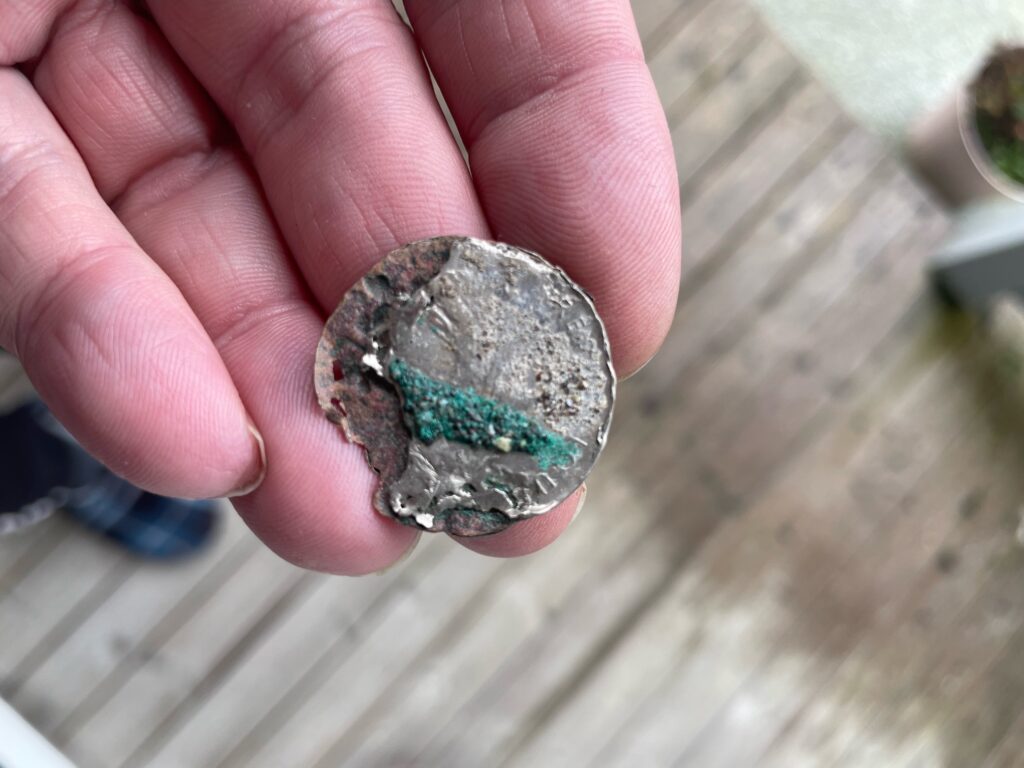
What turned up was the remains of a forged silver coin. Late eighteenth century. French in origin, from a period when bad money was common enough that imitation became an industry. At a glance, it would once have passed. That was the point. A thin skin of silver over a copper core, made deliberately, not accidentally. This wasn’t decay masquerading as fraud; it was fraud, designed to circulate.
The timing matters. The later 1700s were a poor period for trust in money. War finance, repeated debasements, uneven minting, and collapsing confidence created the perfect conditions for forgery. Coins like this didn’t need to endure. They needed to move — quickly — from hand to hand, before anyone stopped to weigh them or listen too closely.
Time and saltwater eventually did what markets often don’t. The thin coating failed. The copper showed. The deception stopped working.
These pieces rarely survive. When discovered, they were pulled from circulation, melted down, or discarded — and the forgers themselves often paid far more dearly. The penalties ranged from execution to transportation to remote colonies. Official forgers, it turns out, have never been fond of unofficial competition.
The sea is one of the few places that keeps such things without judgement. Even in this condition, the forgery may have value. Counterfeit always does, once it has crossed fully into history.
That’s fine with me. It goes straight into my collection.
I like how the day brought several long-running interests together without effort: travel, movement, a walk by the water, history underfoot, and the mechanics of money stripped back to their simplest form. Silver, but only just. Trust doing the work authority failed to do.
The day ended in a Georgian pub, which felt entirely appropriate. Same century. Same worn surfaces. Different transaction.
Instead of a copper halfpenny, the ale cost seven euros.
It was simply a family day out, prompted by nothing more than curiosity — and a shared sense that we were being drawn somewhere specific. None of us had been to Hawick (pronounced Hoick) before. There was no inherited story, no prior familiarity, no practical reason to choose it over anywhere else. Except perhaps the Tweed, both the river and the fabric. And yet the pull was unmistakable.
From the moment we arrived, that instinct made sense. Hawick is rich in Georgian and Victorian architecture — serious, functional buildings that speak to confidence, permanence, and an era when towns were constructed around purpose rather than appearance. This was not a place that had grown accidentally or decoratively. It had been built to last.
What revealed itself over the course of the day was not nostalgia or heritage tourism, but something more precise: the physical remains of a town that once sat squarely inside Britain’s productive and financial system. Textile mills, commercial streets, river infrastructure, banks, clubs — all still legible if you know what to look for.
Hawick was not peripheral by accident. It was connected because it produced. Capital, labour, goods, and credit moved through it with enough volume to justify national integration. Today, much of that system has thinned or gone, but the evidence remains embedded in stone, layout, and institutional residue.
Part of that story is what no longer exists. Hawick was once a mainline railway stop, linking Edinburgh and Glasgow south through England to London. That level of connectivity does not arrive by sentiment or policy — it follows volume, output, and economic justification. The line is gone now. Not dramatically removed, just rendered unnecessary. As production declined and capital withdrew, infrastructure followed. The loss of the railway was not the cause of Hawick’s change, but a confirmation of it.
This post records what can still be read in the landscape: a small town that explains, in physical form, how money once worked — and what changed when production ceased to anchor it.
Scottish Banknotes and the Survival of Issuing Power
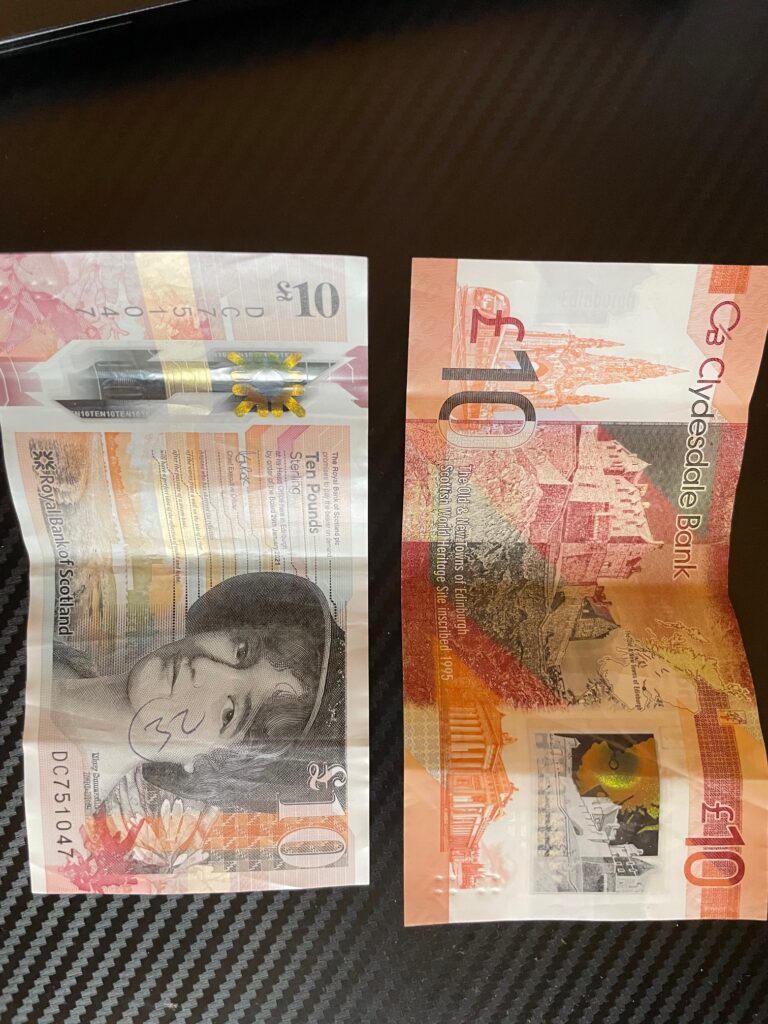
The notes are not issued by the British state. They are issued by private banks.
Scotland remains one of the few places in the developed world where commercial banks still issue their own currency — a legacy arrangement that survived political union and centralisation. Different banks issue different notes, all denominated in sterling, all circulating as money.
Whether this privilege was explicitly negotiated at the Union of 1707 or merely tolerated as a practical necessity is still debated. What is not debated is the outcome: Scotland retained a degree of monetary autonomy that England did not extend elsewhere.
Each note is today backed one-for-one by Bank of England reserves, yet the issuing identity remains private. That distinction matters. It reflects a time when money emerged from institutions embedded in trade, reputation, and locality — not exclusively from the state.
Seen together, the notes are not curiosities. They are surviving fragments of an older monetary settlement: loose, constrained, but not accidental.
Frugality Institutionalised: The Savings Bank Model
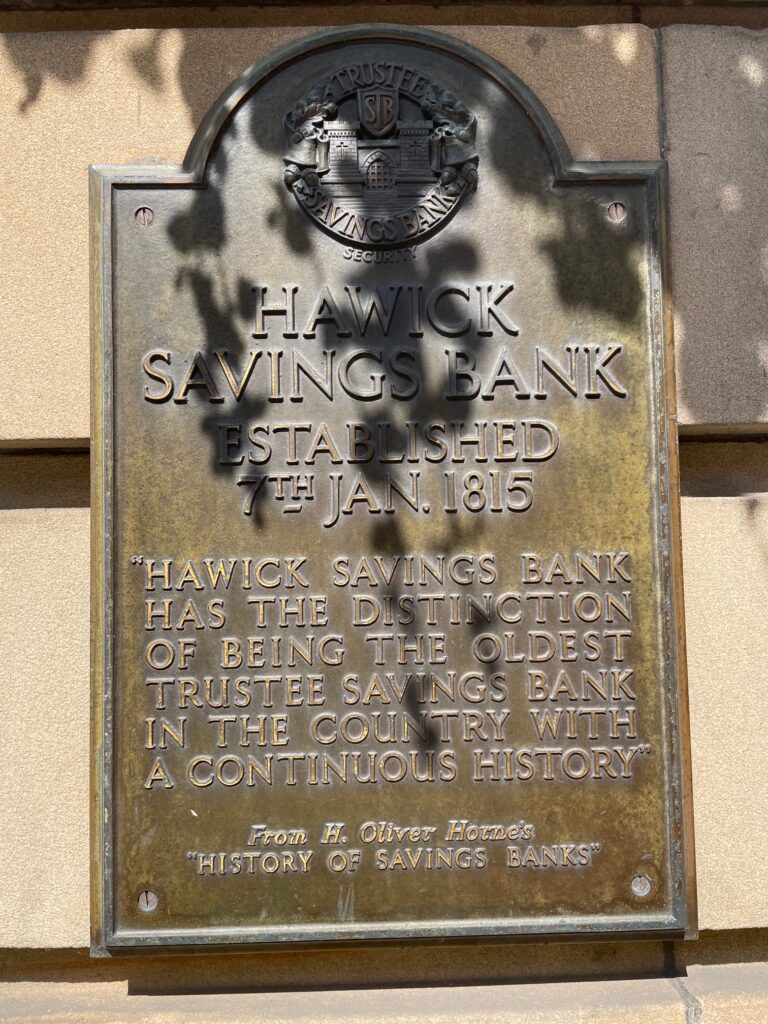
Hawick Savings Bank, established in 1815, was not a commercial bank in the modern sense. It was a trustee savings bank — part of an early movement to formalise thrift, restraint, and deferred consumption among working people.
This was not about growth. It was about preservation.
In an industrial town with cyclical income and narrow margins, security depended on behaviour. Savings banks assumed that capital should be accumulated slowly, custody mattered more than yield, and trust was local and personal.
The language carved into the stone is revealing: trustee, security, continuous history. These are not modern financial slogans. They describe a system designed to endure rather than impress.
Hawick produced surplus. Surplus required safekeeping. Safekeeping demanded credibility. The savings bank completed that loop.
Banking After Hours: When Cash Was Physical
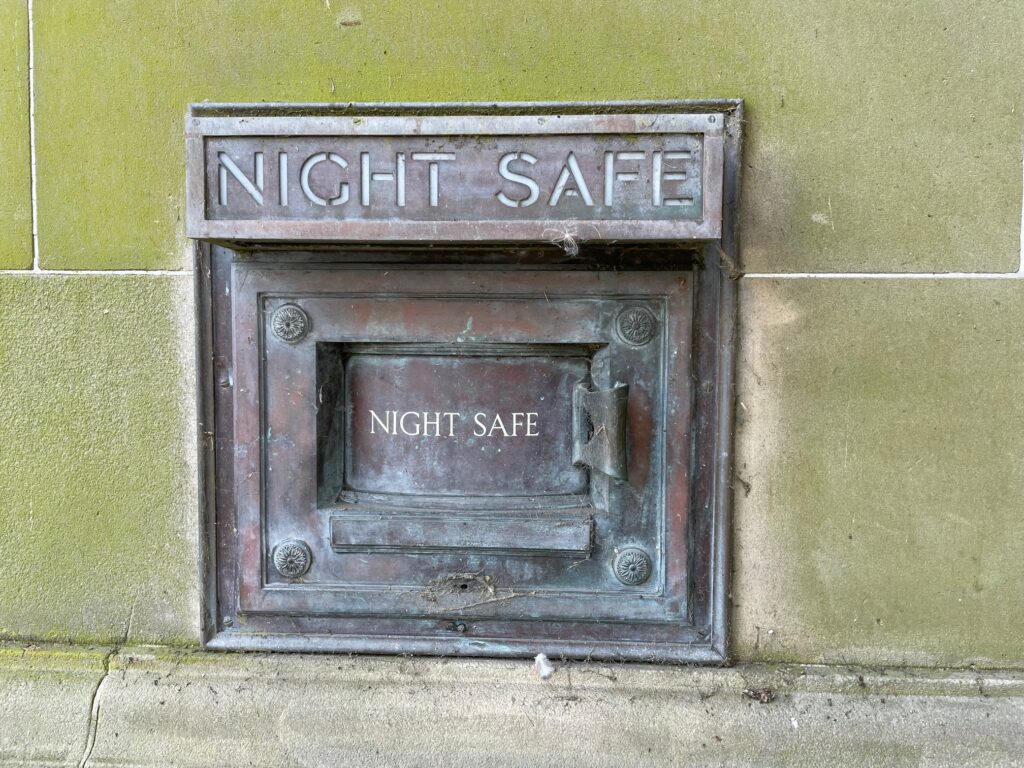
The night safe is easy to miss, but it tells you exactly how money once moved.
Before electronic settlement, takings were physical. Cash accumulated during the day had to be secured immediately. Businesses deposited after closing. Banks collected later. Risk was managed mechanically, not abstractly.
The design assumes distrust, not convenience. Heavy construction. One-way entry. No street-side access.
This was a world where money was earned, counted, deposited, and reconciled. Responsibility sat with the individual and the institution, not with “the system.”
The ATM Hut: Automation as a Holding Pattern
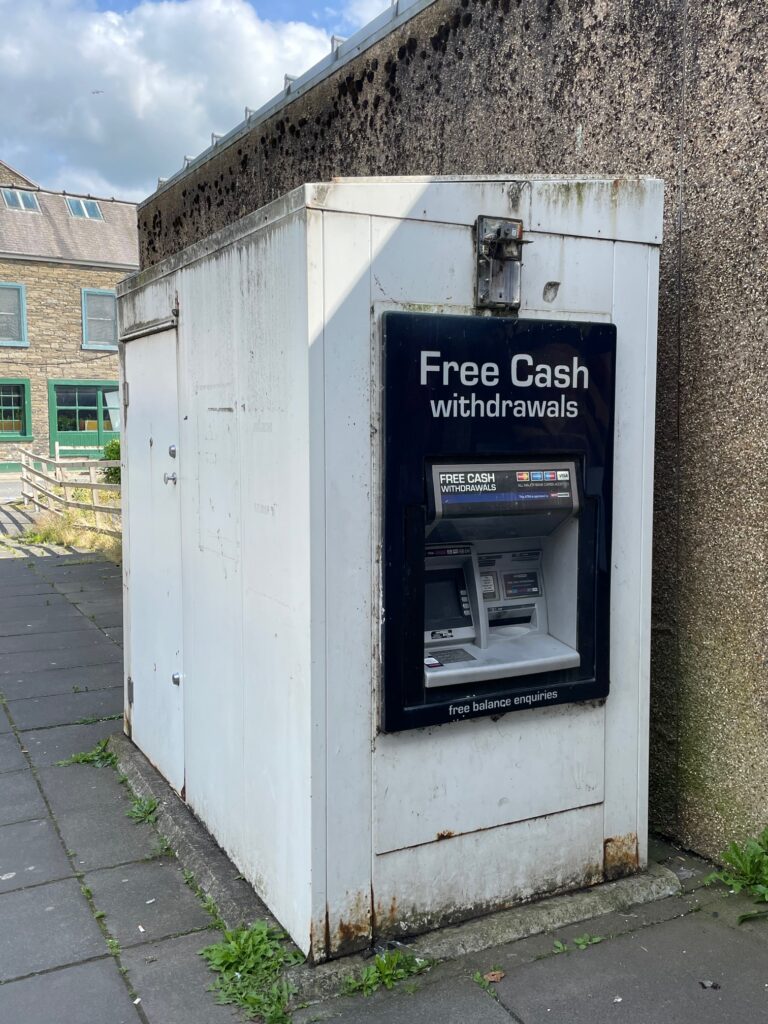
The ATM hut belongs to a different era.
Where the night safe assumed custody, the ATM assumed access. Banking shifted from deposit to withdrawal, from relationship to convenience, from staff to machines.
For decades, this infrastructure spread everywhere. And now it is quietly retreating.
The hut remains not because it is valued, but because removal costs more than neglect. It is a transitional artefact — neither enduring like the savings bank nor central like earlier banking institutions.
Built for convenience, not discipline, it was never meant to last.
From Local Industry to Imperial Circulation
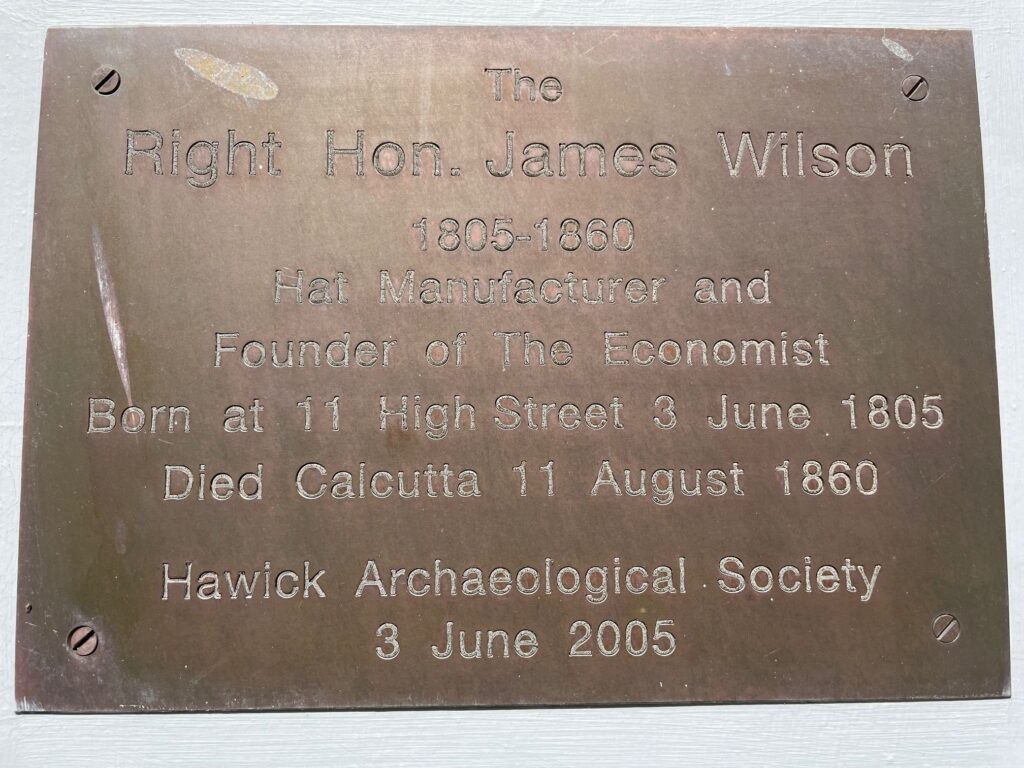
James Wilson was born in Hawick and died in Calcutta.
A manufacturer first, a publisher later, his trajectory mirrors Britain’s nineteenth-century expansion. Local production created surplus. Surplus demanded wider markets. Wider markets required predictable rules, currency stability, and commentary to bind them together.
Calcutta was not a romantic outpost. It was a financial hub — where imperial trade, taxation, and administration converged.
Hawick was not peripheral to empire. It was one of its starting points.
The Club, the Ale, and the Imperial Mindset
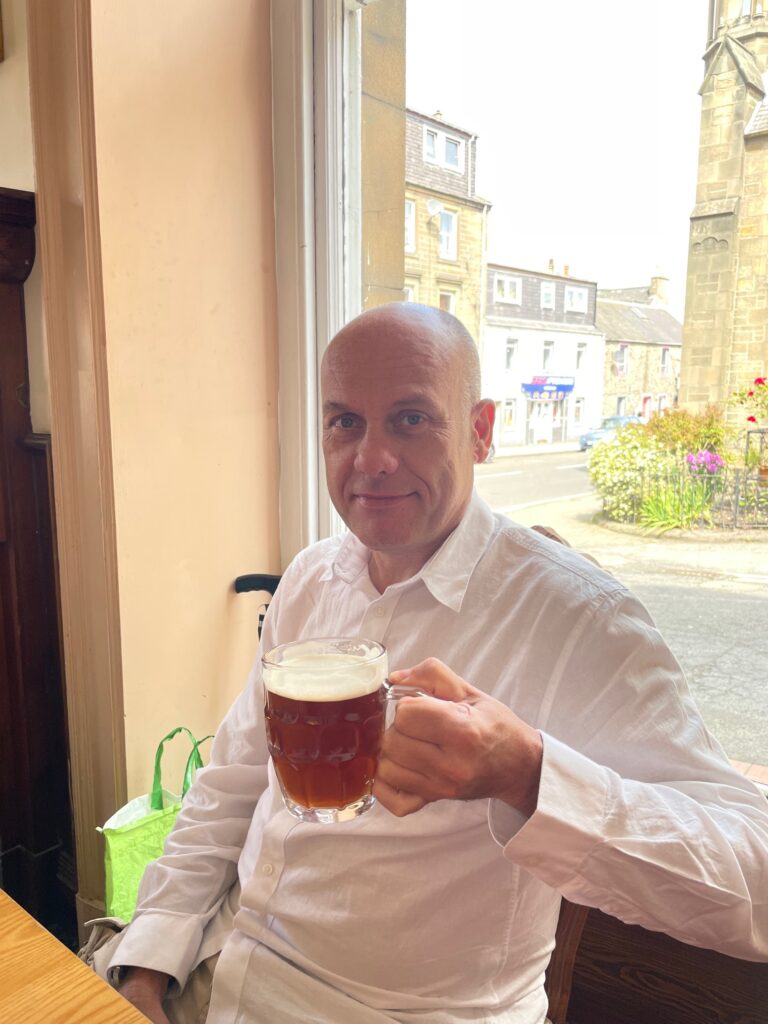
The day ended in a former Conservative Club, now a Wetherspoons, with a solid local ale.
These clubs were not leisure spaces. They were institutional rooms where trade, politics, and empire were discussed practically — as logistics rather than ideology.
Markets. Shipping. Currency. Risk.
Empire was not a theory. It was an operating system.
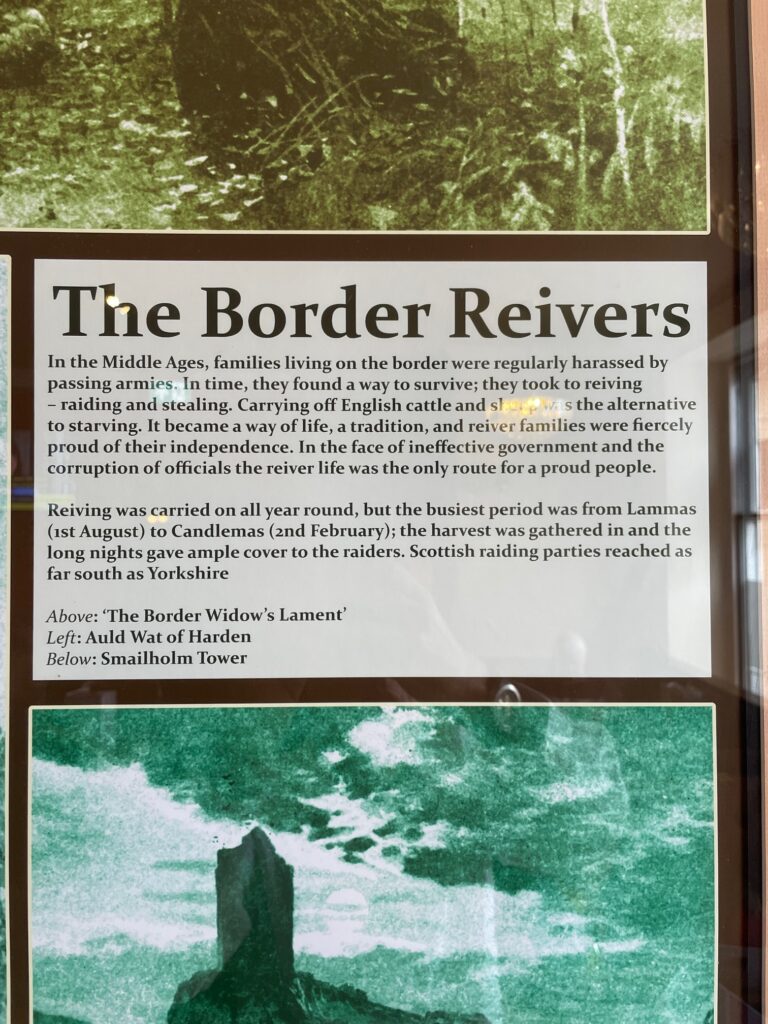
Border Reivers: Movement Under Pressure
The Borders were never stable territory. They were pressure zones — politically weak, economically exposed, repeatedly raided.
The Border Reivers were not romantic outlaws. They were an economic response.
When authority overstepped or failed and agriculture could not sustain life, people reorganised around mobility, kinship, and force. Independence was not ideological. It was practical.
My own ancestors were part of that world.
That matters because the instinct to move when conditions deteriorate is not new. It appears repeatedly in border populations, trading families, and merchant cultures. When systems stop working, people leave.
Sometimes by choice. Sometimes by force.
When People Leave, They’re Voting
Hawick’s population loss is not sudden, but it is decisive. Over time, enough people reached the same conclusion: the town no longer sat at the centre of opportunity.
Other places grew. Hawick thinned.
That is not cultural drift. It is economic sorting.
People stay while systems reward effort. They leave when the future becomes narrower than the past. The decision is rarely ideological and almost never announced. It is executed quietly, family by family, job by job.
Depopulation is not failure. It is judgement.
And it always arrives after the systems that once justified staying have already gone.
Closing
Hawick explains something modern finance and planning repeatedly misunderstand.
Money once followed production. Savings followed discipline. Movement followed pressure. When those relationships weakened, people adapted — first locally, then geographically. Infrastructure did not fail first; it followed capital and people out.
There is now periodic talk of relinking Hawick to Edinburgh by rail. If it happens, it will likely bring commuters. Property demand may rise. The town may become better connected once again.
But commuters are not the same as local productivity.
A commuter economy imports income and exports time. It does not recreate mills, workshops, or locally anchored capital. It changes the function of a town without restoring its purpose.
Hawick has already lived through the difference between being connected because it produces and being connected because it is accessible. Those are not interchangeable states.
The buildings remain. The systems do not. What survives is not nostalgia, but evidence.
The sea had reclaimed the beach. After the recent storms, the shingle had come back in and covered the sand again, resetting the ground as if nothing had passed before. It wasn’t one of those rare, generous days like the bumper outing back in early December, but it was finally dry — and that was reason enough to go.
Everything they say about Irish weather at this time of year is true. You learn to move when the window opens.
What struck me most wasn’t the number of finds, but the number of conversations.
On an almost deserted beach, people wanted to talk. In fact, I probably spent a quarter of the trip standing still, leaning on the detector, chatting with strangers who were curious, cheerful, and entirely unguarded.
One couple had opportunistically decided to collect scallops that had been washed ashore by the tide. Another pair were searching for sea glass. They didn’t find much, but they were perfectly content — happy simply to be there, pockets light, spirits not.
Further along, on the long walk back, I met a man who stopped to ask about the detector. He turned out to be a long-time Time Team viewer and had always fancied having a go himself. That opened the door to stories — him gold prospecting in the mountains, the patience it demands, the silence, the feeling of working ground that doesn’t yield easily. Add that to the list.
He mentioned he had a four-year-old son.
That stayed with me.
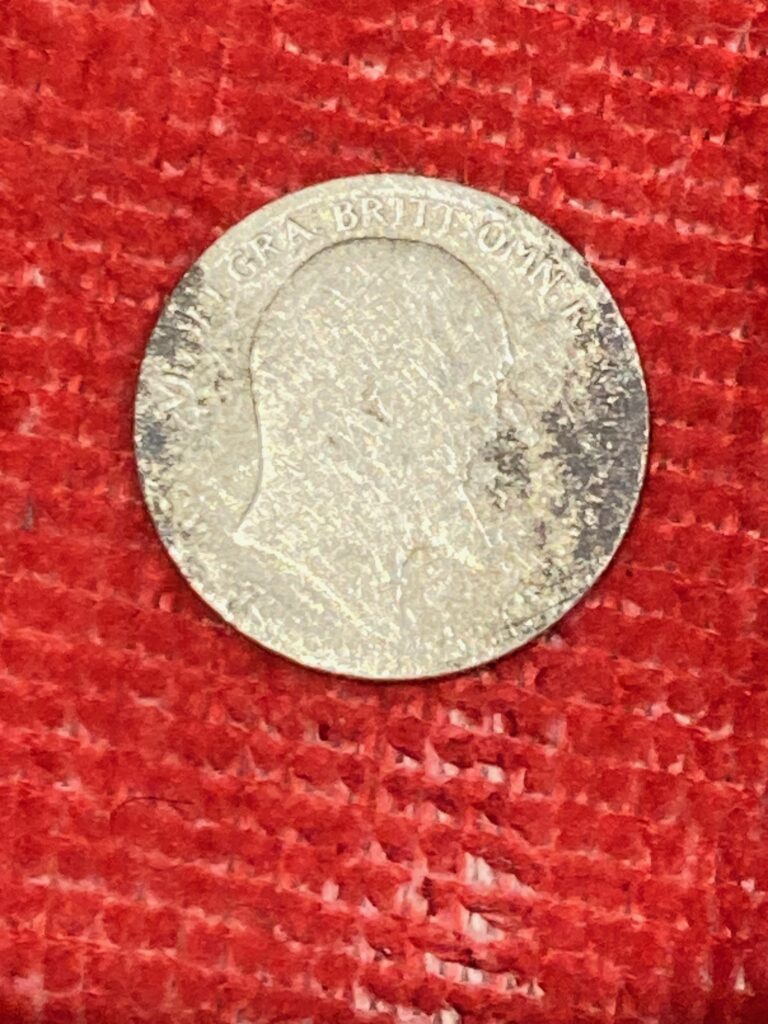
It reminded me how I returned to metal detecting as an adult after a childhood moment that never quite left me — the wild excitement of finding an Edwardian penny, green with age, still carrying the authority of its era. It’s still in a tin somewhere.
My son may no longer be part of these walks. That chapter has closed. But years later, here I am again — this time finding Edwardian silver, a sixpence lifted cleanly from the Irish sand.
Sound Money Unearthed
Hold a coin like that and you feel something modern life rarely offers: density.
Not symbolic value. Actual weight.
The British pound sterling was once exactly that — a pound of sterling silver. This Edwardian sixpence now carries around four pounds’ worth of silver by weight alone. A figure I suspect is heading higher, given the modern appetite for silver — AI infrastructure, solar panels, electrification, and weapons all competing for the same finite metal. The beer pint index (BPI) agrees with me. This sixpence would’ve bought 3-4 pints back in 1905, now it doesn’t even buy one most places.
Fiat erodes quietly, daily, through mechanisms designed to go unnoticed. This coin has endured wars, resets, empires, and ideologies — and still holds value simply by existing.
No promises. No counterparty. No narrative required.
Just metal.
Sovereign Parallels
Metal detecting mirrors the nomadic path.
You move steadily. You ignore the noise. You dig where the signal rings true. Most swings yield nothing. Then, occasionally, the ground gives something back — a quiet confirmation that patience still works.
Ireland’s beaches reset every day. The tides erase tracks, cover ground, and rearrange the surface. But history persists beneath your feet, indifferent to policy cycles or opinion.
That man’s curiosity — and his young son — felt like a reminder. Cycles renew. People come and go. Systems rise and decay. But the hunt endures.
Next rain-free day, I may follow those mountain prospecting leads.
Sound assets over fiat traps. Weight over promises. Ground truth over abstraction.
Metal detecting entered my life quietly, but it stayed because it spoke to something fundamental.
It connects me to history in two ways at once — the literal and the metaphorical. Actual objects, buried and forgotten. And actual meaning, hidden beneath surfaces most people never question.
I walk ground that thousands of others have crossed without pause. Beaches, fields, edges of towns. Ordinary places, endlessly repeated. Most people see nothing there. They’re looking ahead, not down. They assume value is visible, signposted, approved.
I don’t.
I slow down. I listen. I trust signals that don’t shout.
Sometimes the ground gives nothing. That’s part of the discipline. Metal detecting punishes expectation and rewards patience. You cannot force it. You cannot negotiate with it. There is no entitlement.
Then occasionally, the earth offers something precise: a coin worn smooth by hands long gone, a button, a clasp, a fragment of a life that once mattered intensely to someone.
When you hold it, history stops being abstract.
It has weight. Texture. Temperature.
You realise that the past wasn’t an idea — it was people moving through days, making choices, losing things, loving things, surviving systems that no longer exist.
That matters to me.
Actual Gold, Metaphorical Gold
Sometimes you find actual value — silver, old coins, things that once had economic meaning and still do. That’s satisfying, but it’s not the real reward.
The real gold is what the process trains you to notice.
Metal detecting teaches that:
value is often buried, not advertised
the obvious path is rarely the richest
patience compounds in non-linear ways
most people walk over opportunity every day
That applies to land, to history, to investment — and to life.
I’ve connected with metaphorical gold the same way I’ve occasionally found actual gold: by ignoring noise, trusting instinct, and accepting long stretches of nothing without complaint.
That’s not optimism. It’s realism.
Solitude Without Isolation
Metal detecting is solitary, but it is not lonely.
I didn’t realise this at first, but you are observed.
People watch quietly as you work. Some are curious. Some are respectful. Some simply want to understand what you’re doing. And quite often, they engage.
Strangers ask questions. Conversations begin — unforced, unguarded, meaningful.
There is something disarming about a person absorbed in a task that isn’t performative. It invites genuine interaction. No status. No agenda. Just interest.
Metal detecting reminds me that solitude doesn’t sever connection. It refines it.
Even when you’re alone, good people remain present in the world. They notice. They speak. They engage with curiosity rather than extraction.
That’s reassuring.
It’s physical without being competitive. Focused without being anxious. Purposeful without being productive in the modern sense.
There is no audience. No performance. No outcome demanded.
Just movement, attention, and response.
In a world obsessed with validation, that’s a relief.
The Keys
One of the things I find most often are house keys.
Not coins. Not jewellery. Keys.
They turn up in the sand after storms, half-buried, corroded, sometimes still on a ring. Ordinary objects, easy to overlook — but they always stop me for a moment.
Because every key marks a precise instant of panic.
Somewhere, long ago, someone finished a relaxed day at the beach. Sun, salt, ease. The sort of day where time loosens its grip. Then the moment comes — hands go to pockets, or a bag is opened — and the weight is wrong.
Keys gone.
What follows is easy to imagine: the sudden tightening in the chest, the frantic retracing of steps, the dawning realisation that the door home will not open.
That quiet domestic crisis is now all that remains of the day. The laughter, the warmth, the pleasure — gone. The key is what survives.
I hold them sometimes and think about how small the moment was, and how large it must have felt at the time.
That appeals to me more than gold.
Because keys aren’t symbols of wealth — they’re symbols of access, shelter, belonging. They open doors that mattered to someone, once.
Now they belong to the ground.
Metal detecting teaches you that history isn’t only made of grand events. It’s made of dropped things, small mistakes, moments of distraction, lives briefly intersecting with chance.
Empires fall. Houses change hands. Keys rust.
And yet the story remains intact enough to be felt.
Why It Fits This Life
Metal detecting suits the life I’m building now because it aligns with everything else:
Sovereignty — no institution grants permission to listen to the ground. History — not curated, not moralised, just encountered. Health — walking, air, rhythm, patience. Clarity — long hours strip thought down to what actually matters.
It also keeps ambition honest.
When you spend time with artefacts from collapsed empires and forgotten lives, you stop believing in permanence as a given. You build more carefully. You choose what’s worth carrying forward.
The Ground Remembers
The ground remembers far more than we do.
It keeps what was dropped, lost, hidden, or discarded — without judgement. It offers it back occasionally, without promise.
I like that.
Metal detecting reminds me that history isn’t finished, value isn’t always visible, and progress isn’t always forward-facing.
Sometimes the most meaningful work is done with your eyes down, your pace slow, and your expectations restrained.
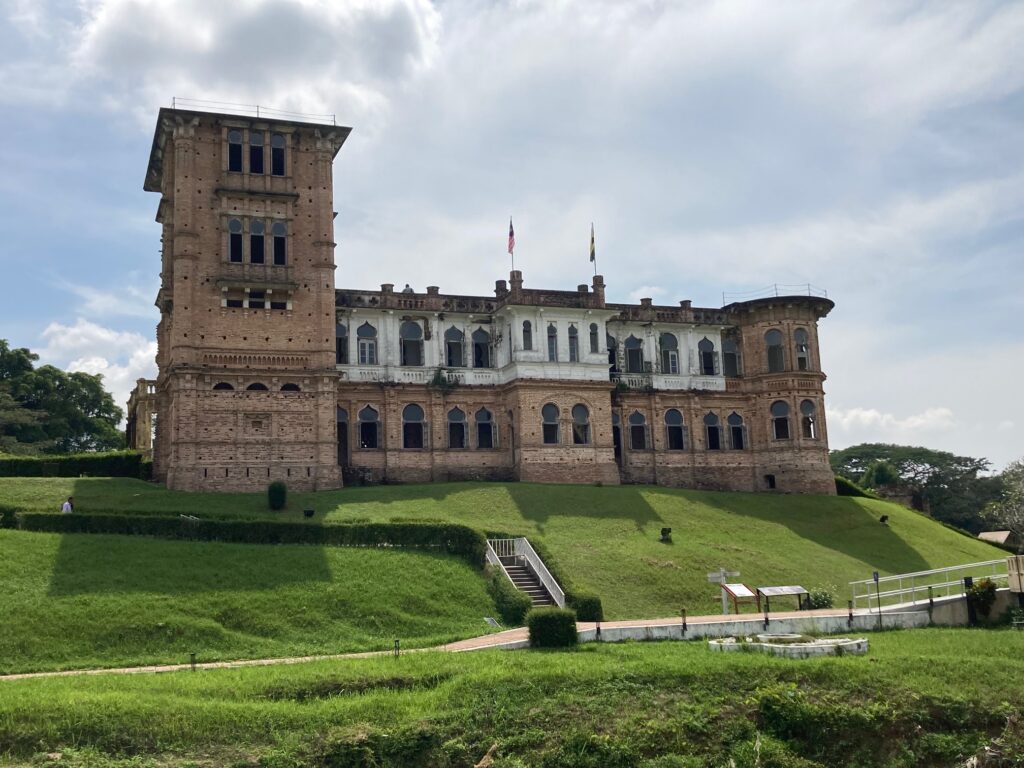
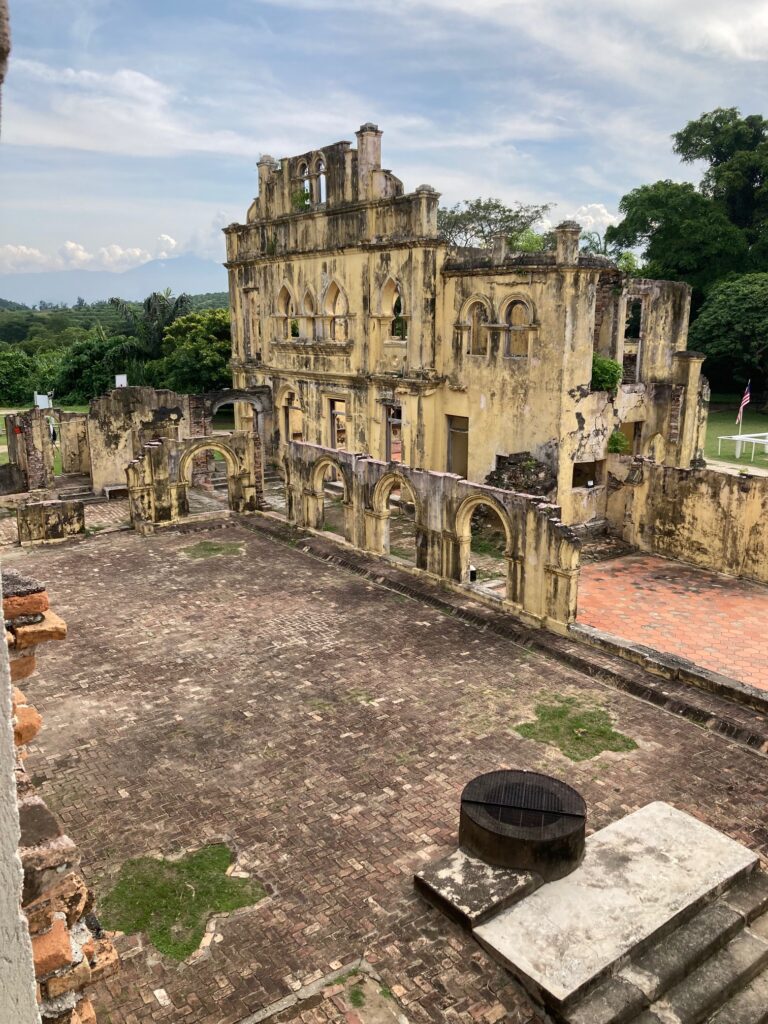
I had waited to see this place for thirty-five years. Michael Palin’s railway journeys put me onto it long ago, but nothing prepared me for the feeling of standing in the shell of another man’s unfinished ambitions.
Kellie built this hill like a man laying out his immortality brick by brick. He wanted a palace, a monument, a statement carved into the heat and stone of Malaya. And yet, here it stands — empty, echoing, beautiful, and broken. A place half-born and never lived in.
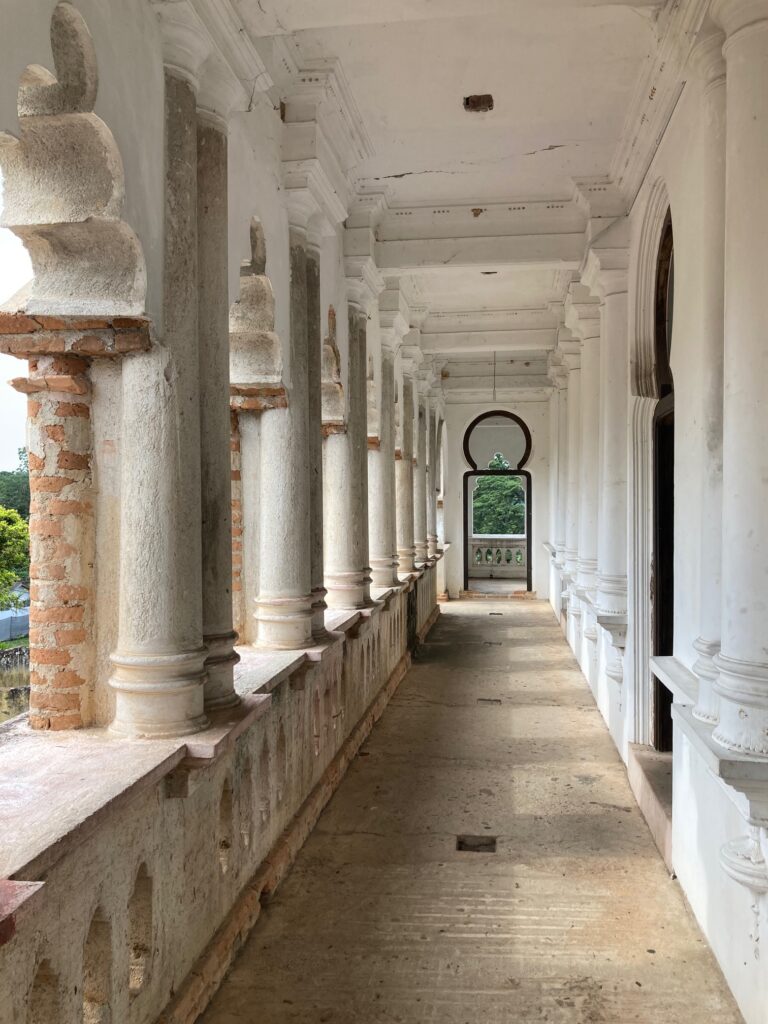
You walk these corridors and you wonder:
Was there ever a better monument to how fleeting success and happiness really are?
How quickly a legacy can rot or die?
How quietly a story can end without anyone truly noticing?
Today, standing in the abandoned rooms, I thought of Montana — my own project, my own obligation, the weight I carried for years. I held onto that house until it was time to let it go, and when the moment came, I walked away. I exited my castle long before it had the chance to imprison me.
Kellie never had that luxury. He died in Portugal at fifty-six, still fighting bureaucrats and labour shortages, still believing he had more time. They say his ghost walks the upper corridor here. Not in anger — in yearning. A man trapped in the dream he never escaped.
There’s a curse whispered locally:
Any man who binds his identity to his creation will lose both.
Kellie’s story follows that script with frightening precision — a child lost, a labour force wiped out by influenza, a dream stalled by red tape, and finally, a sudden death. The castle became a tomb for his intentions.
I realised as I walked through the wine cellar — the one he planned to air-condition, the first in Malaya — that I am only two years younger than he was when he died. That hit harder than I expected. It forced a question I’ve avoided for most of my life:
What dream of mine is unfinished, and will I have the courage to leave it behind when the time comes?
The truth is this: legacy is fragile, memory is temporary, and the world is ruthless with sentiment. Even Ipoh reminded me of that this week — the colonial cemeteries bulldozed, the graves poured over with fresh concrete. Whole lives, whole sorrows, erased in an afternoon.
Maybe that’s why this castle struck me.
Maybe this is the lesson:
Do not stay too long.
Do not cling to the past.
Do not become a ghost in a house you once loved.
Kellie tried to build permanence.
I am learning to build only momentum.
And perhaps that is the real inheritance of these ruins — the quiet instruction to walk forward, lightly, before the walls close in.