Twenty-eight and a half years ago, in that city, I had an MRI scan that resulted in me being told I might never walk again. Some sentences do not fade. They divide a life. There is the man before them, and the man after.
I wanted to stand again where that fracture began. Not for closure. I have no use for that word. I wanted to look back at the man who heard it, and at the road he took afterwards, with all that followed from it, for better and for worse.
Ireland can do that. It can alter the course of a life without warning, and only decades later do you see the full shape of the turn.
I visited a few places in Limerick, but took no photographs. It seemed wrong somehow. Not every place should be converted into an image. Some are better left as encounter.
And yet Limerick, appropriately enough, also gave me a limerick:
There once was a man from Hobro Who knew it was time to go, And start a new life Without all that strife, And so he went off to Wicklow.
A joke, obviously. But not only a joke.
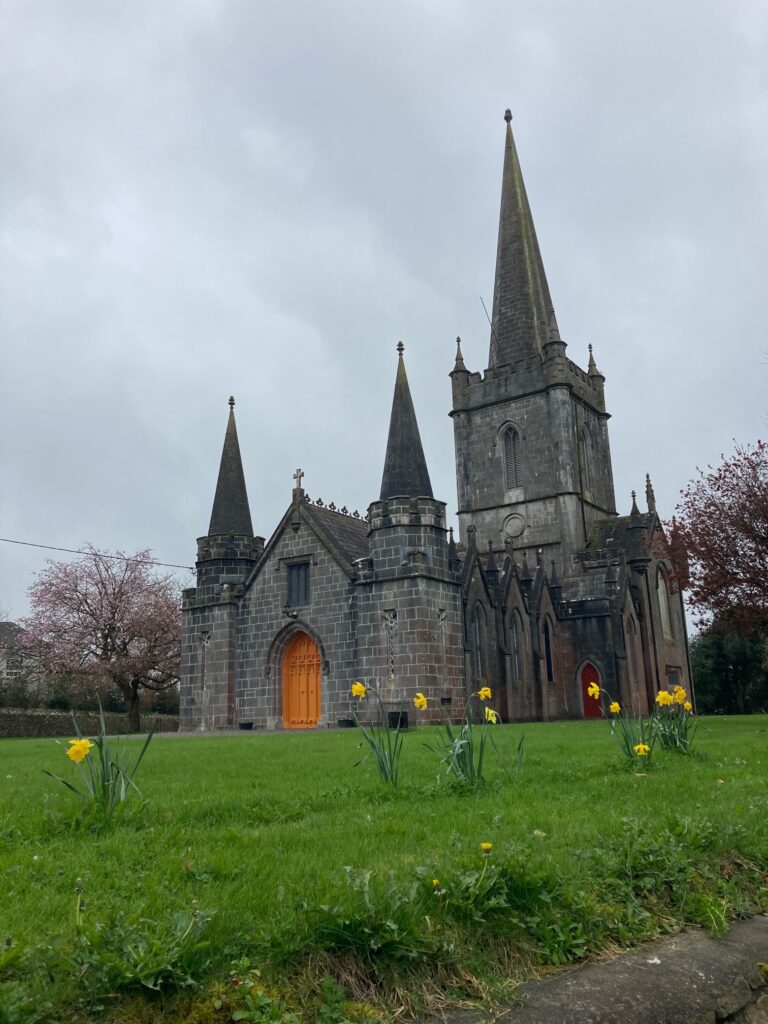
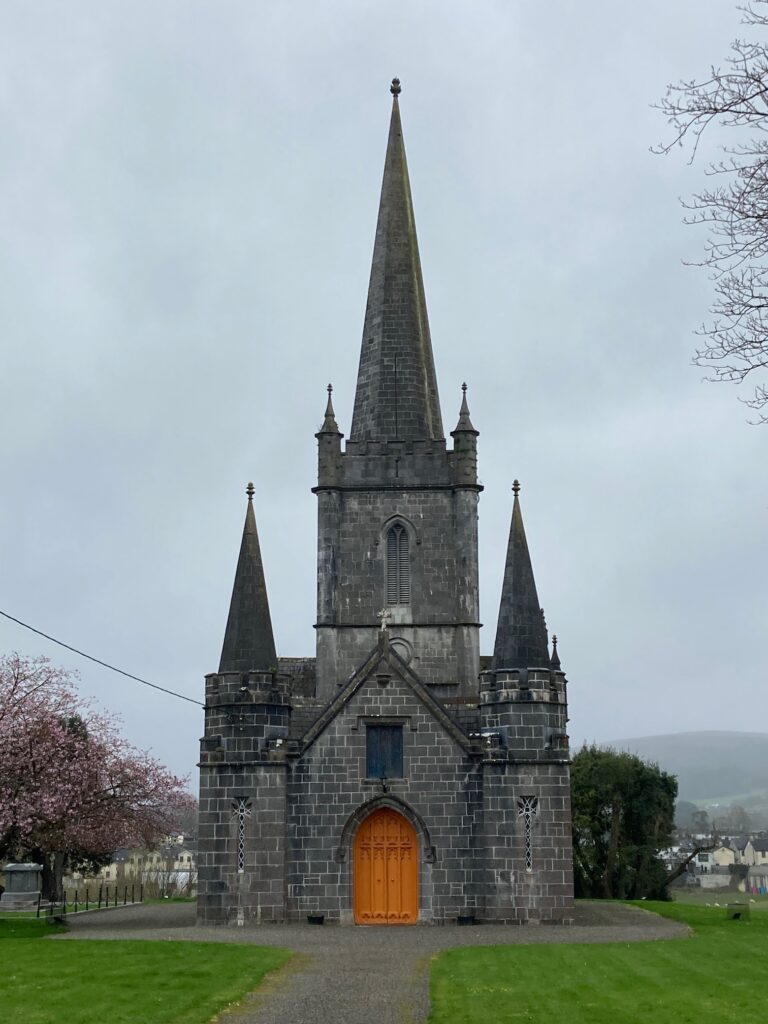
From there I drove on, meaning to see Cahir Castle, and instead found myself halted by something else: one of the most beautiful churches I have seen in Ireland.
You could see it from far off. Protestant Gothic. Intact, solid, self-possessed. Built in 1818 and designed by Nash, it immediately pulled me toward the age I so often meet in the earth and on the beaches: the late Georgian and Regency world, the world of old copper, worn silver, and the coins that still surface beneath the grass and sand. Then there was the door, painted a challenging orange. In Ireland, orange is never merely orange. History still speaks through colour.
Then Dungarvan.
A beautiful seaside town, but one marked by subtraction. You can feel the railway’s absence in the place. The town remains handsome, but the old line still haunts it. The Greenway now runs through that lost corridor, with so much railway architecture still standing that the old movement has not entirely gone. It has only changed form.
Then Waterford.
The energy shifted again. Medieval, certainly, but not trapped in its own past. Some towns feel burdened by memory. Waterford did not. It felt old, but still open. Less weighed down by what it had been. More alive to what it may yet become.
That, perhaps, was the shape of the journey.
Limerick was reckoning. Cahir was surprise. Dungarvan was beauty marked by loss. Waterford was old stone with forward motion still in it.
Tomorrow I will head home. But first there is Waterford city centre, and perhaps, if the weather opens, a new beach or two to detect. I have already identified them.
Then Passage East, literally. A rarity now: a car ferry between Irish places. After years in Denmark, I like the thought of that more than I should. Driving onto a boat, crossing a stretch of water, and letting it put me down elsewhere. Not exile. Not escape. Just passage.
And then home.
And perhaps that is enough for now: not answers, but movement.
I had just come back from Consett, which still feels like home in some older sense, and went through security at Newcastle Airport.
It was busy. The gates were full. The trays moved forward in a slow line under the white lights. The staff were in no mood to wave anything through. They were checking everything properly, or at least thoroughly, which is not always the same thing.
Then my tray slid off for inspection.
That feeling came at once. The small drop in the stomach. There were five trays ahead of mine in the queue and no way round it.
The man in front had already been stopped. He opened his bag. They took out some bananas and swabbed them. He turned and shouted something in Polish to his friend about the delay and his banan, half angry, half laughing, while they tested the fruit as though it might bring down the airport.
When they gave the bananas back, he looked at me and smiled. Not much. Just enough to say that now it was my turn.
Then they opened my bag.
The suspicious item was a few corned beef pies I was bringing back with me.
The woman opened the clear plastic bag carefully. She was about to take them out. I said, “They’re pies. Can I get them out for you?”
That changed it.
You could see it happen. Something in her face shifted. The programme broke for a second. She looked slightly embarrassed, as though she had suddenly seen herself from outside and did not much like what she saw.
No, she said, and put them back in the bag.
That was all.
But it stayed with me.
A man has his bananas swabbed. Another man has his pies inspected. Everyone stands there under the lights, waiting, obedient, serious, playing his part. The staff play theirs too. That is how much of life is now. Not evil. Not dramatic. Just people inside systems, doing what the system says, until the thing itself becomes too foolish to ignore.
Then sometimes the spell breaks.
A pie is a pie again. A person becomes a person again. For a moment the machine weakens and common sense comes back into the room.
Then the trays moved on. The airport survived.
Who ate all the pies? Me, of course. The last one disappeared at breakfast today.
I’ve come to realise that much of the history we are taught is little more than a convenient story. Yet the real clues sit quietly around us, waiting to be noticed. Often all it takes is looking up, or down, to see that the world is not quite what we are repeatedly told it is.
Baltinglass is a good place to begin.
You will not find it in many guidebooks. It is not promoted as a destination. Yet a chance video on YouTube suggested the valley may hold one of the largest Bronze Age landscapes in Europe, certainly one of the most significant in Ireland.
While tourists head for Newgrange, the officially presented megalithic site, I chose the opposite direction and drove south into the Wicklow Mountains.
The mountains feel older than the road that crosses them. Clear water cuts through the valleys. Strange stones appear where you would not expect them. Hills rise in shapes that seem deliberate rather than accidental. It is the kind of landscape that makes you slow down and pay attention.
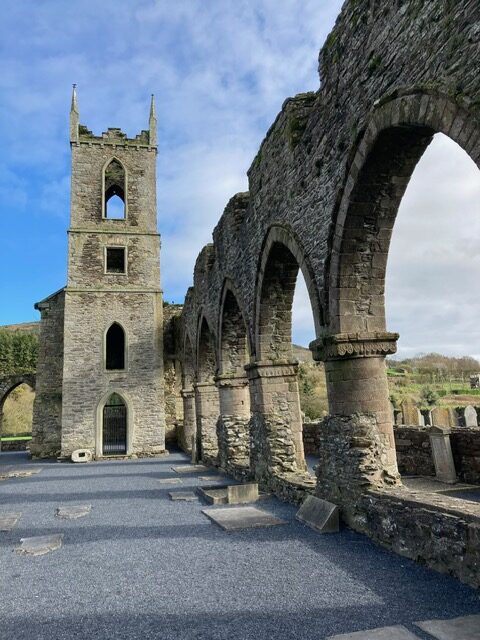
My first stop in Baltinglass was the abbey.
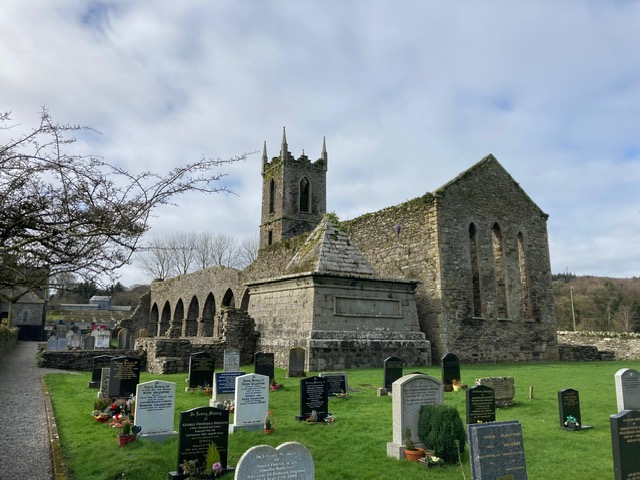
It stands ruined now, but inside the walls sits another building — a Protestant church constructed within the remains of the medieval structure, and now itself also abandoned. Layers of occupation. Different groups arriving centuries apart and choosing the same place to build.
That alone tells you something about the location.
Walking through the grounds I came upon a tomb structure topped with a pyramid. The tomb itself is now empty. There was no chequerboard pattern here, but the symbolism still brought to mind the same geometric language that appears elsewhere — pyramids, grids, and repeating forms that surface again and again across different cultures.
It makes you wonder what ideas sit behind those symbols, and how old they really are.
Looking out from the abbey, the surrounding hills have strange shapes.
They reminded me of Penshaw Hill near Sunderland and the old story of the Lambton Worm winding itself around the hill before it was slain. Today that hill is crowned with a Greek temple. Another structure placed on top of something older, as if each generation feels compelled to mark the same point in the landscape.
The pyramid above the abbey tomb seemed to belong to the same instinct.
I walked toward the largest of the hilltop forts overlooking the town. There are several scattered around the valley.
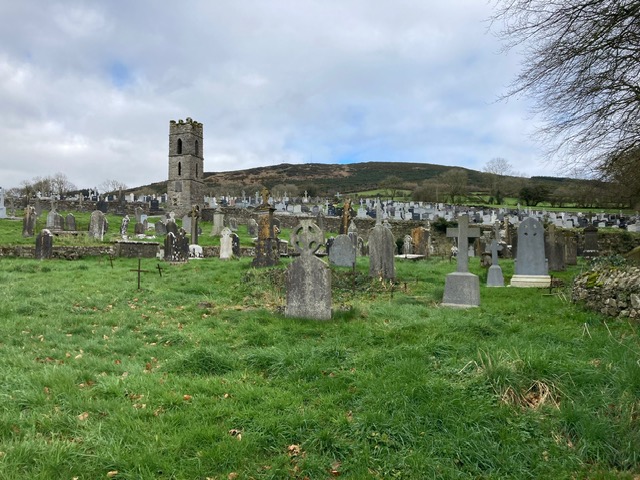
The slope of one hill has become a vast cemetery. At its centre stands a tower that feels older than the graves surrounding it. Beside it sits Ireland’s national brain injury hospital, another modern institution that has somehow found its place on this same ground.
Places with long histories seem to keep attracting new occupants.
Later I walked down into the town itself.
I stopped at the butcher and bought some local lamb. It felt right to eat something raised in the same valley I had been walking through. If places carry energy, perhaps the animals raised there do too.
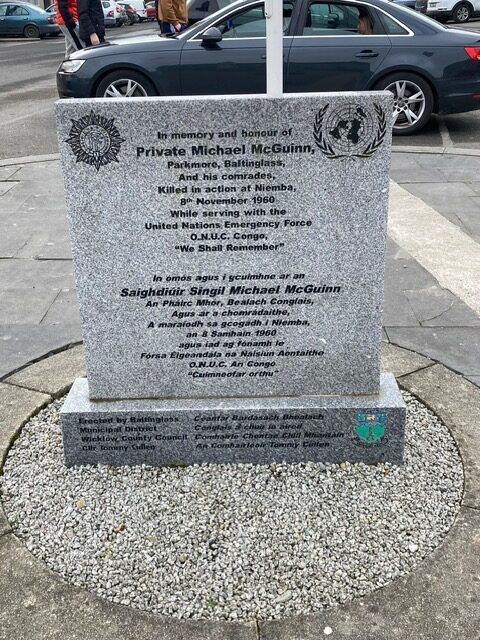
Nearby I came across something I had not expected at all — a United Nations memorial.
It commemorates Irish soldiers killed in the Congo during the UN operations of the early 1960s. I knew little about the incident before seeing the memorial, but one discovery always leads to another. Research tends to follow later.
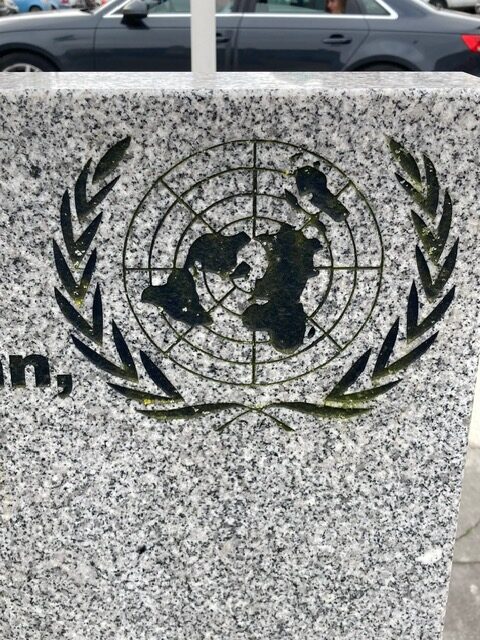
What caught my attention most was the map carved into the monument — the familiar UN world projection surrounded by a laurel wreath. A symbol most people see without ever looking closely.
It took me many years myself before I began noticing how many narratives are quietly constructed for us.
Eventually I returned to the car.
There was one last thing I wanted to see — the old railway station.
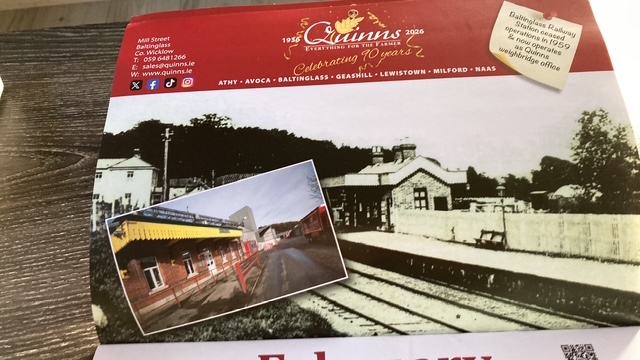
To my surprise the building still exists. It now sits inside an agricultural retail yard belonging to Quinns. I was about to leave after taking a quick look when someone knocked on the car window and asked if I needed help with anything.
When I explained I had only come to see the station, I was suddenly being given a private tour.
Inside the old office the station still has its safe, the kind of heavy metal vault you would expect in a historic house, Montana had one too. The place felt frozen in time. It was a quiet day, so perhaps that made the difference, but the generosity was appreciated, as was the company calendar I was given.
Encounters like that happen now and then to me.
Once in Georgetown a local gave me a full tour of a colonial cemetery. Another time in Newcastle someone walked me through the history of the village church and the old castle nearby. Some people still care about preserving these stories.
And that matters.
Now it really was time to head home.
There was just one final stop.
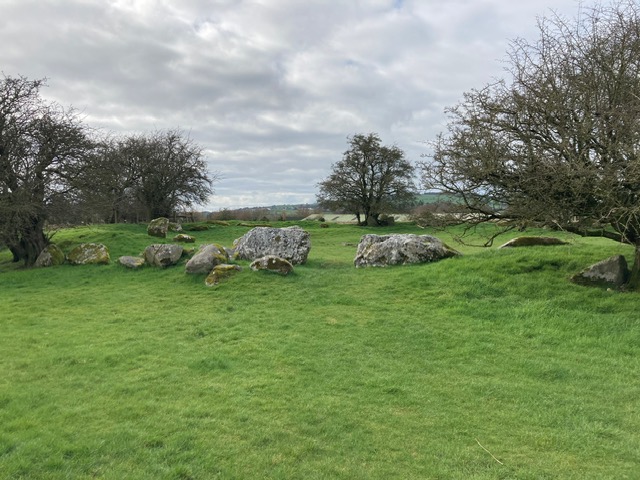
A stone circle standing quietly in a field outside the town.
Officially the circle is dated to around 2,500 years ago. Perhaps that was the last time it was used. Personally I suspect the site is far older.
When I stepped inside the circle my legs shivered slightly. Cold wind perhaps. Or something else.
What I did notice were threads and ribbons tied to nearby branches. Someone had been here before me, leaving small offerings or tokens. Even now people feel that places like this hold something.
Stones carry a presence modern culture tends to ignore.
Our ancestors may have understood that better than we do.
When I arrived home YouTube suggested another video for me.
The subject was Larry Murphy — Ireland’s notorious serial killer, often called the Beast of Baltinglass.
The valley clearly holds its share of darker stories too.
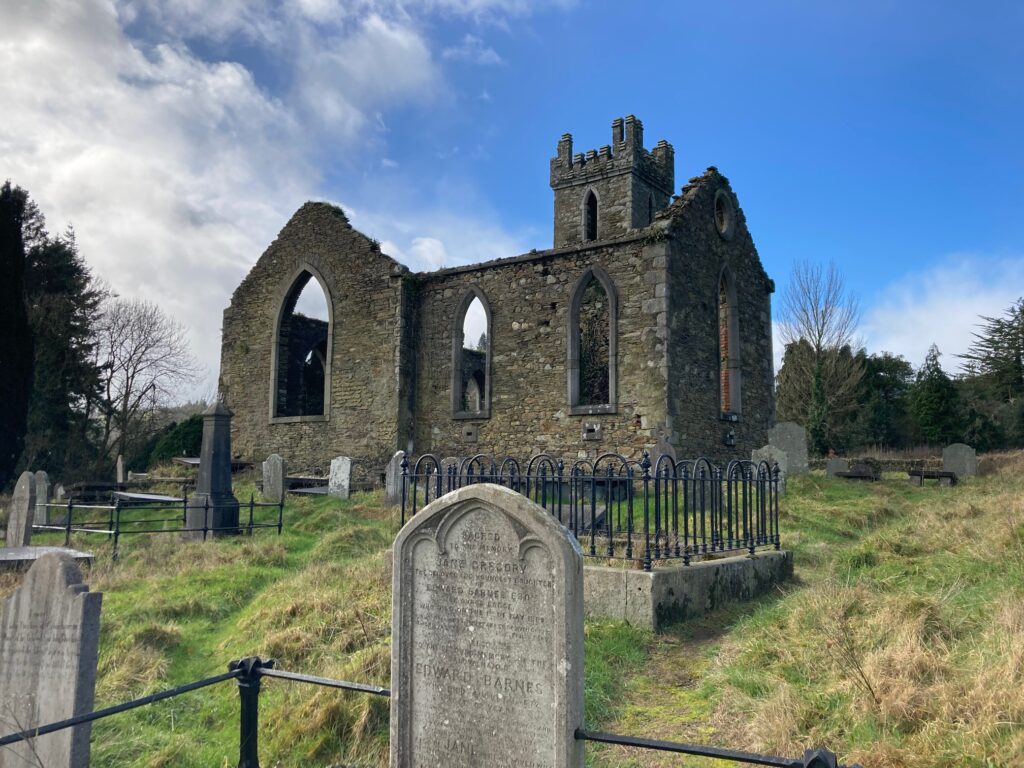
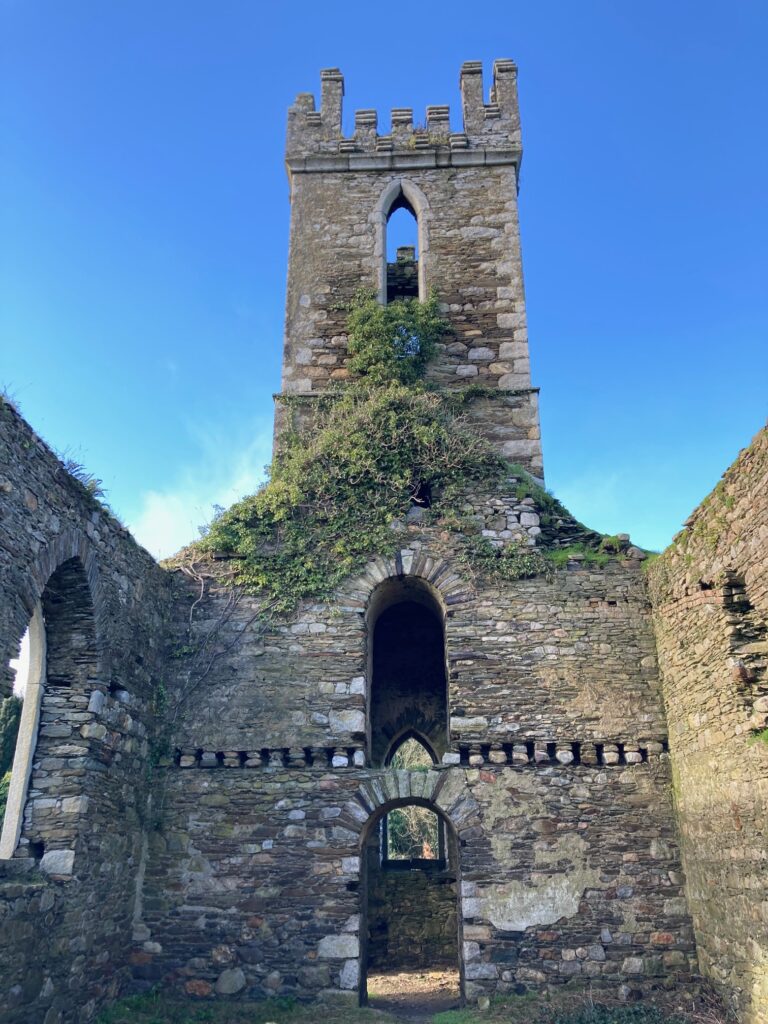
Yesterday I stood inside the ruins of Castle MacAdam Church near Avoca.
Georgian stone. Tall, empty lancets. Gravestones from the 1760s leaning into Wicklow grass.
It is not romantic. It is posthumous.
Once it held a Protestant parish certain of its continuity — baptisms, marriages, burials, sermons absorbed into timber and lime. The structure assumed endurance. The families who filled it assumed the same.
They are gone. The walls remain.
Standing there, the pattern felt older than Ireland.
Confidence. Consolidation. Moral certainty. Demographic thinning. Repurposing or abandonment.
No dramatic fall. Just erosion.
I thought of Consett. The church where my own family passed through its rites still stands, but the density has changed. Attendance narrows. Conviction competes with comfort. Ritual competes with distraction.
Across Europe, Christianity contracts.
An underused sacred space does not remain underused for long.
Capital enters first.
Active churches — not only deconsecrated chapels — now host candlelit concerts and pop retrospectives. ABBA lyrics about casual intimacy rising into vaults built for penitence. A Rolling Stones tribute singing Sympathy for the Devil would not feel implausible.
The acoustics remain. The geometry remains. The symbolism remains.
And something else remains — the accumulated imprint of prayer. If repetition imprints atmosphere, then centuries of petition are not erased by lighting rigs and ticket scanners. Stone stores more than sound.
When I saw the chequerboard floor at Notre-Dame Cathedral, especially in the wake of the fire and restoration, I became conscious of how symbols intensify in moments of weakness.
Black and white geometry is ancient. Medieval. It is also associated with later initiatory traditions, including Freemasonry. I make no declarative claim. But I notice timing. After fire. After fracture. During reconstruction. Perhaps Nostradamus was right?
Subconscious signs matter most when institutions falter.
Is that occult takeover? I do not assert it as fact. I consider the possibility that when conviction weakens, form becomes available for reinterpretation. Not through theatrical conquest, but through vacancy.
Belief drains. Form persists. Meaning shifts.
Other energies move in.
The Roman Empire followed its own arc. Its temples once carried incense and oath. When conviction thinned and power shifted, those temples were stripped, repurposed, abandoned. Their gods did not vanish in a day; they eroded across generations.
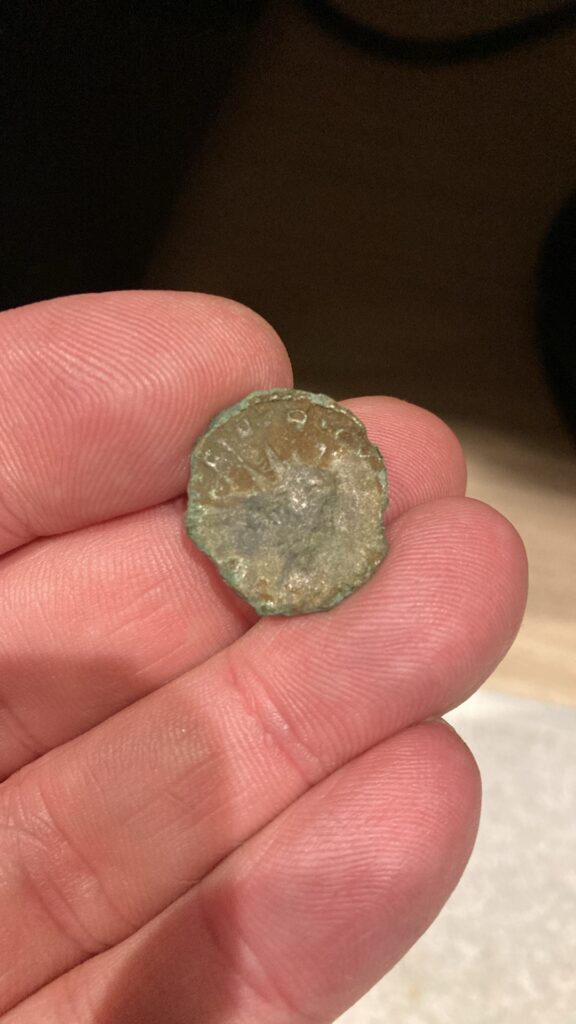
A Roman coin surfaced in my detector this week — thin, worn, carried across centuries before settling in Wicklow sand. Empire leaves residue. It does not preserve intention.
Christian churches in Mogadishu, in Tunis, in parts of Turkey once served confident congregations. Some are ruins now. Some are museums. Some are other things entirely.
Every civilisation believes its sacred architecture is immune to reversal.
History suggests otherwise.
The ruin at Avoca is simply further along the curve.
No concerts. No reinterpretation. No congregation.
Just stone admitting the demographic arithmetic.
What unsettled me was not anger. It was pattern recognition.
Institutions outlive belief for a time. When belief thins, monetisation begins. When monetisation cannot sustain coherence, abandonment follows. When abandonment completes, something else inherits the ground.
If Protestant Ireland travelled that road, Protestant England may be mid-journey.
Every structure eventually reveals whether it was built on conviction or habit.
Castle MacAdam stands as evidence that once conviction drains, the walls may remain — but the force that justified them does not automatically return.
The question is not whether churches survive.
The question is whether the civilisation that built them still believes what they were built to hold.
If not, the stone will endure.
And history will write over it, as it always does.
It was simply a family day out, prompted by nothing more than curiosity — and a shared sense that we were being drawn somewhere specific. None of us had been to Hawick (pronounced Hoick) before. There was no inherited story, no prior familiarity, no practical reason to choose it over anywhere else. Except perhaps the Tweed, both the river and the fabric. And yet the pull was unmistakable.
From the moment we arrived, that instinct made sense. Hawick is rich in Georgian and Victorian architecture — serious, functional buildings that speak to confidence, permanence, and an era when towns were constructed around purpose rather than appearance. This was not a place that had grown accidentally or decoratively. It had been built to last.
What revealed itself over the course of the day was not nostalgia or heritage tourism, but something more precise: the physical remains of a town that once sat squarely inside Britain’s productive and financial system. Textile mills, commercial streets, river infrastructure, banks, clubs — all still legible if you know what to look for.
Hawick was not peripheral by accident. It was connected because it produced. Capital, labour, goods, and credit moved through it with enough volume to justify national integration. Today, much of that system has thinned or gone, but the evidence remains embedded in stone, layout, and institutional residue.
Part of that story is what no longer exists. Hawick was once a mainline railway stop, linking Edinburgh and Glasgow south through England to London. That level of connectivity does not arrive by sentiment or policy — it follows volume, output, and economic justification. The line is gone now. Not dramatically removed, just rendered unnecessary. As production declined and capital withdrew, infrastructure followed. The loss of the railway was not the cause of Hawick’s change, but a confirmation of it.
This post records what can still be read in the landscape: a small town that explains, in physical form, how money once worked — and what changed when production ceased to anchor it.
Scottish Banknotes and the Survival of Issuing Power
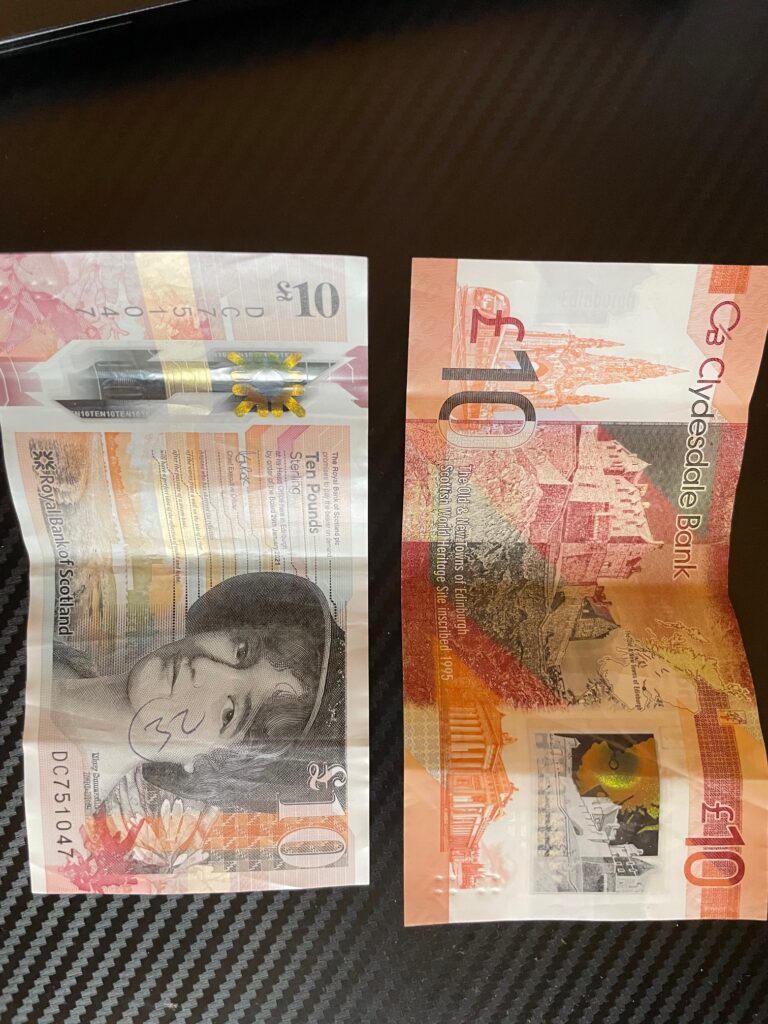
The notes are not issued by the British state. They are issued by private banks.
Scotland remains one of the few places in the developed world where commercial banks still issue their own currency — a legacy arrangement that survived political union and centralisation. Different banks issue different notes, all denominated in sterling, all circulating as money.
Whether this privilege was explicitly negotiated at the Union of 1707 or merely tolerated as a practical necessity is still debated. What is not debated is the outcome: Scotland retained a degree of monetary autonomy that England did not extend elsewhere.
Each note is today backed one-for-one by Bank of England reserves, yet the issuing identity remains private. That distinction matters. It reflects a time when money emerged from institutions embedded in trade, reputation, and locality — not exclusively from the state.
Seen together, the notes are not curiosities. They are surviving fragments of an older monetary settlement: loose, constrained, but not accidental.
Frugality Institutionalised: The Savings Bank Model
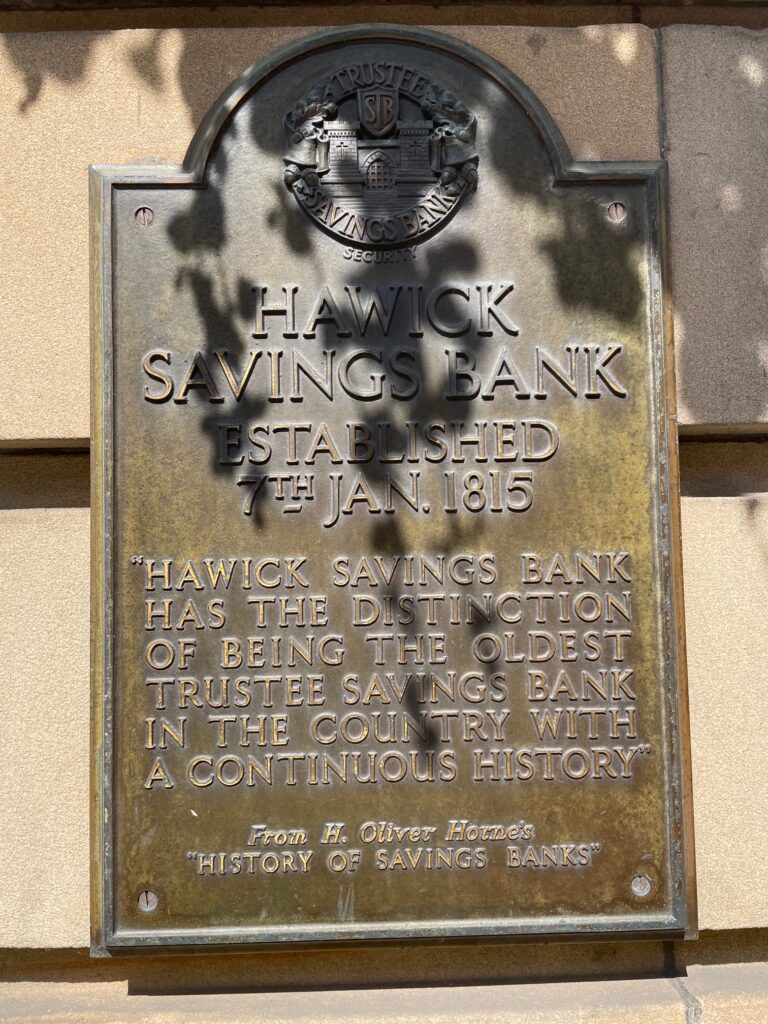
Hawick Savings Bank, established in 1815, was not a commercial bank in the modern sense. It was a trustee savings bank — part of an early movement to formalise thrift, restraint, and deferred consumption among working people.
This was not about growth. It was about preservation.
In an industrial town with cyclical income and narrow margins, security depended on behaviour. Savings banks assumed that capital should be accumulated slowly, custody mattered more than yield, and trust was local and personal.
The language carved into the stone is revealing: trustee, security, continuous history. These are not modern financial slogans. They describe a system designed to endure rather than impress.
Hawick produced surplus. Surplus required safekeeping. Safekeeping demanded credibility. The savings bank completed that loop.
Banking After Hours: When Cash Was Physical
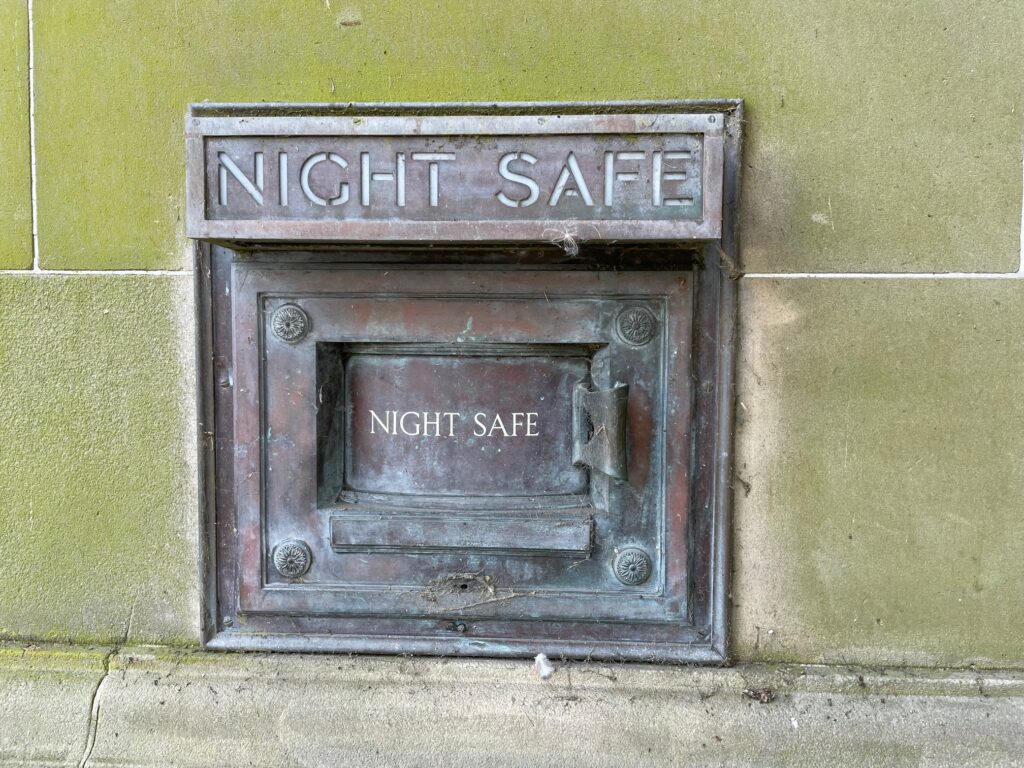
The night safe is easy to miss, but it tells you exactly how money once moved.
Before electronic settlement, takings were physical. Cash accumulated during the day had to be secured immediately. Businesses deposited after closing. Banks collected later. Risk was managed mechanically, not abstractly.
The design assumes distrust, not convenience. Heavy construction. One-way entry. No street-side access.
This was a world where money was earned, counted, deposited, and reconciled. Responsibility sat with the individual and the institution, not with “the system.”
The ATM Hut: Automation as a Holding Pattern
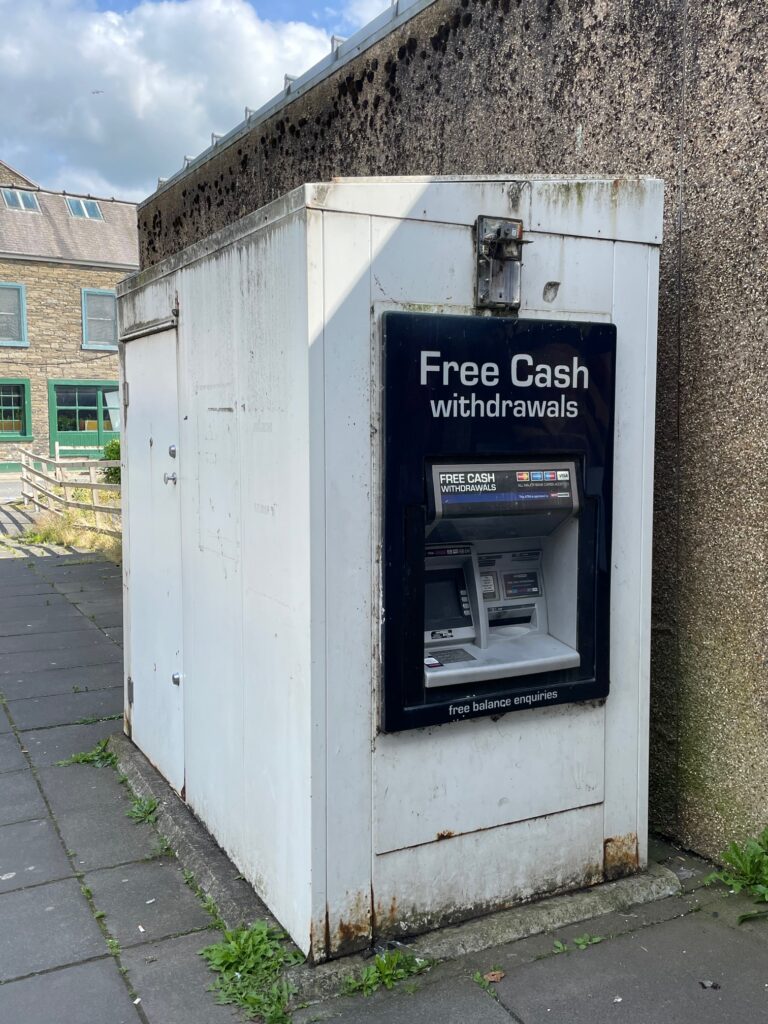
The ATM hut belongs to a different era.
Where the night safe assumed custody, the ATM assumed access. Banking shifted from deposit to withdrawal, from relationship to convenience, from staff to machines.
For decades, this infrastructure spread everywhere. And now it is quietly retreating.
The hut remains not because it is valued, but because removal costs more than neglect. It is a transitional artefact — neither enduring like the savings bank nor central like earlier banking institutions.
Built for convenience, not discipline, it was never meant to last.
From Local Industry to Imperial Circulation
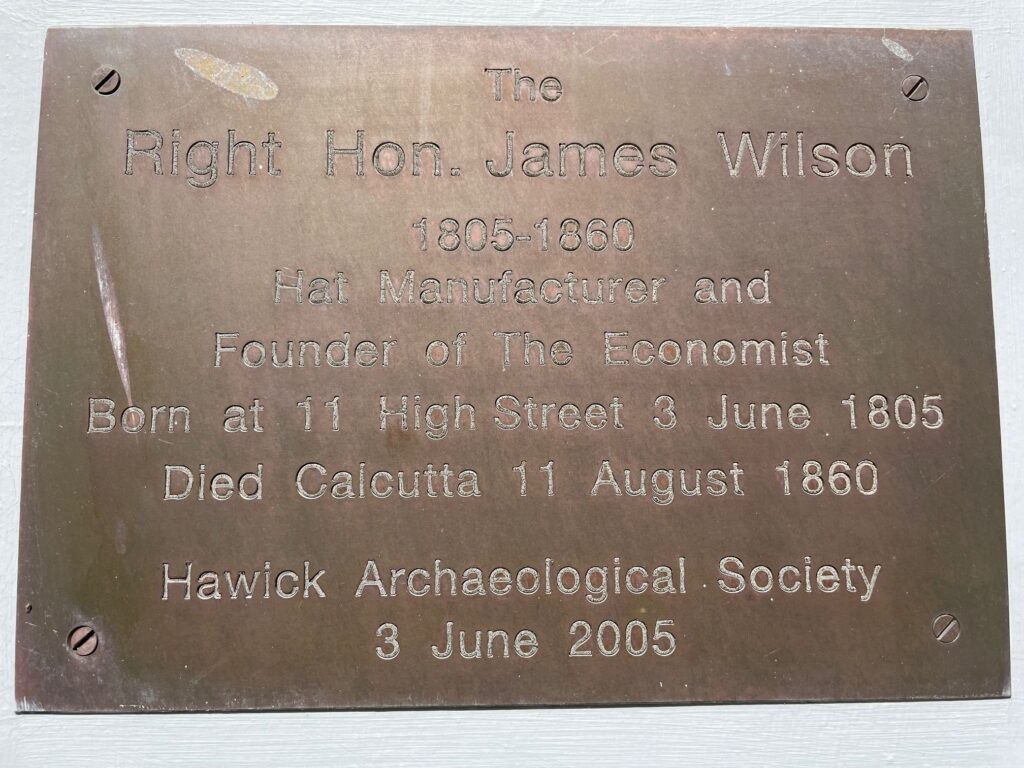
James Wilson was born in Hawick and died in Calcutta.
A manufacturer first, a publisher later, his trajectory mirrors Britain’s nineteenth-century expansion. Local production created surplus. Surplus demanded wider markets. Wider markets required predictable rules, currency stability, and commentary to bind them together.
Calcutta was not a romantic outpost. It was a financial hub — where imperial trade, taxation, and administration converged.
Hawick was not peripheral to empire. It was one of its starting points.
The Club, the Ale, and the Imperial Mindset
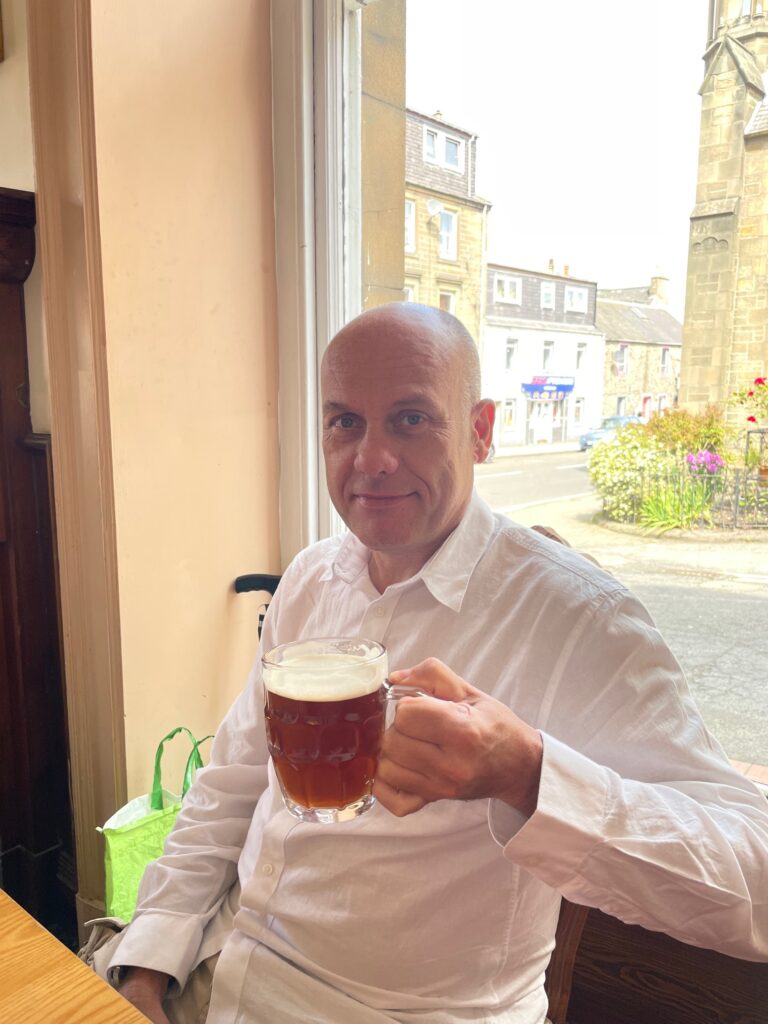
The day ended in a former Conservative Club, now a Wetherspoons, with a solid local ale.
These clubs were not leisure spaces. They were institutional rooms where trade, politics, and empire were discussed practically — as logistics rather than ideology.
Markets. Shipping. Currency. Risk.
Empire was not a theory. It was an operating system.
Border Reivers: Movement Under Pressure
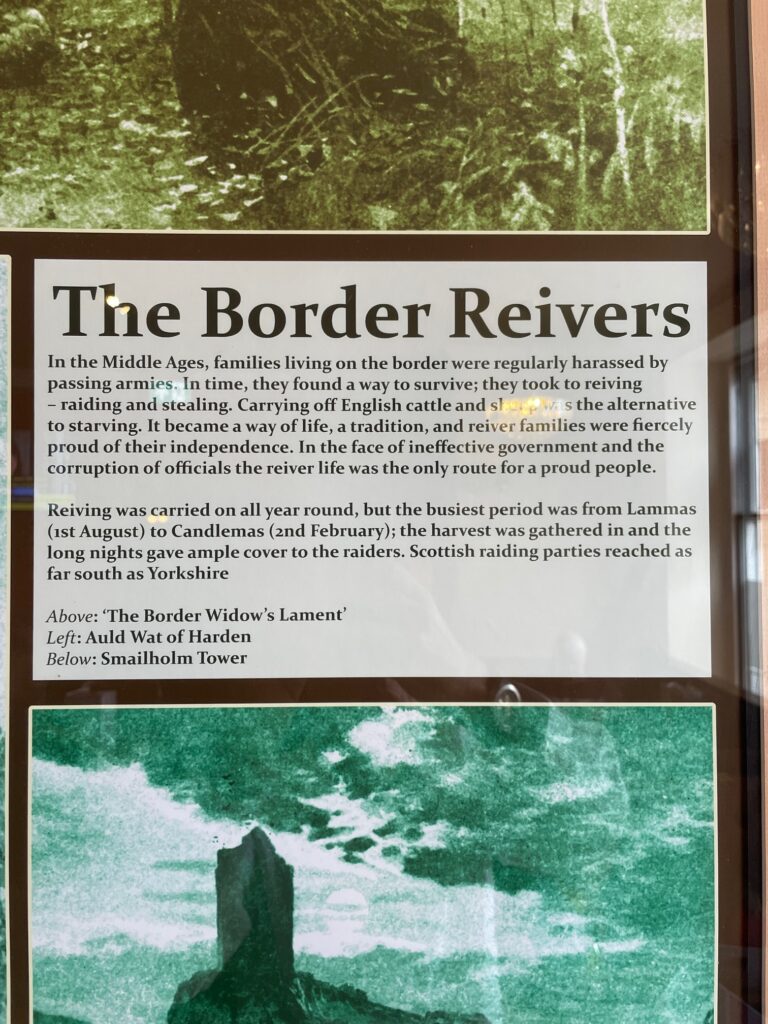
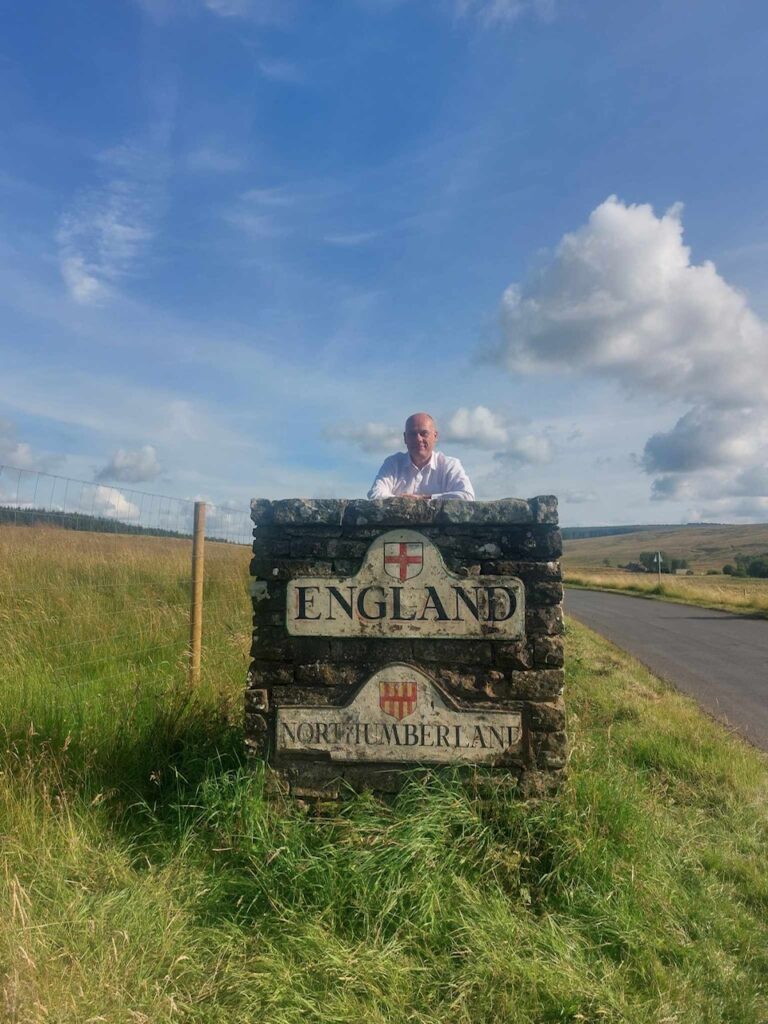
The Borders were never stable territory. They were pressure zones — politically weak, economically exposed, repeatedly raided.
The Border Reivers were not romantic outlaws. They were an economic response.
When authority overstepped or failed and agriculture could not sustain life, people reorganised around mobility, kinship, and force. Independence was not ideological. It was practical.
My own ancestors were part of that world.
That matters because the instinct to move when conditions deteriorate is not new. It appears repeatedly in border populations, trading families, and merchant cultures. When systems stop working, people leave.
Sometimes by choice. Sometimes by force.
When People Leave, They’re Voting
Hawick’s population loss is not sudden, but it is decisive. Over time, enough people reached the same conclusion: the town no longer sat at the centre of opportunity.
Other places grew. Hawick thinned.
That is not cultural drift. It is economic sorting.
People stay while systems reward effort. They leave when the future becomes narrower than the past. The decision is rarely ideological and almost never announced. It is executed quietly, family by family, job by job.
Depopulation is not failure. It is judgement.
And it always arrives after the systems that once justified staying have already gone.
Closing
Hawick explains something modern finance and planning repeatedly misunderstand.
Money once followed production. Savings followed discipline. Movement followed pressure. When those relationships weakened, people adapted — first locally, then geographically. Infrastructure did not fail first; it followed capital and people out.
There is now periodic talk of relinking Hawick to Edinburgh by rail. If it happens, it will likely bring commuters. Property demand may rise. The town may become better connected once again.
But commuters are not the same as local productivity.
A commuter economy imports income and exports time. It does not recreate mills, workshops, or locally anchored capital. It changes the function of a town without restoring its purpose.
Hawick has already lived through the difference between being connected because it produces and being connected because it is accessible. Those are not interchangeable states.
The buildings remain. The systems do not. What survives is not nostalgia, but evidence.
Once in Morocco, once in Ireland, and now again in Malaysia.
Different faces. Different languages. Different climates.
But the same man.
He speaks.
And then he leaves.
And he asks for nothing.
In Morocco he came to me without ceremony. No smile meant to sell. No story rehearsed for tourists. He said a few sentences—about the place, about the way things used to be—and then he was gone. No request. No lingering. No expectation that I would remember him.
But I did.
At the time, I didn’t understand why. I only knew that something in me had gone quiet afterwards, the way the sea does after a boat passes.
Ireland was different.
Ireland is my old world, not my exotic one. The fields are familiar. The air carries memory. When the man appeared there, it surprised me more. He spoke as if I already belonged, even though I felt between lives at the time. He said something ordinary—almost nothing at all—but it landed with weight.
He did not ask who I was.
He did not ask what I did.
He did not offer advice.
He simply acknowledged my presence, and then walked on.
That, too, stayed with me.
Malaysia was the third time.
By then I was no longer searching. I was moving slowly. Watching. Letting days be days. And that is when he appeared again. A few words. Calm eyes. No curiosity about my plans. No attempt to extract anything—money, story, validation.
He spoke because speaking was right.
And then he left because staying was unnecessary.
These men do not exist in the modern West, or if they do, they are buried beneath noise.
In the West, conversation is a transaction. Men speak to gain ground, establish position, sell something, or defend themselves. Silence is suspicious. Time is monetised. Presence is rare.
But in certain places—what I can only call intact cultures—there are still men who have nothing to prove.
They are not mentors.
They are not guides.
They are not mystical sages.
They are witnesses.
They appear when a man is alone but not lonely. When he is not extracting from the world. When he is walking without performance. They do not come to everyone. They cannot be summoned. They cannot be chased.
And if you try to turn them into a story too quickly, they disappear.
Odysseus met many men on his journey. Kings who demanded allegiance. Hosts who offered shelter at a price. Monsters who tested his strength. But there were also quiet figures along the way—men who pointed once, spoke briefly, and asked nothing in return.
Those were the moments that told him he was still on the right path.
Not home yet.
But not lost.
I don’t tell everyone about these encounters. I didn’t tell my inner circle this time. Some things lose their truth when spoken aloud too often. What is given freely should be carried quietly.
I don’t believe this is destiny.
I don’t believe it makes me special.
I believe it means something simpler, and harder to earn:
For brief moments this year, in Morocco, in Ireland, and now in Malaysia, I was walking correctly.
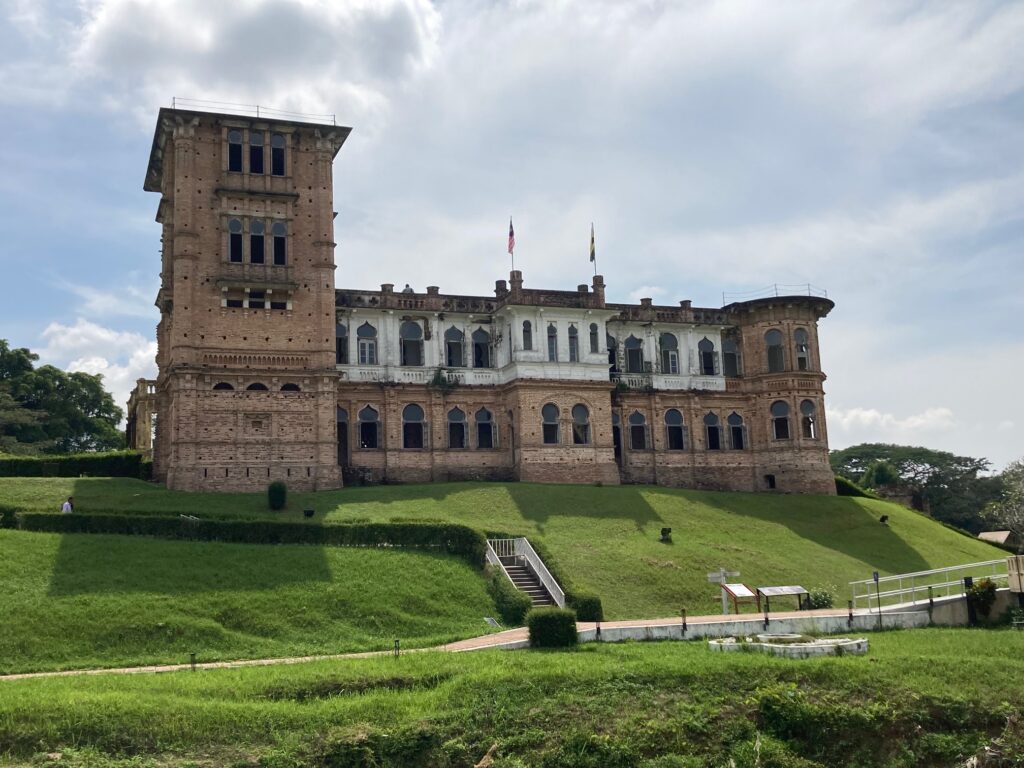
I had waited to see this place for thirty-five years. Michael Palin’s railway journeys put me onto it long ago, but nothing prepared me for the feeling of standing in the shell of another man’s unfinished ambitions.
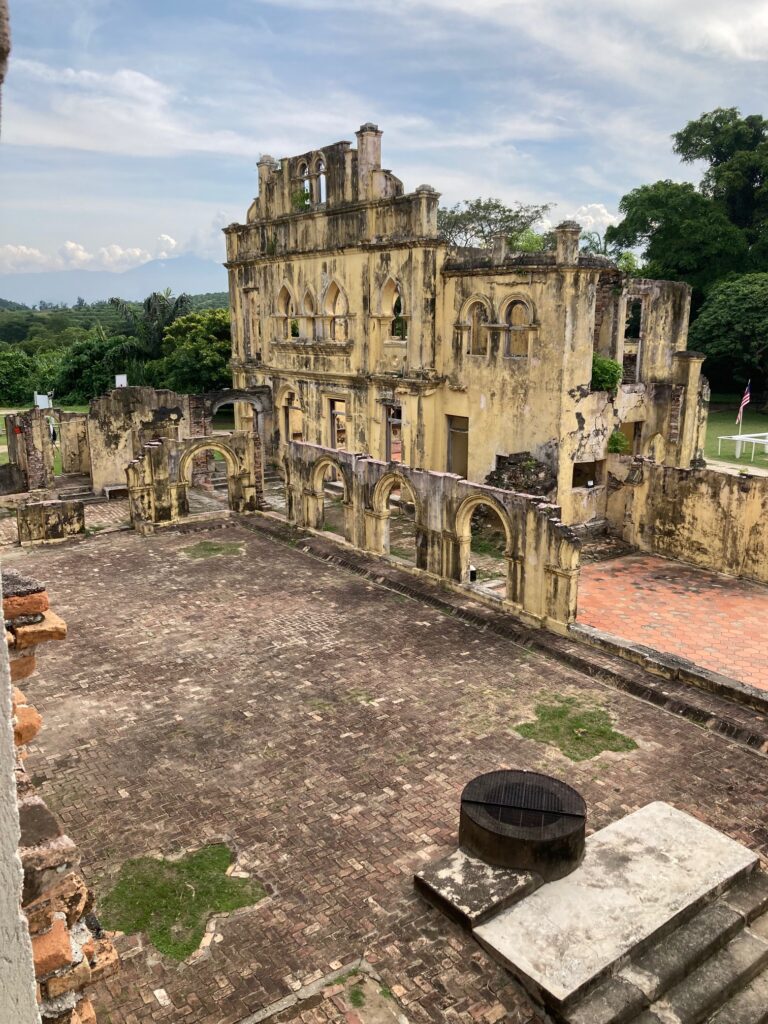
Kellie built this hill like a man laying out his immortality brick by brick. He wanted a palace, a monument, a statement carved into the heat and stone of Malaya. And yet, here it stands — empty, echoing, beautiful, and broken. A place half-born and never lived in.
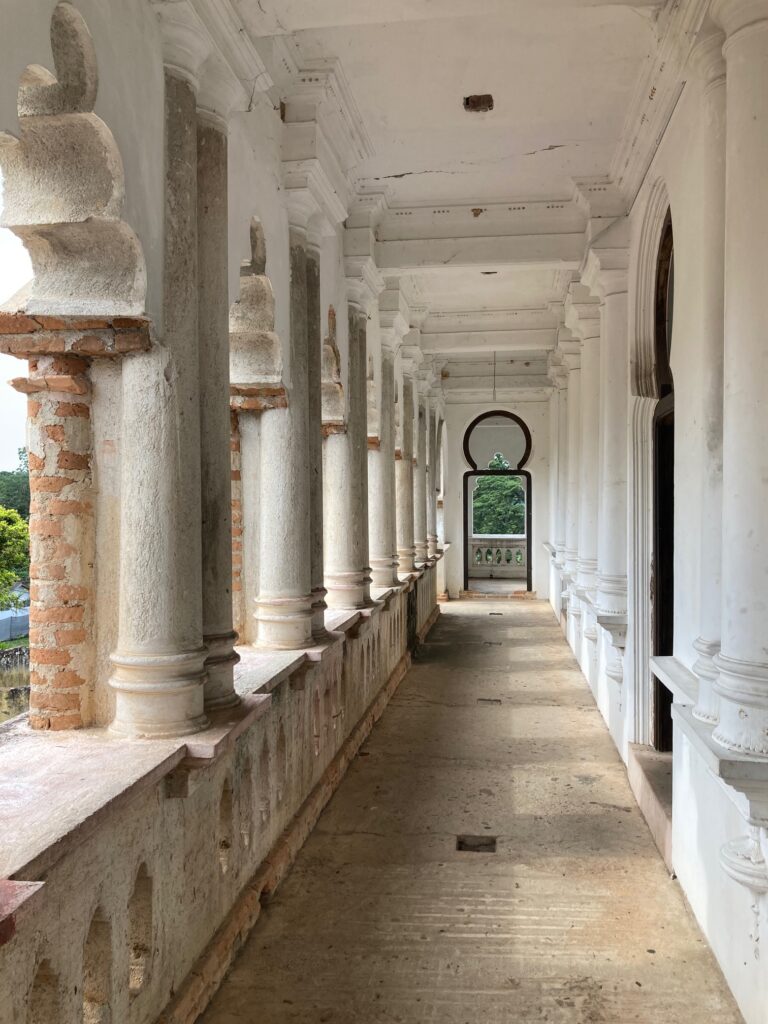
You walk these corridors and you wonder:
Was there ever a better monument to how fleeting success and happiness really are?
How quickly a legacy can rot or die?
How quietly a story can end without anyone truly noticing?
Today, standing in the abandoned rooms, I thought of Montana — my own project, my own obligation, the weight I carried for years. I held onto that house until it was time to let it go, and when the moment came, I walked away. I exited my castle long before it had the chance to imprison me.
Kellie never had that luxury. He died in Portugal at fifty-six, still fighting bureaucrats and labour shortages, still believing he had more time. They say his ghost walks the upper corridor here. Not in anger — in yearning. A man trapped in the dream he never escaped.
There’s a curse whispered locally:
Any man who binds his identity to his creation will lose both.
Kellie’s story follows that script with frightening precision — a child lost, a labour force wiped out by influenza, a dream stalled by red tape, and finally, a sudden death. The castle became a tomb for his intentions.
I realised as I walked through the wine cellar — the one he planned to air-condition, the first in Malaya — that I am only two years younger than he was when he died. That hit harder than I expected. It forced a question I’ve avoided for most of my life:
What dream of mine is unfinished, and will I have the courage to leave it behind when the time comes?
The truth is this: legacy is fragile, memory is temporary, and the world is ruthless with sentiment. Even Ipoh reminded me of that this week — the colonial cemeteries bulldozed, the graves poured over with fresh concrete. Whole lives, whole sorrows, erased in an afternoon.
Maybe that’s why this castle struck me.
Maybe this is the lesson:
Do not stay too long.
Do not cling to the past.
Do not become a ghost in a house you once loved.
Kellie tried to build permanence.
I am learning to build only momentum.
And perhaps that is the real inheritance of these ruins — the quiet instruction to walk forward, lightly, before the walls close in.