I awoke early, determined to enjoy a full rain-free day for once, and took the first train available. It was late — no surprise, given the flooding — and I was the only passenger boarding at that particular station. That suited me. Trains are better when they’re half-empty, running slightly off schedule, moving through a landscape that has already started its day without you.
The journey fitted my travel instinct perfectly. Closed stations slipped past, now converted into houses where platforms still exist but purpose has drained away. I recognised stretches of line where I’d walked before, and others where I suspected the ground nearby would hold small, forgotten things — places worth returning to, should I ever get time to reconnoitre this route properly. Travel like this isn’t about arrival. It’s about observation and accumulation.
Next, there was a walk by the sea. Wind off the water, the familiar rhythm of scanning, listening, pacing. Metal detecting is never just about finding things. It’s a discipline of attention. Most days you come back with nothing more than distance covered and salt on your jacket. Occasionally, the ground answers.
This time it did — quietly.
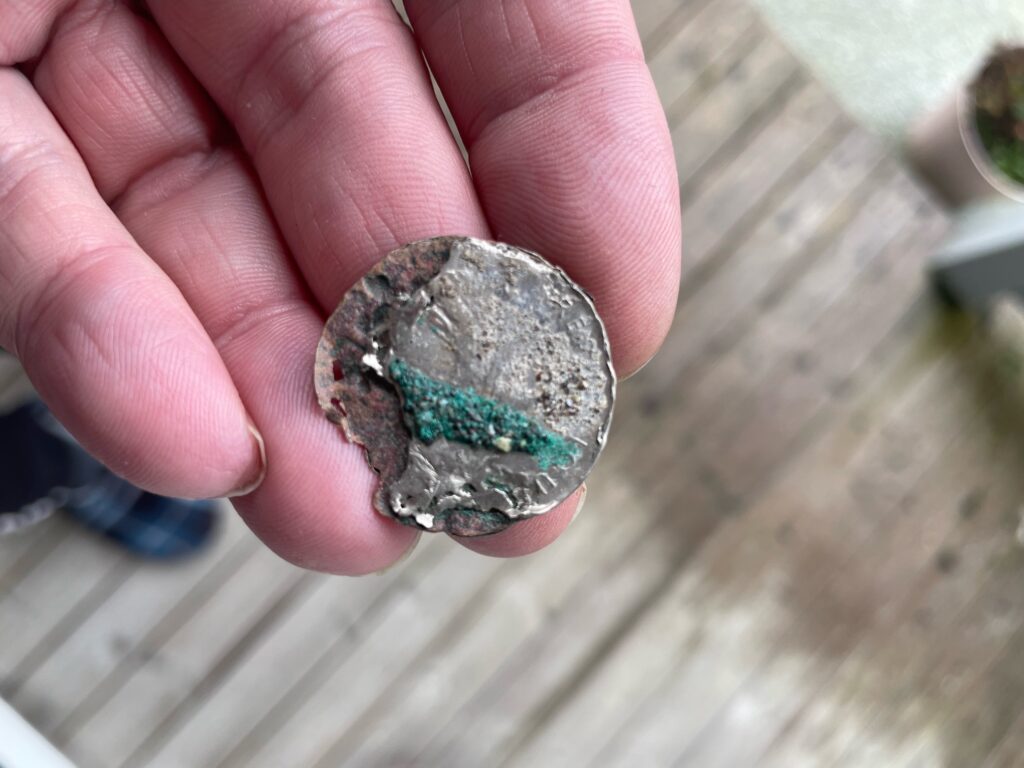
What turned up was the remains of a forged silver coin. Late eighteenth century. French in origin, from a period when bad money was common enough that imitation became an industry. At a glance, it would once have passed. That was the point. A thin skin of silver over a copper core, made deliberately, not accidentally. This wasn’t decay masquerading as fraud; it was fraud, designed to circulate.
The timing matters. The later 1700s were a poor period for trust in money. War finance, repeated debasements, uneven minting, and collapsing confidence created the perfect conditions for forgery. Coins like this didn’t need to endure. They needed to move — quickly — from hand to hand, before anyone stopped to weigh them or listen too closely.
Time and saltwater eventually did what markets often don’t. The thin coating failed. The copper showed. The deception stopped working.
These pieces rarely survive. When discovered, they were pulled from circulation, melted down, or discarded — and the forgers themselves often paid far more dearly. The penalties ranged from execution to transportation to remote colonies. Official forgers, it turns out, have never been fond of unofficial competition.
The sea is one of the few places that keeps such things without judgement. Even in this condition, the forgery may have value. Counterfeit always does, once it has crossed fully into history.
That’s fine with me. It goes straight into my collection.
I like how the day brought several long-running interests together without effort: travel, movement, a walk by the water, history underfoot, and the mechanics of money stripped back to their simplest form. Silver, but only just. Trust doing the work authority failed to do.
The day ended in a Georgian pub, which felt entirely appropriate. Same century. Same worn surfaces. Different transaction.
Instead of a copper halfpenny, the ale cost seven euros.
It was simply a family day out, prompted by nothing more than curiosity — and a shared sense that we were being drawn somewhere specific. None of us had been to Hawick (pronounced Hoick) before. There was no inherited story, no prior familiarity, no practical reason to choose it over anywhere else. Except perhaps the Tweed, both the river and the fabric. And yet the pull was unmistakable.
From the moment we arrived, that instinct made sense. Hawick is rich in Georgian and Victorian architecture — serious, functional buildings that speak to confidence, permanence, and an era when towns were constructed around purpose rather than appearance. This was not a place that had grown accidentally or decoratively. It had been built to last.
What revealed itself over the course of the day was not nostalgia or heritage tourism, but something more precise: the physical remains of a town that once sat squarely inside Britain’s productive and financial system. Textile mills, commercial streets, river infrastructure, banks, clubs — all still legible if you know what to look for.
Hawick was not peripheral by accident. It was connected because it produced. Capital, labour, goods, and credit moved through it with enough volume to justify national integration. Today, much of that system has thinned or gone, but the evidence remains embedded in stone, layout, and institutional residue.
Part of that story is what no longer exists. Hawick was once a mainline railway stop, linking Edinburgh and Glasgow south through England to London. That level of connectivity does not arrive by sentiment or policy — it follows volume, output, and economic justification. The line is gone now. Not dramatically removed, just rendered unnecessary. As production declined and capital withdrew, infrastructure followed. The loss of the railway was not the cause of Hawick’s change, but a confirmation of it.
This post records what can still be read in the landscape: a small town that explains, in physical form, how money once worked — and what changed when production ceased to anchor it.
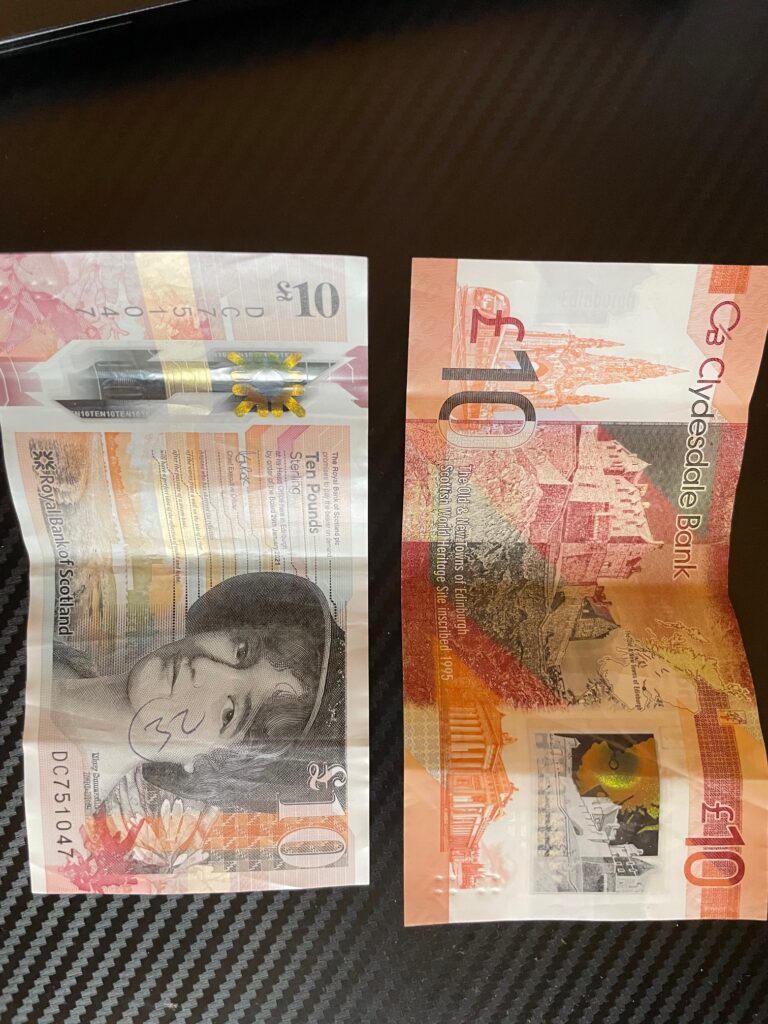
Scottish Banknotes and the Survival of Issuing Power
The notes are not issued by the British state. They are issued by private banks.
Scotland remains one of the few places in the developed world where commercial banks still issue their own currency — a legacy arrangement that survived political union and centralisation. Different banks issue different notes, all denominated in sterling, all circulating as money.
Whether this privilege was explicitly negotiated at the Union of 1707 or merely tolerated as a practical necessity is still debated. What is not debated is the outcome: Scotland retained a degree of monetary autonomy that England did not extend elsewhere.
Each note is today backed one-for-one by Bank of England reserves, yet the issuing identity remains private. That distinction matters. It reflects a time when money emerged from institutions embedded in trade, reputation, and locality — not exclusively from the state.
Seen together, the notes are not curiosities. They are surviving fragments of an older monetary settlement: loose, constrained, but not accidental.
Frugality Institutionalised: The Savings Bank Model
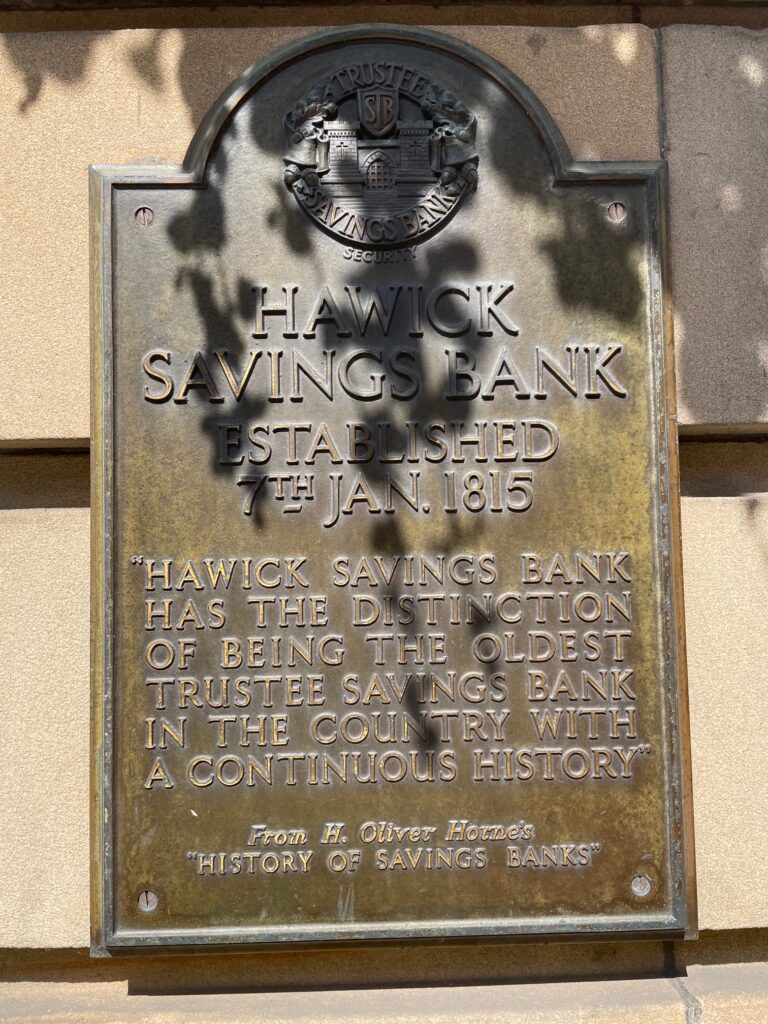
Hawick Savings Bank, established in 1815, was not a commercial bank in the modern sense. It was a trustee savings bank — part of an early movement to formalise thrift, restraint, and deferred consumption among working people.
This was not about growth. It was about preservation.
In an industrial town with cyclical income and narrow margins, security depended on behaviour. Savings banks assumed that capital should be accumulated slowly, custody mattered more than yield, and trust was local and personal.
The language carved into the stone is revealing: trustee, security, continuous history. These are not modern financial slogans. They describe a system designed to endure rather than impress.
Hawick produced surplus. Surplus required safekeeping. Safekeeping demanded credibility. The savings bank completed that loop.
Banking After Hours: When Cash Was Physical
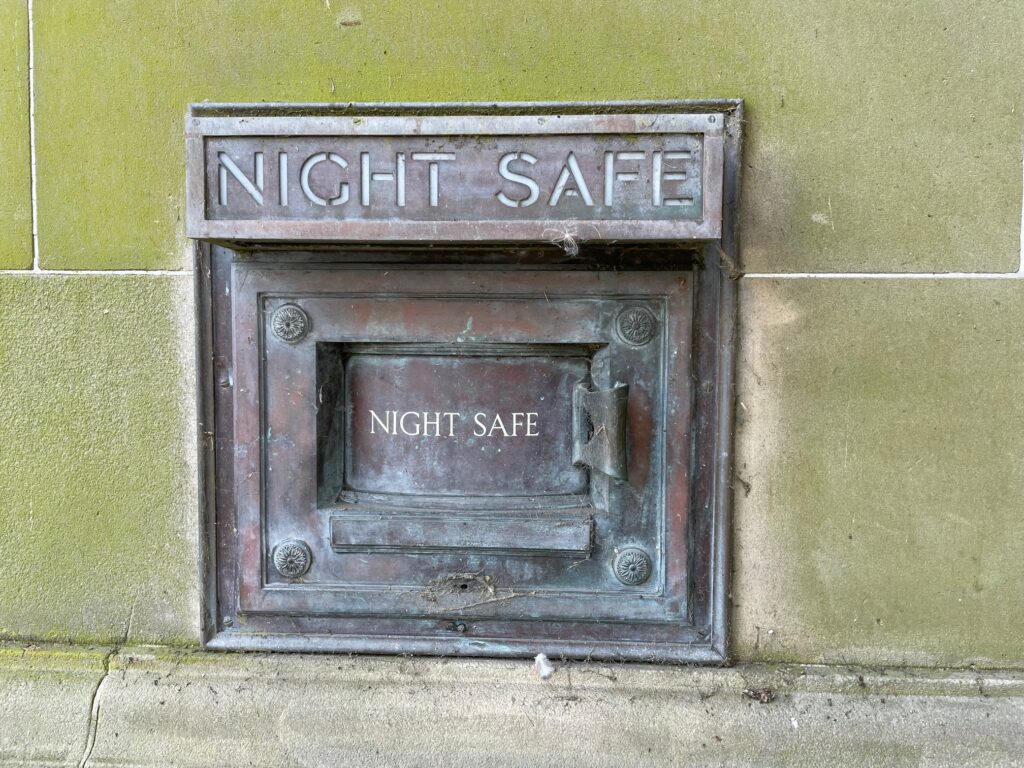
The night safe is easy to miss, but it tells you exactly how money once moved.
Before electronic settlement, takings were physical. Cash accumulated during the day had to be secured immediately. Businesses deposited after closing. Banks collected later. Risk was managed mechanically, not abstractly.
The design assumes distrust, not convenience. Heavy construction. One-way entry. No street-side access.
This was a world where money was earned, counted, deposited, and reconciled. Responsibility sat with the individual and the institution, not with “the system.”
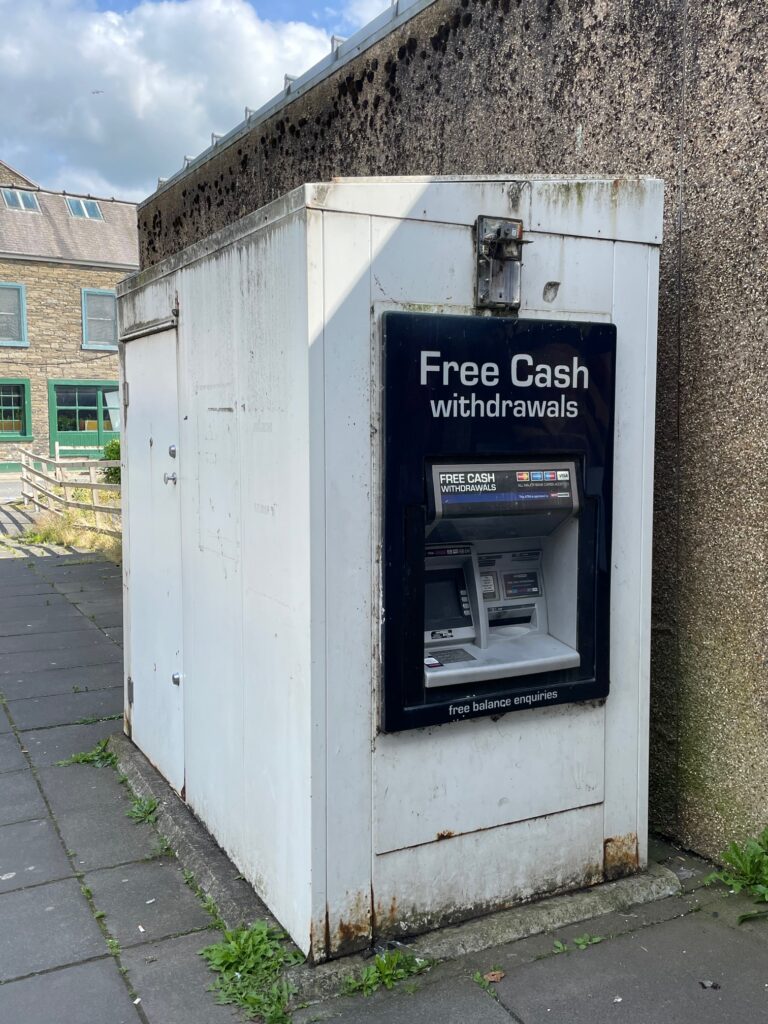
The ATM Hut: Automation as a Holding Pattern
The ATM hut belongs to a different era.
Where the night safe assumed custody, the ATM assumed access. Banking shifted from deposit to withdrawal, from relationship to convenience, from staff to machines.
For decades, this infrastructure spread everywhere. And now it is quietly retreating.
The hut remains not because it is valued, but because removal costs more than neglect. It is a transitional artefact — neither enduring like the savings bank nor central like earlier banking institutions.
Built for convenience, not discipline, it was never meant to last.
From Local Industry to Imperial Circulation
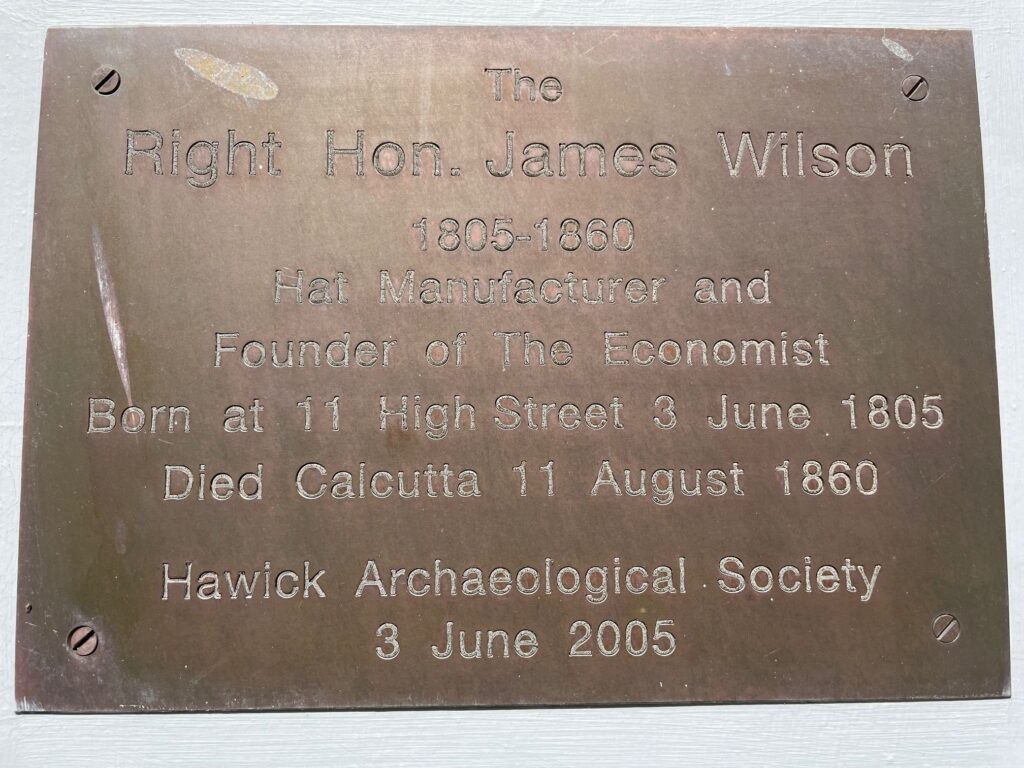
James Wilson was born in Hawick and died in Calcutta.
A manufacturer first, a publisher later, his trajectory mirrors Britain’s nineteenth-century expansion. Local production created surplus. Surplus demanded wider markets. Wider markets required predictable rules, currency stability, and commentary to bind them together.
Calcutta was not a romantic outpost. It was a financial hub — where imperial trade, taxation, and administration converged.
Hawick was not peripheral to empire. It was one of its starting points.
The Club, the Ale, and the Imperial Mindset
The day ended in a former Conservative Club, now a Wetherspoons, with a solid local ale.
These clubs were not leisure spaces. They were institutional rooms where trade, politics, and empire were discussed practically — as logistics rather than ideology.
Markets. Shipping. Currency. Risk.
Empire was not a theory. It was an operating system.
Border Reivers: Movement Under Pressure
The Borders were never stable territory. They were pressure zones — politically weak, economically exposed, repeatedly raided.
The Border Reivers were not romantic outlaws. They were an economic response.
When authority overstepped or failed and agriculture could not sustain life, people reorganised around mobility, kinship, and force. Independence was not ideological. It was practical.
My own ancestors were part of that world.
That matters because the instinct to move when conditions deteriorate is not new. It appears repeatedly in border populations, trading families, and merchant cultures. When systems stop working, people leave.
Sometimes by choice. Sometimes by force.
When People Leave, They’re Voting
Hawick’s population loss is not sudden, but it is decisive. Over time, enough people reached the same conclusion: the town no longer sat at the centre of opportunity.
Other places grew. Hawick thinned.
That is not cultural drift. It is economic sorting.
People stay while systems reward effort. They leave when the future becomes narrower than the past. The decision is rarely ideological and almost never announced. It is executed quietly, family by family, job by job.
Depopulation is not failure. It is judgement.
And it always arrives after the systems that once justified staying have already gone.
Closing
Hawick explains something modern finance and planning repeatedly misunderstand.
Money once followed production. Savings followed discipline. Movement followed pressure. When those relationships weakened, people adapted — first locally, then geographically. Infrastructure did not fail first; it followed capital and people out.
There is now periodic talk of relinking Hawick to Edinburgh by rail. If it happens, it will likely bring commuters. Property demand may rise. The town may become better connected once again.
But commuters are not the same as local productivity.
A commuter economy imports income and exports time. It does not recreate mills, workshops, or locally anchored capital. It changes the function of a town without restoring its purpose.
Hawick has already lived through the difference between being connected because it produces and being connected because it is accessible. Those are not interchangeable states.
The buildings remain. The systems do not. What survives is not nostalgia, but evidence.