I went back to Tunisia to see whether the energy I remembered was still there.
That matters.
I was not arriving as a naive first-time visitor with a guidebook, a bucket list and a head full of borrowed expectations. I had worked in Tunis in 2010. I had known something of the city before: its streets, its European bones, its Arab life, its Mediterranean confidence, its mixture of French, Italian, African and North African currents. Tunis had left an impression on me then.
Not just as a place.
As an energy.
There had been life in it. Movement. Beauty. Possibility. A certain charged urban quality I had carried with me for years afterwards. Some cities vanish from memory almost as soon as you leave them. Others remain as an unresolved note.
Tunis had remained.
So I returned, not simply to see Tunisia, but to test memory against reality.
Was the energy still there?
Had the city changed?
Had I changed?
Had I remembered it accurately, or had 2010 become one of those private myths that time polishes into something cleaner than it was?
That is a different kind of travel from first arrival. A first visit asks, “What is this place?” A return asks, “What remains?” It asks what survived, what has shifted, what memory preserved correctly, and what life now allows you to see that you were not ready to see before.
I came back to Tunis with more life behind me.
That changes the eye.
I still wanted history, ruins, sea air, Roman stones, cafés, whitewashed streets, old towns, railway stations, louages, and the usual North African mixture of hospitality, negotiation and theatre.
I found all of that.
I also found something else.
Not danger.
Not hostility.
Not even serious hassle in the grand dramatic sense.
Something smaller.
A repeated claim on my attention.
“Where are you from?”
“My friend.”
“Taxi?”
“I show you a good place.”
“Restaurant?”
“Guide?”
“Come, come.”
This did not happen every ten metres. It was not a constant siege. Some days it happened once. One day it happened twice. On paper, that sounds like nothing.
But travel is not lived on paper.
A man calls out to you in the street. You smile. You answer. You say England, Britain, Ireland, or whatever degree of accuracy the next ten seconds deserve. He welcomes you to Tunisia. He asks if it is your first time. He says he knows a good restaurant, or a nice shop, or a place tourists do not know. Perhaps he says the street is closed. Perhaps his cousin has a business. Perhaps he is a guide. Perhaps he just wants to help.
Then comes the story.
Then comes the ask.
Money, restaurant, taxi, shop, tip, guide fee, cigarettes, “just one minute,” “come look,” “no obligation,” “special price.”
The first time, you are polite.
The second time, you are cautious.
After a few repetitions, you already know the script before the second line has been delivered.
And what begins to irritate is not the money.
It is not even the attempted extraction.
It is the interruption.
That is what took me a while to understand. The real cost of the low-level street hassle in Tunisia was not financial. I was never seriously at risk of being ruined by a bad taxi fare, a tourist-priced couscous, or a man with an invented story about a restaurant. The sums were small. The stakes were minor.
The real cost was cognitive.
That is the hidden tourist tax.
Attention.
Tourists are trained to think in prices. How much is the taxi? How much is the hotel? How much is lunch? How much is the museum ticket? How much should I pay for this ride, this meal, this bottle of water, this transfer, this guide?
Those questions matter.
But they are not the whole account.
There is another ledger.
Who interrupted your walk?
Who broke your thought?
Who made you classify them while you were trying to observe a place?
Who turned a street into a sales funnel?
Who took ten seconds of your consciousness without permission?
That tax is harder to measure, but after a few days you feel it.
I had come to look.
That sounds simple, but it is not. Looking properly is one of the great pleasures of travel. Not looking as a consumer. Not looking as a tourist ticking off sights. Looking as a man trying to understand where he is.
To walk down Avenue Habib Bourguiba and notice the French colonial bones beneath the modern traffic.
To return to streets I had known in 2010 and compare them with the version still living in memory.
To wander through the old French and Italian city, that European Mediterranean layer of Tunis, with its balconies, façades, cafés, churches, apartment blocks, commercial buildings, shaded streets and half-faded ambitions.
This became one of my favourite parts of the trip.
Not because it was picturesque in some shallow way, but because it carried atmosphere. It was not a theme park or a preserved colonial postcard. It was a surviving urban layer. A whole world had once existed there in daily form. People had worked in those buildings, worshipped in those churches, argued in those cafés, taken trams, buried their dead, sent letters home, raised children, made money, lost money, loved, aged, and imagined futures.
They did not live as historical symbols.
They lived as themselves.
Then history moved.
The buildings remained.
That old French and Italian city fascinated me because it was close enough in time to feel almost touchable, yet already remote. It belonged neither fully to Europe nor fully to the modern Tunisia around it. It was a layer of confidence left behind by people who assumed their institutions, language, churches, clubs, consulates, banks, cemeteries and routines would outlast them.
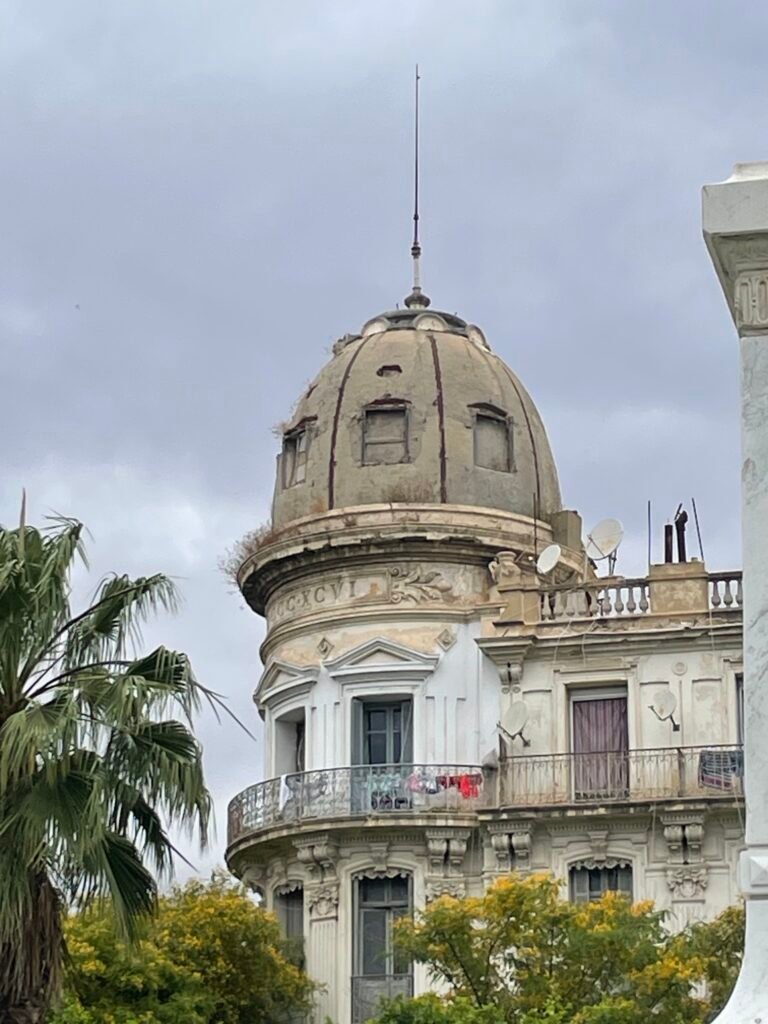
They did not.
That is one of Tunisia’s great powers as a travel destination. It does not present history as a single period. It layers it. Punic, Roman, Arab, Ottoman, French, Italian, modern Tunisian — not cleanly separated, but folded into one another.
In Tunis, especially, you can walk from one civilisation’s confidence into another civilisation’s afterlife within a few streets.
I saw two cathedrals.
That alone is a reminder that Tunisia is not the simplified country imagined by people who have never looked properly at North Africa. Churches, synagogues, mosques, Roman ruins, colonial boulevards, Ottoman traces, French apartment blocks, Italian names, Arab medinas, African migration, European memory, modern statehood — the country is not one thing.
It is a palimpsest.
The cathedrals mattered not because I wanted to consume them as sights, but because they revealed the impermanence of power.
A cathedral is built by people who believe, at some level, that their world has weight. It may be religious weight, imperial weight, civic weight, cultural weight. But it is never casual. Nobody builds a cathedral for a temporary mood.
And yet in Tunisia, the cathedrals now stand in a changed world.
That is what made them interesting.
They were not merely pretty buildings. They were evidence. Evidence that people had once belonged there, or believed they belonged there, and then, in the long movement of history, no longer did.
The most powerful refuge, however, was not one of the grander cathedrals.
It was the Protestant church.
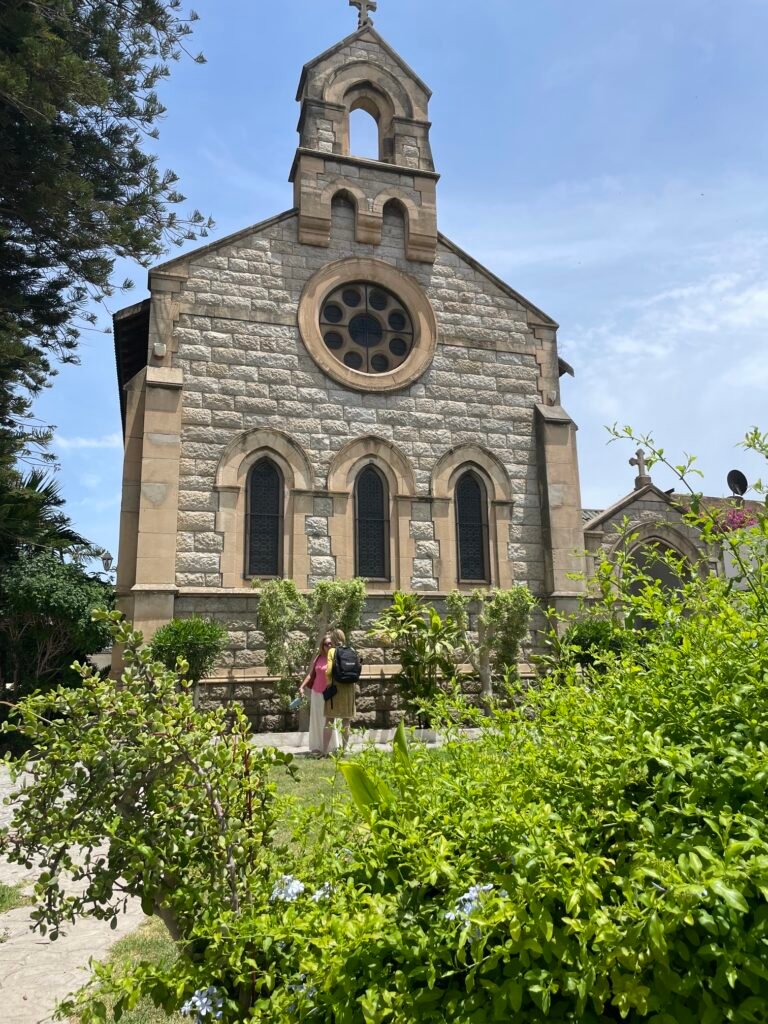
I had been walking through the busy street atmosphere of Tunis, with all the life and interruption that comes with it. The traffic, the call-outs, the street approaches, the little claims on your time, the small negotiations, the commercial noise, the “my friend” routine, the feeling that even a quiet walk could be turned into someone else’s opportunity.
Then I stepped into the Protestant church and its cemetery garden.
The change was immediate.
Outside: movement, demand, noise, heat, salesmanship, traffic, human friction.
Inside: shade, stone, names, graves, flowers, silence.
It was not silence in the empty sense. It was a full silence. A silence with memory in it.
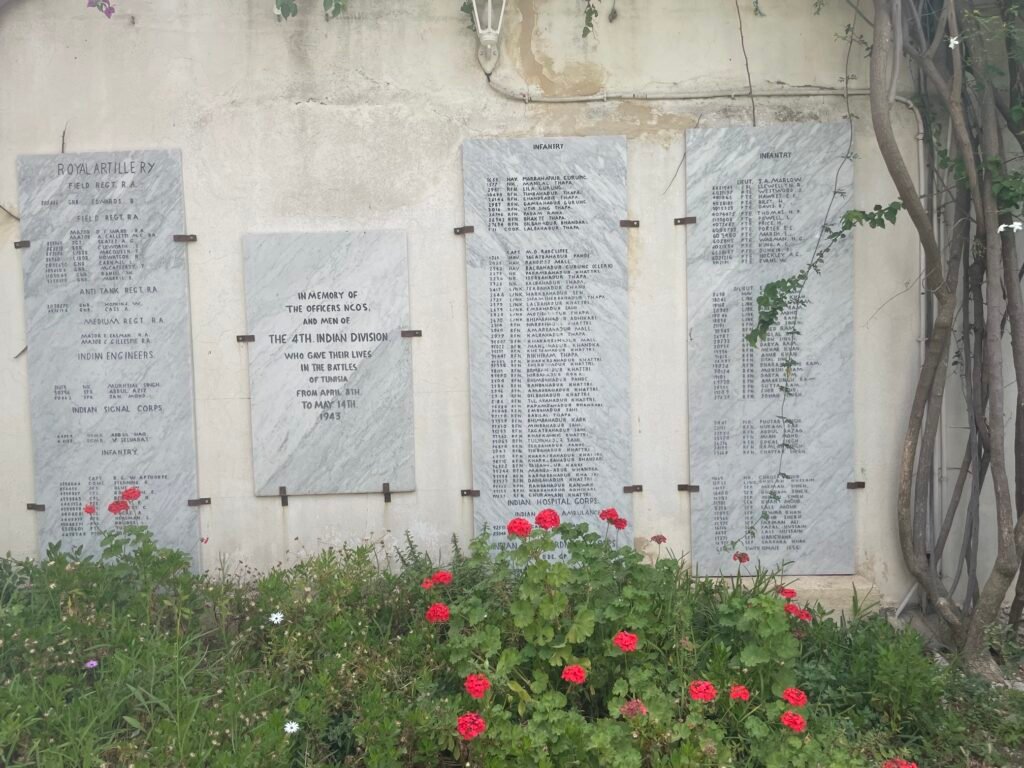
There were British graves, as one might expect. But there were also Danish and Swedish graves, and those touched me in a different way. I had lived in Denmark for many years. To find Danish names in a cemetery garden in Tunis was to be reminded again that lives cross in ways official history rarely captures.
Men and women had come south. They had lived, traded, served, married, fallen ill, died, and been buried far from the cold north.
A Scandinavian name in Tunis is a small thing, but small things often carry the most human weight.
That cemetery was not an attraction.
It was a refuge.
And in the context of the trip, that mattered.
Because it showed me the contrast I had been feeling all along. The irritation of street hassle was not really about Tunisia, or poverty, or sellers, or guides, or taxi men. It was about the right to experience a place without being constantly pulled out of the experience.
In the cemetery garden, nobody wanted anything from me.
The dead do not pitch restaurants.
They do not ask where you are from.
They do not offer to show you a special place for a special price.
They simply remain.
And because they remain, you can think.
That kind of looking requires attention.
And attention is not an unlimited resource.
When a stranger inserts himself into your walk, he is not merely asking a question. He is taking control of the next few seconds of your consciousness.
You are walking. You are thinking. You are building a map of the place. You are comparing Tunisia with 2010, with Morocco, with Denmark, with Ireland, with Malaysia, with all the other places that have left marks on you. You are noticing how the light falls on a wall, how a street bends, how a railway station functions, how a café fills, how people dress, how men gather, how women move through public space, how old empires leave behind buildings that outlive the people who built them.
Then:
“Hello my friend.”
The thread breaks.
Now you must classify the approach.
Friendly? Commercial? Scam? Guide? Taxi? Beggar? Harmless? Persistent? Does he want to sell something? Is there a story coming? Do I answer? Do I ignore? Do I say no? Do I walk faster? Is he going to follow?
All this happens in a second or two, but it happens.
The cost is the context switch.
And after a while, the context switches accumulate.
Not because it happens constantly.
Because it happens at the wrong moment.
A single interruption can break the thread of a place. Two in a day can make you feel watched as an opportunity rather than left alone as a traveller. One more on another day is enough to remind you that the same script is waiting at the edge of the street.
That is the hidden tax.
A tax on solitude.
A tax on observation.
A tax on the very thing travel is supposed to give you: direct experience of a place.
This is why I found myself liking certain Tunisian moments far more than others.
El Jem was magnificent not only because the amphitheatre is magnificent, though it is. It was magnificent because, at the top, looking down into the arena and out across the town, nobody wanted anything from me.
The place simply existed.
The amphitheatre did not ask where I was from. The stones did not have a cousin with a restaurant. The ghosts of Thysdrus did not want a tip for showing me something “very special.” I could sit there and absorb the absurdity of it: one of the great Roman structures of Africa, still standing, while the city that justified it had largely vanished beneath ordinary Tunisian life.
That is real travel.
Not consumption.
Not checklist tourism.
Not the deadening routine of taking the same photograph as everyone else.
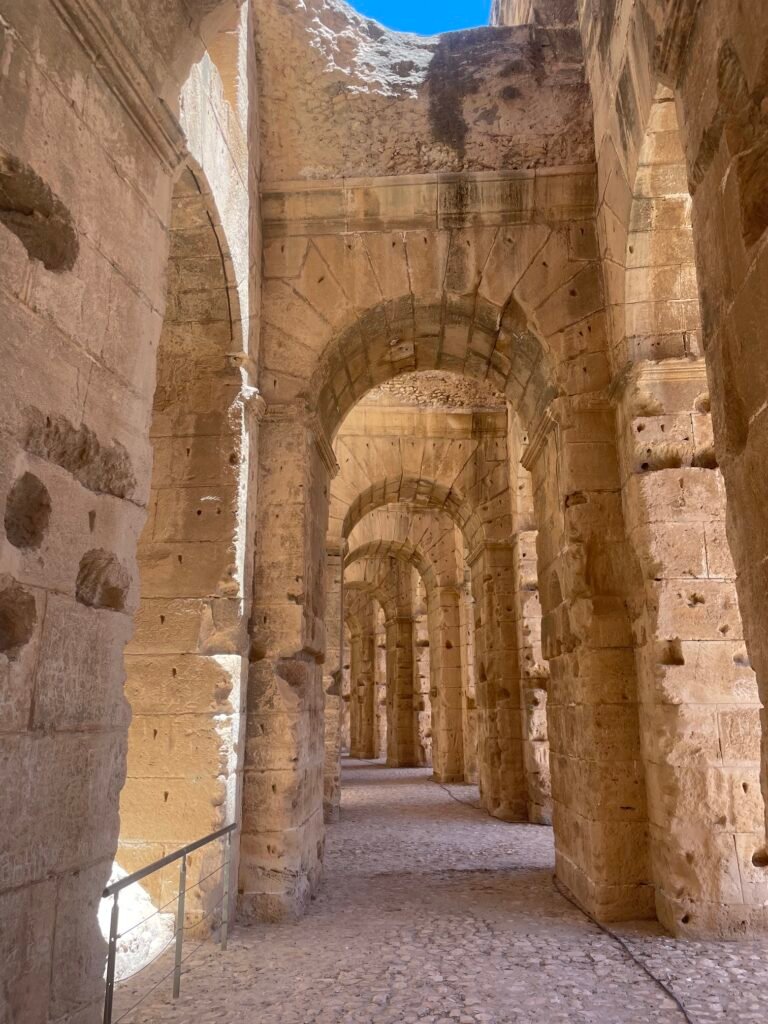
Real travel is the sudden perception of depth.
You look at a modern town and realise another city is beneath it. You look at a ruin and understand it was not built as a ruin. You look at Tunisia and realise how absurdly underrated it is as a Roman country.
This land was not peripheral. It was rich. Grain, olive oil, cities, theatres, baths, amphitheatres, ports, roads, villas, trade. Carthage, Dougga, Utica, Thuburbo Majus, Uthina, El Jem.
The map of ancient North Africa is not empty.
It is crowded with lost significance.
Tunisia is full of these half-visible depths.
The country rewards people who look beyond the obvious.
That is the kind of thought I travel for.
And it needs silence.
Not absolute silence. I do not mean the absence of sound. Tunisia is not quiet, and I would not want it to be. I like the noise of cafés, the call of streets, the comedy of transport, the mild chaos of railway boards, the bargaining over taxis, the cigarette smoke, the scooters, the men talking too loudly, the waiters pretending not to notice you, the small dramas of ordinary life.
That is atmosphere.
What I object to is not noise.
It is claim.
There is a difference between a city being alive around you and a stranger repeatedly trying to recruit you into his agenda.
A train station is alive. A café is alive. A market is alive. A louage station is alive. Sousse is alive. Tunis is alive. Mahdia is alive. El Jem is alive in the strange way that a place can be half modern town and half buried empire.
But the street hustler does not merely add to the life of the place.
He redirects yours.
That is why the irritation can seem disproportionate if described badly.
Someone at home might say, “What is the problem? Just say no.”
And yes, that is the technical answer.
Say no. Keep walking. Do not answer the opening question. Do not stop. Do not explain. Do not negotiate unless you have chosen to negotiate. Do not let “Where are you from?” become the first step in a sales funnel.
But the deeper answer is that travel depends on voluntary attention.
The best moments of a trip are chosen.
You choose the café.
You choose the walk.
You choose the ruin.
You choose the conversation.
You choose to step into the Protestant church and sit among the graves.
You choose to stand beneath the shadow of a cathedral built for a vanished community.
You choose to sit at the top of El Jem.
You choose to look at the sea.
You choose to get on a train, even when the timetable is less obvious than it should be.
You choose to change the route when the original route no longer fits the reality of the trip.
My Tunisia plan changed because Tunisia itself corrected it.
The first version was more ambitious: Tunis, Monastir, Sfax, Gabès, perhaps further south, perhaps a grander line across the map.
But travel is not a spreadsheet.
A route can be logical and still wrong.
Once I was there, the trip began to reveal its proper shape: Tunis, Sousse, Mahdia, El Jem, Sidi Bou Said. Less heroic, perhaps. Better. More coherent. More coastal. More historical. More atmospheric. More in tune with what I actually value.
That is a good travel lesson.
Do not defend the itinerary against the country.
Let the place speak.
Tunisia spoke in fragments.
A restaurant bill that began too high and came down when challenged.
A taxi price that started at thirty dinars, then twenty-five, then twenty.
A man in the street with a story that eventually became a request.
A railway board photographed because the internet could not be trusted.
A town like Mahdia, where the sea and the old stones did more for the spirit than another box ticked on a map.
A message from a host before arrival, transforming a hotel with zero reviews from a possible phantom into a real human arrangement.
The old French and Italian city of Tunis, still carrying the outline of a vanished European Mediterranean world.
Two cathedrals that showed how even confident communities can become historical layers.
A Protestant cemetery garden where Danish and Swedish names lay quietly beneath North African light.
An amphitheatre in El Jem that made modern assumptions look temporary.
And all through it, the same lesson kept returning.
Freedom is not only movement.
Freedom is also the right to decide what enters your mind.
I used to think of travel mostly in terms of money, logistics, time, risk and reward. What does the hotel cost? How much is the taxi? Is the train running? Is the area safe? Is the food good? Is the route efficient? How many nights should I stay? What is the best base?
Those things matter.
But they are not the core.
The real currency of travel is attention.
Spend it badly and even a cheap country becomes expensive.
Spend it well and a simple day becomes memorable.
That is why a quiet coffee can be worth more than a famous attraction. Why a walk by the sea can outlast a guided tour in memory. Why a churchyard can restore you more than a bar. Why a ruin at the right hour can do more than five items from a tourist list. Why the old French and Italian city of Tunis may linger longer in the mind than a sight that guidebooks insist is more important.
The travel industry sells movement, accommodation, meals, excursions and experiences.
But the traveller is really buying conditions for attention.
A good hotel gives you rest, so your attention is clean the next day.
A good café gives you a place to observe without being processed.
A good walk lets the mind stretch.
A good churchyard gives silence a physical form.
A good ruin gives attention somewhere worthy to land.
A good conversation expands the day rather than hijacking it.
A good destination does not merely entertain you. It gives your attention back to you in better condition than it found it.
That is why low-level hassle is so corrosive. It may not be dangerous. It may not even be dishonest in every case. Often it is just local economic theatre: poorer country meets richer foreigner, and each side knows the game to some extent.
But repetition changes everything.
The first approach is human.
The second is recognisable.
The next one feels like a pattern.
And the experienced traveller learns to protect himself without becoming closed.
That is the balance.
I do not want to become the man who ignores everyone. Some of the best travel moments come from saying yes when there was no plan to say yes. Lives cross. Moments are made. Places are explored. A stranger can become a story. A conversation can change a day. A host can turn a booking into a welcome. A woman in a café can alter the temperature of an evening. A waiter, a driver, a shopkeeper, a fellow passenger — any of them can become part of the trip.
But not everyone gets access.
That is the line.
Travel requires openness, but not availability.
Curiosity, but not gullibility.
Warmth, but not compliance.
The right to wander includes the right not to be recruited.
So the lesson from Tunisia is not “avoid people.”
That would be a dead way to travel.
The lesson is sharper.
Choose your openings.
Do not let every outstretched hand, every “my friend,” every “where are you from,” every invented guide, every restaurant recommendation, every taxi whisper, every little claim from the edge of the street determine the shape of your inner life.
There is no need to be dramatic.
No lecture.
No anger.
No explanation.
Just a small refusal and forward motion.
“No, merci.”
“La, merci.”
“Not today.”
Keep walking.
Attention preserved.
Trip restored.
Because the best of Tunisia was worth attention.
The energy I remembered from 2010 deserved it.
The old French and Italian streets of Tunis deserved it.
The Roman dead deserved it.
The sea at Mahdia deserved it.
The medina walls deserved it.
The railway stations deserved it.
The cafés deserved it.
The two cathedrals deserved it.
The Protestant cemetery garden deserved it.
The strange sight of El Jem rising from ordinary life deserved it.
The feeling of changing the plan because reality had spoken deserved it.
Even the irritation deserved it, in the end, because it clarified something I already knew but had not yet expressed so cleanly:
The hidden tourist tax is not always money.
Sometimes it is attention.
And once I understood that, Tunisia made more sense.
The country had not failed me. It had taught me another rule.
Move freely.
Look properly.
Spend attention only where it compounds.
Everything else is noise.
Leave a Reply