I awoke early, determined to enjoy a full rain-free day for once, and took the first train available. It was late — no surprise, given the flooding — and I was the only passenger boarding at that particular station. That suited me. Trains are better when they’re half-empty, running slightly off schedule, moving through a landscape that has already started its day without you.
The journey fitted my travel instinct perfectly. Closed stations slipped past, now converted into houses where platforms still exist but purpose has drained away. I recognised stretches of line where I’d walked before, and others where I suspected the ground nearby would hold small, forgotten things — places worth returning to, should I ever get time to reconnoitre this route properly. Travel like this isn’t about arrival. It’s about observation and accumulation.
Next, there was a walk by the sea. Wind off the water, the familiar rhythm of scanning, listening, pacing. Metal detecting is never just about finding things. It’s a discipline of attention. Most days you come back with nothing more than distance covered and salt on your jacket. Occasionally, the ground answers.
This time it did — quietly.
What turned up was the remains of a forged silver coin. Late eighteenth century. French in origin, from a period when bad money was common enough that imitation became an industry. At a glance, it would once have passed. That was the point. A thin skin of silver over a copper core, made deliberately, not accidentally. This wasn’t decay masquerading as fraud; it was fraud, designed to circulate.
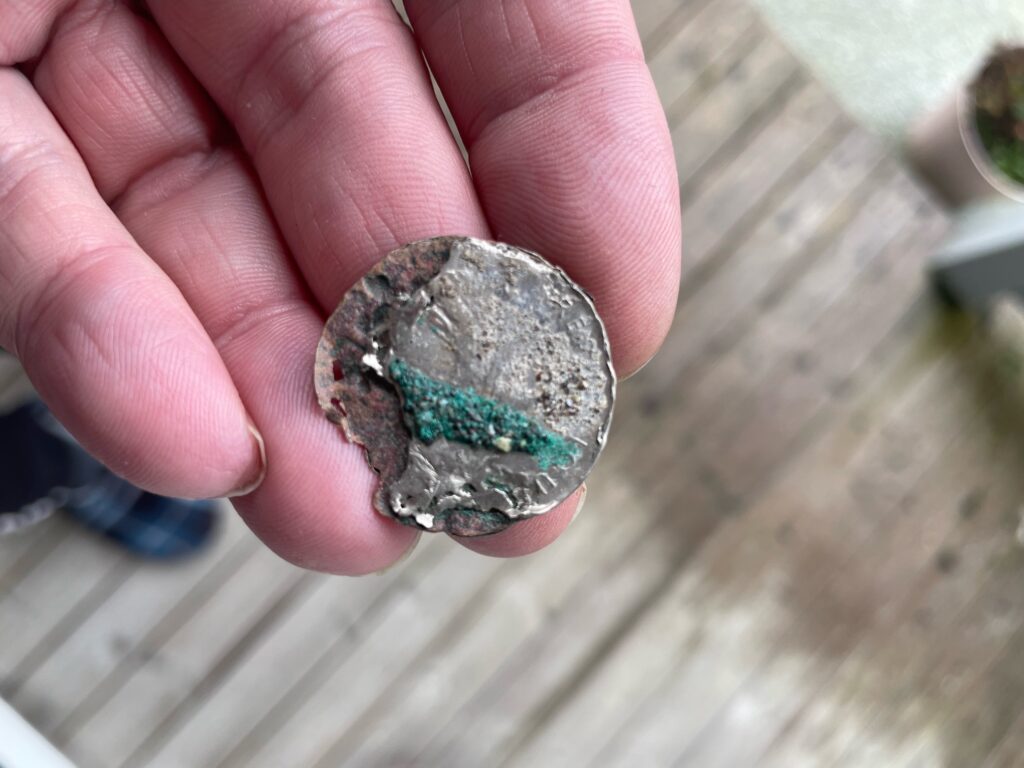
The timing matters. The later 1700s were a poor period for trust in money. War finance, repeated debasements, uneven minting, and collapsing confidence created the perfect conditions for forgery. Coins like this didn’t need to endure. They needed to move — quickly — from hand to hand, before anyone stopped to weigh them or listen too closely.
Time and saltwater eventually did what markets often don’t. The thin coating failed. The copper showed. The deception stopped working.
These pieces rarely survive. When discovered, they were pulled from circulation, melted down, or discarded — and the forgers themselves often paid far more dearly. The penalties ranged from execution to transportation to remote colonies. Official forgers, it turns out, have never been fond of unofficial competition.
The sea is one of the few places that keeps such things without judgement. Even in this condition, the forgery may have value. Counterfeit always does, once it has crossed fully into history.
That’s fine with me. It goes straight into my collection.
I like how the day brought several long-running interests together without effort: travel, movement, a walk by the water, history underfoot, and the mechanics of money stripped back to their simplest form. Silver, but only just. Trust doing the work authority failed to do.
The day ended in a Georgian pub, which felt entirely appropriate. Same century. Same worn surfaces. Different transaction.
Instead of a copper halfpenny, the ale cost seven euros.
Leave a Reply