A record of storms survived and horizons still calling

Category: Sound Money

Alan Whicker Filmed my Two Futures

YouTube knows what it is doing.

I had recently been writing about China, overnight trains and the life that movement had made possible. Alongside those travel posts sat another piece born in Shanghai: Gresham’s Law of Courting, clarifying the dating and relationship world I grew up in.

Then the algorithm reached into the past and returned two old films by Alan Whicker. One connected directly to the trains. The other connected so precisely to Gresham’s Law that it might have been waiting there for me since before I was born.

The first was Whicker’s World: Aboard the Orient Express, filmed in May 1982 on the newly revived service from London Victoria to Venice.

I remembered it.

Not perfectly. I remembered the feeling of it.

My father liked Alan Whicker and I watched him too. Whicker was old-fashionedly pleasant: immaculate, conversational and interested. He could enter somebody else’s world without becoming subordinate to it. People wanted to talk to him. They frequently told him far more than they intended.

The Orient Express film came from a Britain which no longer exists. The passengers are white. So are the train staff, the porters and the audience gathered at Victoria to watch the departure. Porters carry luggage through the station. Passengers settle into restored carriages as the journey from London, across the Channel to Boulogne and onward to Venice, prepares to begin. That journey no longer leaves Victoria. The British leg has gone and the train now begins in Paris. Back then, continental Europe is not reached by airport security, retail corridors and a plastic seat at 35,000 feet. It begins at a railway terminus in London.

The whole thing seemed impossibly exotic when I was young. Sleeping on a train. Dressing for dinner. Crossing countries during the night and waking somewhere with another language outside the window. It belonged to Whicker’s world, not mine.

Then YouTube returned it to me at 55 and I realised that I had become the man who does it.

Not in a dinner jacket on the Orient Express, but on overnight trains through Europe and Asia, travelling towards cities whose names once sounded impossibly distant. The luxury was incidental. The movement was the thing. A railway carriage at night, a border crossed while sleeping, and another place waiting in the morning.

A small part of my father must have understood the attraction. He had once considered joining the Merchant Navy. Instead, he met a woman worth surrendering that possibility for. He married her, built a family and spent much of his life improving the house in which that family lived. His journey became a fixed construction. The horizon was converted into a home.

I tried to make the same exchange.

I did not avoid households, marriage or fatherhood in favour of travel. I constructed several and produced five children. I invested much of my adult life in precisely the bargain my father had made. I believed in it strongly enough to keep allocating years, work, money and loyalty to it.

Those constructions did not hold. Much of the capital had already been spent by the time I accepted that. What remained—time, money, movement and authorship—was placed elsewhere. The life my father considered and relinquished became open to me only after I had spent decades attempting his alternative.

That was the first recognition YouTube gave me.

Then it offered another Alan Whicker film.

The Starter Culture

Swingles Inc. was broadcast on 16 June 1969, more than two years before I was born.

Whicker presents America’s unmarried young adults as a curious new economic force: millions of people with earnings, freedom and few apologies for being single. He visits the Catskills, where men and women gather at a resort to meet one another. He examines a computer dating bureau. He talks to women who intend to work, enjoy themselves and postpone marriage. He talks to men who are beginning to calculate their value differently.

He thinks he has found an unusual American subculture.

What he has actually found is a starter culture.

It sits there in one corner of America like bacteria in a dish, apparently localised and faintly amusing. But the entire new sexual economy is already present: female earnings, contraception, hook-ups and casual sex outside marriage, abortion as the backstop when contraception fails, mobility, weakened supervision, computer records, commercial intermediaries and a growing population whose lives no longer pass directly from the parental home into marriage.

Sexual access is being separated from courtship, childbirth and permanent settlement. This culture will not coexist harmlessly with marriage. It will consume the scarcity, restraint and consequence on which marriage depended.

Once those conditions spread, the culture will convert everything around it into more of itself.

Whicker does not know that. The people he interviews do not know it. They believe they are describing a new American lifestyle.

They are describing the next sixty years.

Before I Was Born

That article owns the full currency argument. What Swingles Inc. added was the date.

I had written about a boy born in 1971, the year the United States closed the gold window. Whicker showed me that the sexual currency was already circulating two years before the boy arrived. The unmarried were a recognised consumer class. Businesses were courting them. Women were deferring marriage. Men were recalculating their value. A computer bureau was storing their preferences and reusing the data for matches, cocktail parties and further events.

I was born after the new system had begun, then taught the rules of the previous one.

Tinder did not invent this market. Smartphones did not invent it. The internet increased its reach, speed and opacity, but the operating system was already running in 1969.

The Catskills weekend was Tinder with physical friction. The participants had to travel, dress, enter a room, dance and speak to one another. Their reputations still existed in a recognisable social world. Opportunities were limited by geography and time. Even the women presented as daringly modern in Whicker’s film likely accumulated fewer partners over years than many women on dating apps now accumulate in months.

The printing press was working. It had not yet been automated.

The Man Who Understood

One man in the film sees further than the others.

He appears to be British, in his thirties, and explains with cheerful simplicity that as he gets older he makes more money. The money increases his appeal and seems to attract younger women.

He laughs.

In 1969 he has already identified the male counterstrategy.

Men and women do not carry the same assets through time. Women begin adulthood holding youth, fertility and sexual desirability. Men commonly begin with little status, limited resources and no demonstrated capability. The woman’s valuable asset is present early and depreciates. The man’s must be constructed and may appreciate for decades.

The old settlement joined those different curves. A woman selected a man whose capability could support a family. A man selected a woman whose youth, fertility, vitality, restraint and character made her worth building that family with.

Once marriage could be delayed, the consequences of delay were not equal.

Whicker remarks upon the glances of women over 25 searching for a man, and men over 30 searching for a woman. The age thresholds sound astonishing now, but they reveal a society which still understood the different clocks. A woman over 25 was consuming reproductive time. A man over 30 was expected to have completed enough economic construction to support a household.

Her urgency came from biology. His clock was different, but his urge to find a woman was not merely convention.

Most men want to find a worthwhile woman in whom they can invest, who will bear their children and give direction to the work of succeeding. The male reproductive window may remain open much longer, but the desire to build, provide, protect and pass something forward is not a social decoration. It is one of the forces which turns male capability into a household and a future.

The market can frustrate that drive without abolishing it. When the probability of finding a worthwhile woman falls while the cost and liability of choosing badly rise, the real-life game offers less reward because effort and outcome are no longer reliably connected. Some men redirect the same competitive and constructive energy into activities where the rules are visible, progress must be earned, competence produces results and the ledger cannot pretend that everybody paid the same price.

Even video games have become more rewarding because the real one has abandoned the fairness of hard currency.

The modern dating market has inverted the presentation without changing the underlying facts. Women in their thirties and forties place “would like children” on profiles as though it were a durable lifestyle preference. The same interface permits them to dismiss men for frivolous reasons, including men for whom fatherhood remains biologically possible. Meanwhile, they fail to realise how much the cheap issuance in earlier years has really cost them.

They have issued away their most valuable asset: youth, fertility and sexual desirability at their peak. What was once scarce has been spent cheaply, and the bill arrives when they seek a settlement after the asset has begun to depreciate.

The boxes are identical. The clocks are not.

The Englishman at the Catskills has already realised this. If his productive value continues to rise and attracts younger women, time is not forcing him towards the same settlement at the same moment. He can continue accumulating and transact later with a younger entrant.

He thinks he has noticed a pleasant personal advantage.

He has articulated one of the governing asymmetries of the future dating market.

The Database Is the Business

The computer dating bureau may be the most extraordinary part of the film.

This is 1969. Personal details and preferences are being entered into a computer so that men and women can be selected for one another. But the bureau already understands that the database has uses beyond a single introduction. The same people and information can be organised into cocktail parties and other events.

The data is the asset.

Acquire unattached people. Record their characteristics. Sort the inventory. Manufacture encounters. Keep the participants circulating.

The contradiction inside modern dating platforms is already present. A permanent successful match removes two customers. Continued searching preserves the inventory. The intermediary earns from circulation, not settlement.

The resort understood the same market physically. Gather single people in one place, sell them accommodation and entertainment, and offer the possibility of romantic success. Their unmarried state is no longer merely an absence awaiting correction. It is a commercial category.

What makes the film historic is that the new machinery is already operating while the old expectation of eventual marriage remains visible. Whicker has caught the two systems occupying the same room.

Two Futures

Alan Whicker’s manner makes the evidence unusually clean.

He does not arrive to condemn the singles or to celebrate them. He is polite, curious and faintly perplexed. He allows people to disclose the system in their own words. The women describe optionality. The men describe delayed male value. The businesses describe the commercial power of the unmarried. The computer promises more efficient selection.

Whicker thinks he is recording a novelty.

He is standing at the source.

YouTube placed two of his films beside one another for me. The first showed me a future I eventually entered. The second showed me a future which had already begun before I was born.

On the Orient Express, I saw the overnight journeys which once appeared impossible and later became part of my life. In the Catskills, I saw the relationship market into which I would be born two years later: the warnings already present, the currency already circulating, the databases already filling and one perceptive man already explaining why time increases rather than destroys his options.

My father saw a worthwhile woman and exchanged the horizon for a home.

I attempted the same exchange several times. Eventually I withdrew with what remained and recovered the horizon. I will find more Orient Expresses and take the exotic journeys I dreamt about as a child, and the only baggage I carry will be my own.

Whicker saw an American curiosity.

The participants saw opportunity.

The businesses saw a market.

None of them could yet see the world it would reproduce.

But there it is, fully alive in 1969, waiting to spread.
One Billion Euros a Day

I watched the European Union discuss its trade deficit with China. Then I went to Yantai Port and saw the answer.

This morning, before leaving my hotel in Yantai, I watched Euronews discussing the latest round of trade talks between China and the European Union.

The central figure was almost too large to absorb.

In 2025, the European Union imported €559.4 billion of goods from China and exported €199.6 billion in return. The deficit was €359.8 billion.

Almost one billion euros a day.

Okay, before I go further, it disgusts me to conflate the word Europe, a geographic entity, a continent and European Union, an ailing, sickly political entity. From now, the rest of this story will clearly refer to the EU, excluding other European countries like the UK, that have essential destroyed their manufacturing and productivity in a similar way.

Where I would praise my historic homeland is that there’s still some kind of structural belief dating back to the Victorian era, in free trade. I see the EU putting up desperate barriers everywhere, to the extent that even receiving a parcel in Ireland from outside the EU now attracts at least 2 fees, possibly more, depending on how many items you dare to order. The audacity of anyone who doesn’t just buy it from Amazon. I digress. Back to what was on the TV.

The discussion was about what China might concede, what the EU might restrict and how the relationship could be “rebalanced”. There was talk of subsidies, market access and unfair competition. All of these may form part of the calculation.

But nobody appeared willing to ask the more dangerous question.

What has the EU done to its own ability to produce?

The Cost of Making Things

the EU has spent years making reliable energy expensive.

Germany closed its last nuclear power stations. Coal was burdened before dependable replacements were ready. Cheap Russian gas disappeared. Taxes, carbon costs, regulation and political indecision accumulated on top of one another. The result is not theoretical. The International Energy Agency estimates that electricity for energy-intensive industry in the European Union cost more than 50 per cent more than in China in 2025.

Then the EU expresses surprise when energy-intensive production moves elsewhere.

China is not sentimental about the energy required to run a civilisation. It burns coal, builds nuclear power stations, dams rivers, covers enormous areas with solar panels and erects wind turbines at scale. The energy source may change. The governing principle does not.

The power must exist.

The EU increasingly treats energy as a moral performance. China treats it as an industrial input.

The same difference appears in labour.

The EU has made work expensive and non-participation viable. It pays people to be useless, sometimes for generations.

At the same time, it imports large numbers of people from dubious countries without regard to intelligence, usefulness or cultural fit. Many become useless drains on the society that admitted them, consuming more in welfare, housing, healthcare, policing and public services than they produce in tax or useful work. That is not labour supply. It is parasitic immigration.

The EU taxes the productive economy twice: first to support non-contribution, and again to absorb the damage produced by bad selection.

Several Chinese people I spoke to were genuinely baffled by this.

“Why are you doing this?” they asked. “We would never accept it.”

They were not presenting an elaborate political theory. They simply could not understand why a civilisation would penalise the industries and people that sustain it while subsidising those who do not.

It is a fair question.

At Yantai Port

Then I switched off the television and went to the port.

The answer was waiting there in steel.

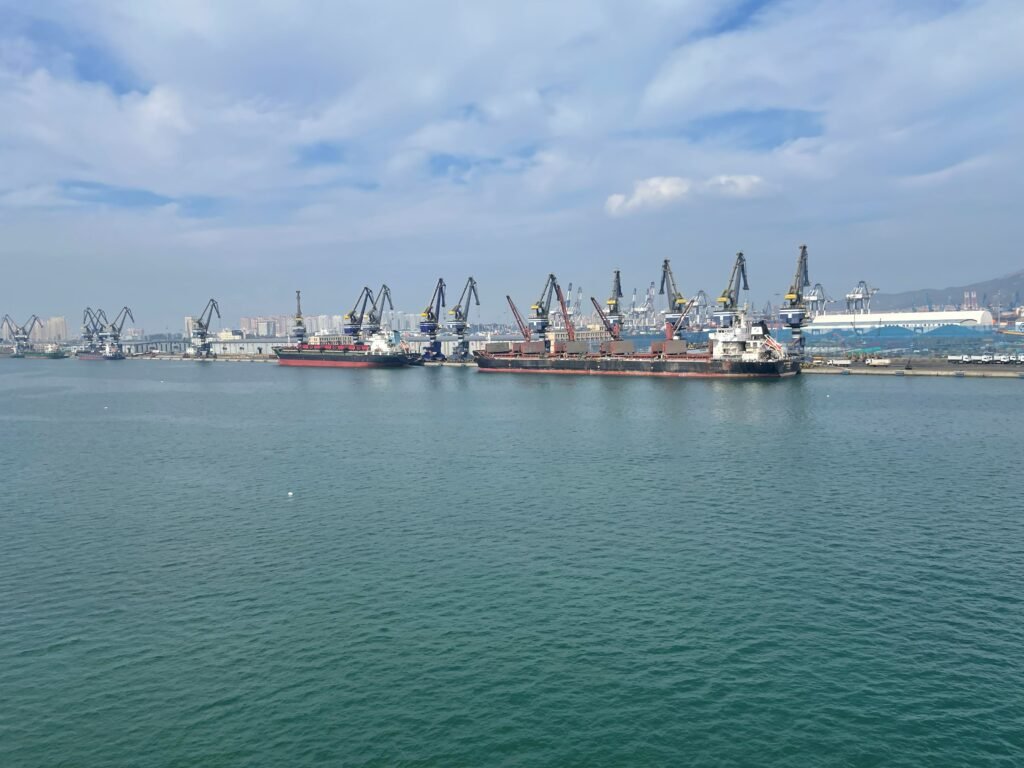
Yantai Port was full of ships: cargo vessels, ferries and working craft of every size. Cranes moved above them. Goods were being loaded, passengers processed and routes maintained across the Bohai Sea and beyond.

This was commerce. Not commerce as a paragraph in an EU communiqué. Not commerce as a political slogan. Goods, machinery, labour and capital were physically moving.

Yet the great ships were only half the scene. Along the water were smaller oyster and shellfish beds, tended by ordinary people operating at an entirely different scale.

The port contained both ends of a functioning economy: immense industrial capacity and small productive enterprise sharing the same stretch of water.

The sea was not scenery. It was working.

A Cabin to Dalian

My own place in this machinery was a first-class private cabin on the ferry to Dalian.

It was clean, comfortable and mine for the six-hour crossing. I could close the door, lie down and sleep while the ship carried me across the water. The equivalent in the EU would either not exist or would be priced at a level I would refuse to pay.

China is not frictionless. The procedures can be opaque. The ticketing can be peculiar. Translation can become an expedition of its own. The efficiency is not always polished.

But it works.

When a practical problem appears, somebody usually tries to solve it. The passenger is moved, the cargo is loaded and the ship leaves. The Chinese system can be clumsy at the edges and formidable at the centre.

The EU has become increasingly skilled at the opposite: polished presentation surrounding declining capacity.

The Wrong Negotiation

China certainly supports its industries. It protects parts of its market, directs credit, builds infrastructure and uses the power of the state to advance national production. The EU may reasonably respond to those things.

But they are not the whole explanation.

A subsidy cannot load a ship. A tariff cannot manufacture competence. Political protection cannot substitute indefinitely for abundant energy, trained labour, functioning ports, industrial scale and a culture which still expects systems to produce a result.

The EU wants China to buy more of their goods while steadily making their goods harder and more expensive to produce. It wants Chinese prices without Chinese scale, Chinese infrastructure or Chinese seriousness. It wants the output while rejecting many of the inputs.

So the officials fly to Beijing and ask China to rebalance the result.

The imbalance was also made in the EU.

Tariffs may slow the ships. Regulations may obstruct their cargo. Trade negotiations may purchase time. None of them will make energy cheaper, rebuild a closed factory or turn subsidised non-participation into productive work.

By evening, this ferry will reach Dalian. Six hours across the water, with a private cabin in which I can sleep. Beyond the port waits the Russian and Japanese history of the city. Behind me, Yantai will continue loading ships and tending shellfish beds.

Brussels will continue talking about China.

The real question is not why China sells so much to the EU. It is why the EU chose to make itself so expensive, so administratively heavy and so tolerant of non-contribution that buying from China became the rational decision.

The deficit is not merely something China did to the EU.

It is the invoice the EU writes to itself one billion Euros at a time.

Gresham’s Law of Courting

I. Shanghai

Shanghai is a city of commerce without apology.

Money is made, exchanged, counted and reinvested. The towers, banks, shopping streets and endless movement of goods carry the same message: this is a city that understands trade.

It has also quietly emerged as the world’s biggest physical gold exchange.

Walking through Shanghai, a principle from monetary history kept returning to me.

Gresham’s Law.

Bad money drives out good.

Under a gold standard, take two instruments, each denominated at one pound: a paper banknote and a gold sovereign. The sovereign contains the gold. The banknote promises its equivalent. The denomination is the same. The backing is not.

When both must be accepted at the same nominal value, the doubtful banknote is spent and the sovereign retained. The paper circulates. The gold goes into reserve. Its owner understands the difference between a pound printed on a promise and a pound settled in gold.

Shanghai gives that distinction physical form. Paper claims move across screens while gold is weighed, tested, bought and stored. One can be created by extending a balance sheet. The other must be acquired.

I was born in 1971, the year the United States closed the gold window. The dollar’s remaining convertibility into gold was suspended. The suspension was called temporary. It became the new order.

I later entered the relationship market believing men and women still exchanged hard currencies. Restraint and exclusivity would meet loyalty and commitment. I would build my reserves. The woman would preserve hers. Both would bring something scarce to the settlement.

I had little capital and little success. I worked, built a career, accumulated money, bought a house and established a company. Female interest increased. The timing was the evidence.

My personality had not suddenly appeared. What had changed was the backing.

I had become hard currency.

Meanwhile, women had been issuing another currency. Sexual access circulated without the commitment I was still accumulating the means to provide. Other men received it on terms never offered to me.

I remained on the old standard while the new currency circulated elsewhere.

One market. Two instruments. Different exchange rates.

II. Hard Currency

The inherited bargain rested on reciprocal scarcity.

But the starting balance sheets were different.

The man began with an empty vault. The woman began with the gold already in hers.

His task was accumulation. Hers was preservation.

The female currency was femininity, purity, sexual restraint and selectivity, with exclusivity promised at settlement. The male currency was accumulated competence, capital and stability, with courtship, loyalty, provision and permanence promised at settlement. He built the reserves he would offer. She preserved the reserves with which she entered the market. The bargain joined acquired reserves to preserved reserves.

A man spends years building his side of the settlement.

Competence requires practice. Capital requires earnings, restraint and accumulation. Stability requires decisions repeated long after their novelty has disappeared. A reputation for reliability requires a record. The house, the savings and the capacity to provide represent life already expended.

Commitment then adds a claim on life still to come.

A man who commits allocates future time, income, attention and optionality. He accepts obligations that may outlast the attraction which brought him into the arrangement. His offer is backed by both accumulated reserves and future production.

That currency is expensive to manufacture.

Demand does not cheapen that currency or create a claim upon it.

The female reserve was the scarcity and selectivity attached to sexual access. It was not manufactured through years of earnings. It was present at the beginning, and its preservation determined what remained available for the eventual settlement.

Cheap issuance did not add gold to that vault. It spent the scarcity which had given the original promise its value. More paper could circulate while less backing remained behind the denomination.

The old bargain made sense while both vaults could support the exchange. Being chosen for an exclusive settlement meant something when access had not already circulated on easier terms.

The sexual revolution broke that reciprocity.

It did not abolish the old denomination. It introduced a cheaper instrument beside it, then continued demanding settlement at the old price.

III. The Second Currency

The new currency allowed sexual issuance to multiply without a corresponding increase in reserves.

Traditional courtship had pillars: family, church, community, reputation and ceremony. Those institutions imposed friction, kept records and made issuance visible. Modern dating demolished the temple and handed every woman a private printing press. Circulation became opaque. Reserves could not be audited. The ledger became self-reported. Yet every note still arrived marked scarce, exclusive and premium-grade. Every dating profile might as well have stood between two Corinthian columns with an issuing clerk behind the desk.

Hookups, casual sex and situationships allowed sexual access to circulate without courtship, exclusivity or a credible future. Contraception and abortion weakened the connection between sex and childbirth. Feminism recast restraint as repression and judgement as illegitimate, reducing the reputational cost of issuance.

Digital platforms widened the market. Anonymous foreign holidays removed the local ledger: no shared social circle, no lasting reputation and a departure date built into the transaction. A woman could issue freely abroad, return to the man whose commitment remained in place and seal the foreign episode inside a separate compartment. He continued pricing the relationship without knowing a second ledger even existed.

What had required a substantial commitment could be issued for immediate desire.

But increased supply did not mean equal access.

Women directed the new currency toward the men they desired most. Highly desired men obtained it without supplying the old backing. They did not need to offer a house, provision, patient courtship or marriage to receive what other men were still accumulating commitment to obtain.

Men outside that flow continued accumulating. They worked, established themselves and prepared for a relationship market whose advertised terms still required serious commitment.

They encountered scarcity while supply expanded elsewhere.

This was the central asymmetry. The same market could be liquid for one class of men and expensive for another. The men receiving cheap issuance had little reason to buy the old bundle. The men expected to buy the old bundle had received little of the cheap issuance.

They were not the beneficiaries of the inflation.

They became its later counterparties.

The two instruments circulated inside the same market, while feminist doctrine insisted that the exchange rate had never changed.

IV. The Hidden Ledger

Choosing a bank requires more than admiring its frontage.

The building may look solid. Its name may inspire confidence. The banknote may carry a handsome promise to pay one pound. None of that establishes how much gold remains in the vault or how many paper claims have been issued against it.

The question is not whether the note looks respectable. It is whether the bank can support the settlement it promises.

The same examination belongs in the relationship market. A man who has spent years filling his own vault needs to know whether the institution offering him a note has preserved its reserves, or merely continued printing against an old reputation for solidity.

Every bank has an issuance history.

A printed denomination does not establish backing. Nor does the declaration of present exclusivity erase the terms on which access was previously offered.

The ledger records selectivity, volume, recipients and price. Who received access? What did they contribute? How readily was it offered? What is now being demanded from the man approached for permanence?

Extensive prior sexual availability reduces a woman’s long-term relationship value in the male market. The proposition is worth less because the scarcity and selectivity men value have already been reduced. Calling the history irrelevant does not restore them.

Volume matters. Terms matter. Exchange rates matter.

A man who received access through desire alone and a man later asked for resources, legal commitment and years of loyalty were offered different prices. The later offer cannot be valued by its label alone.

Present exclusivity is part of the offer. Its history is part of the valuation.

Concealment adds duplicity, but concealment does not create the dilution. The issuance has already occurred. Hiding the ledger merely prevents the next counterparty from pricing it accurately.

Nor does a higher asking price establish a higher value. A demand for permanence reveals what the issuer wants. It does not demonstrate what the buyer will receive.

The banknote says one pound.

The vault determines what that promise is worth.

Harbin branch of Bank of Communications. Built in 1928 with a magnificent frontage that would impress any would-be depositor. By 1942 it closed.

V. Slagflation

The expansion of sexual currency created a powerful arbitrage.

Women issued cheaply to men selected for immediate desire, then sought permanent settlement from other men in the old denomination: courtship, resources, protection, loyalty and marriage.

One market supplied excitement. The other supplied backing. The advantage lay in taking the benefits of both while denying that the first transaction changed the value of the second.

This is slagflation.

Slagflation is the inflation of female sexual issuance combined with continued demand for premium male settlement.

The consequence was delayed, not abolished. Issuance and settlement had simply been separated by a decade or more.

The new currency expanded while the advertised cost of male commitment remained high. Sexual access became easier to issue. The years required to build a solvent, competent and reliable man did not become easier to compress.

Women observed what other women obtained and adjusted their behaviour. What began as an individual advantage became a market norm. Feminist doctrine then supplied its moral justification: female issuance was private and irrelevant, while male resources, intentions and future commitment remained open to inspection, negotiation and judgement.

The asymmetry entered the accounting itself. One ledger was examinable. The other was supposed to be accepted unopened.

The trade cleared while men still honoured the inherited bargain.

Men continued accumulating against the inherited bargain and failed to audit the market. They assumed that the currency offered to them had been preserved under a discipline resembling their own. Their assets were real. Their understanding of the exchange rate was obsolete.

They had mistaken scarcity to themselves for scarcity in the market. The earlier price had been low. The later price was high. A generation of men had kept accumulating against terms that no longer existed.

Women had circulated paper and requested settlement in gold.

The arbitrage depended on the later man accepting the denomination without examining the issuance. Once he compared the two, the difference could no longer be hidden inside the language of commitment.

VI. The Repricing

No arbitrage survives discovery forever.

Men began comparing exchange rates. They distinguished being desired from being selected to provide. They noticed when substantial obligations were being demanded for an offer previously made without them.

Why release years of accumulated capital and a claim on future life at the historic price when the reciprocal scarcity had already been diluted?

Repricing followed.

Some men offered less courtship, less provision and less commitment. Others extended the audit, watching behaviour before releasing reserves. Some accepted casual terms while refusing permanent liabilities. Others stopped trading.

The responses differed. The effect was the same: hard currency became harder to obtain.

Feminist orthodoxy continued treating the one-pound banknote and the one-pound sovereign as though matching denominations guaranteed equal backing. Men who recognised the difference began retaining their gold rather than exchanging it for paper of uncertain redemption value.

Their competence had not disappeared. Their capital had not vanished. Their capacity for loyalty had not ceased to exist. Those reserves were withheld from transactions that failed to justify their release.

Once men withheld their half, the old reciprocal bargain could no longer circulate on demand.

Women who still wanted the old settlement called this male commitment phobia.

The market has no commitment phobia. It has a bid.

This was a valuation crisis.

The asking price remained high because women still wanted the old benefits. The bid fell because the buyer no longer accepted the old valuation. Calling him reluctant, immature or afraid of commitment did not close the spread.

Nor could additional accumulation solve it. A larger reserve does not improve the terms of a bad exchange. It merely gives the holder more to surrender.

The good money withdrew because its owners could finally see what they were being asked to buy.

VII. Into Reserve

Shanghai understands the distinction.

Paper moves quickly. Credit expands. Numbers multiply across screens. Physical gold must be weighed, tested, acquired and settled.

Its absence from ordinary circulation does not mean it has lost its value. It means its holders understand its value and refuse the offered exchange rate.

The same logic applies to accumulated male capital.

A man who has built resources, competence, stability and the capacity to commit holds assets with uses beyond the relationship market. They can finance movement, experience, independence and a life already worth living. Their value does not depend on surrendering them to someone else’s preferred settlement.

Commitment is available when the return justifies the allocation. Its mere availability creates no claim upon it.

I read the ledger. I examine the issuing bank, its reserves and its history. I distinguish a well-backed promise from a demand that my own gold should make good someone else’s paper.

When the exchange rate is false, I retain my gold.

Bad money has driven out good.

Hard currency will return when the settlement is again backed on both sides.

Five Centuries in the Palm

The beach does not give.
It keeps.

Until it doesn’t.

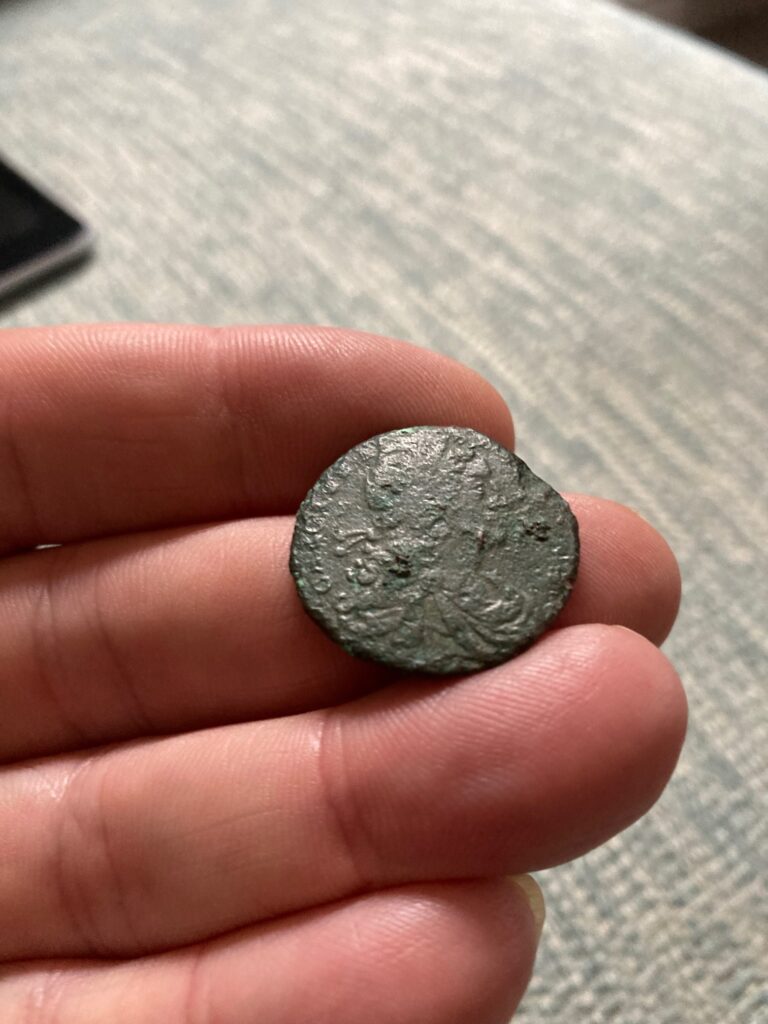
Yesterday, under a grey sky, it let five coins surface from the shingle. Five small discs. Five centuries. I walked the line of tide, sand and stone alone, detector humming low. Each signal was brief. Each recovery deliberate.

When I laid them out in my palm, they formed a quiet chronology.


Charles II of England — Seventeenth Century

Copper. Thick. Dark with age.

A halfpenny from the late 1600s. The outline of the king still there if you angle it to the light.

This coin moved in a century of upheaval and rebuilding. Markets in mud. Ale traded for labour. Ships coming and going from harbours that were older than the crowns stamped into metal.

It passed from hand to hand without commentary.

A farmer settling a small debt.
A dockworker paid at week’s end.
A woman measuring grain behind a wooden counter.

No one carrying it needed a theory of empire. They needed acceptance. A coin either worked or it didn’t.

It worked.

Until it fell. Or was dropped. Or slipped from a pocket on a windy day much like this one.


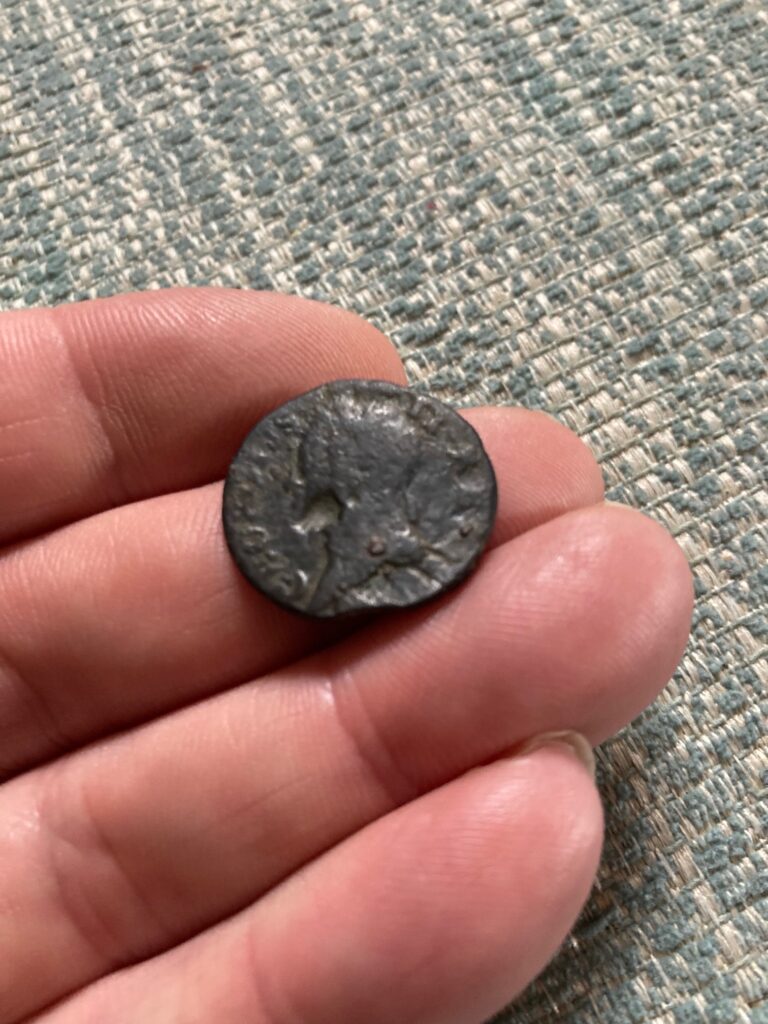
George II of Great Britain — Eighteenth Century Silver

Silver changes the mood.

A Hibernia sixpence. Smaller. Sharper. Still carrying a trace of brightness beneath the tarnish.

Silver carries intent. It stores effort in a way copper does not. It might have crossed a market table in Dublin. Paid for cloth, for passage, for tools. It might have been saved for a week before being spent.

The word Hibernia sits there — neither defiant nor submissive. Just naming.

Metal does not argue politics. It records authority at the time of minting and then submits to circulation.

This one travelled. It did not live an idle life.


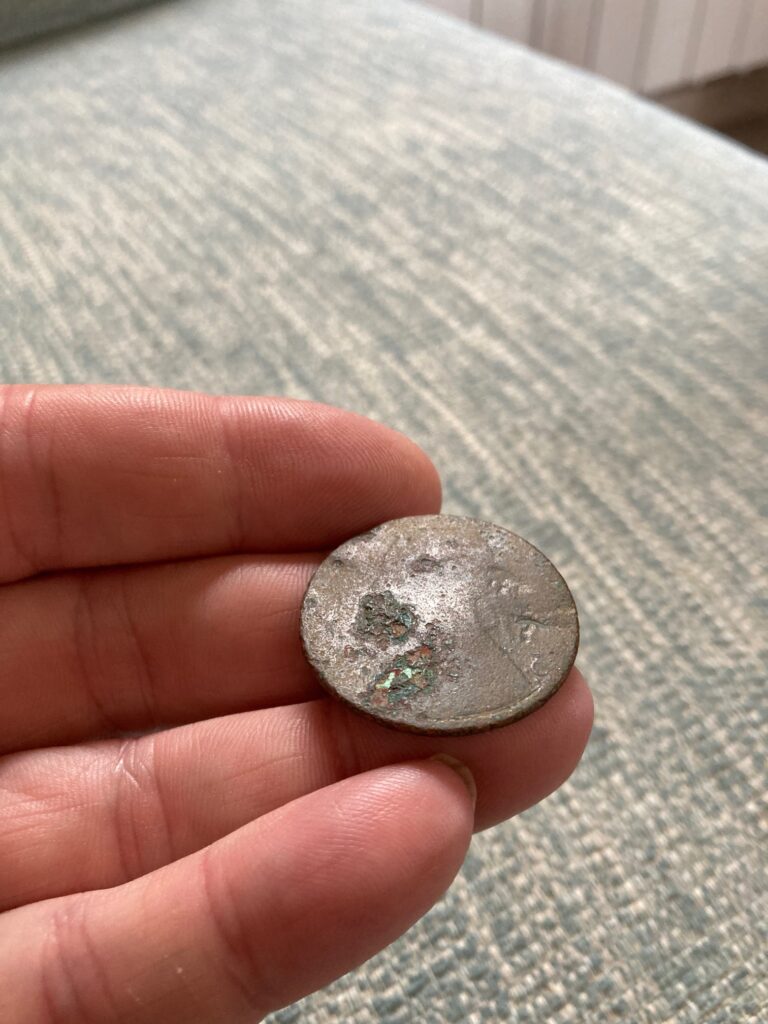
Queen Victoria — Nineteenth Century Penny

This penny is worn almost flat.

The face has softened into memory. The edges are tired.

It worked for decades.

It passed through repetition. Bread. Coal. Ferry fares. Wages broken into smaller parts. It might have travelled to Liverpool and back. It might have crossed the Atlantic in a coat pocket and returned years later in another.

The wear is the story.

You do not get that smoothness from one dramatic moment. You get it from thousands of ordinary exchanges.

History is often written in headlines.

It is lived in pennies.


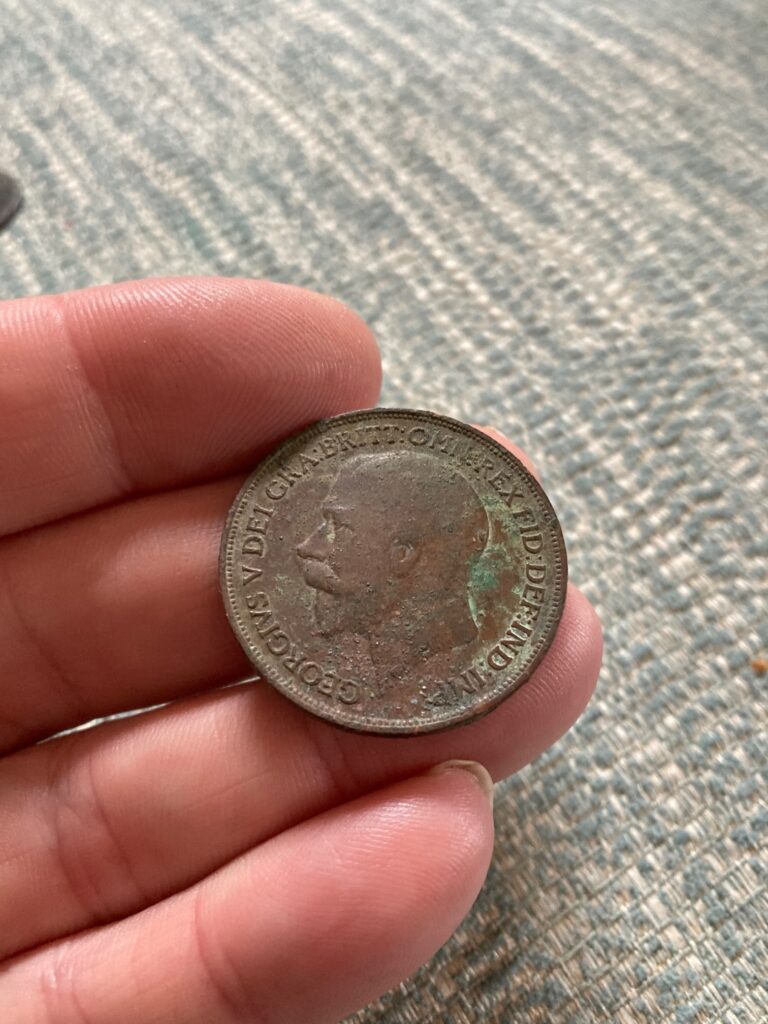
George V — Early Twentieth Century

This coin sits at a hinge in time.

Empires shifting. Lines redrawn. Arguments hardening.

Yet the metal is calm.

It would have bought newspapers carrying declarations and denials. It would have paid for a drink in rooms where loyalties were debated. It may have sat in the pocket of someone who believed the future would look different from the past.

Political reality changes in bursts.

Coins change more slowly.

The head remains until a new one is struck.


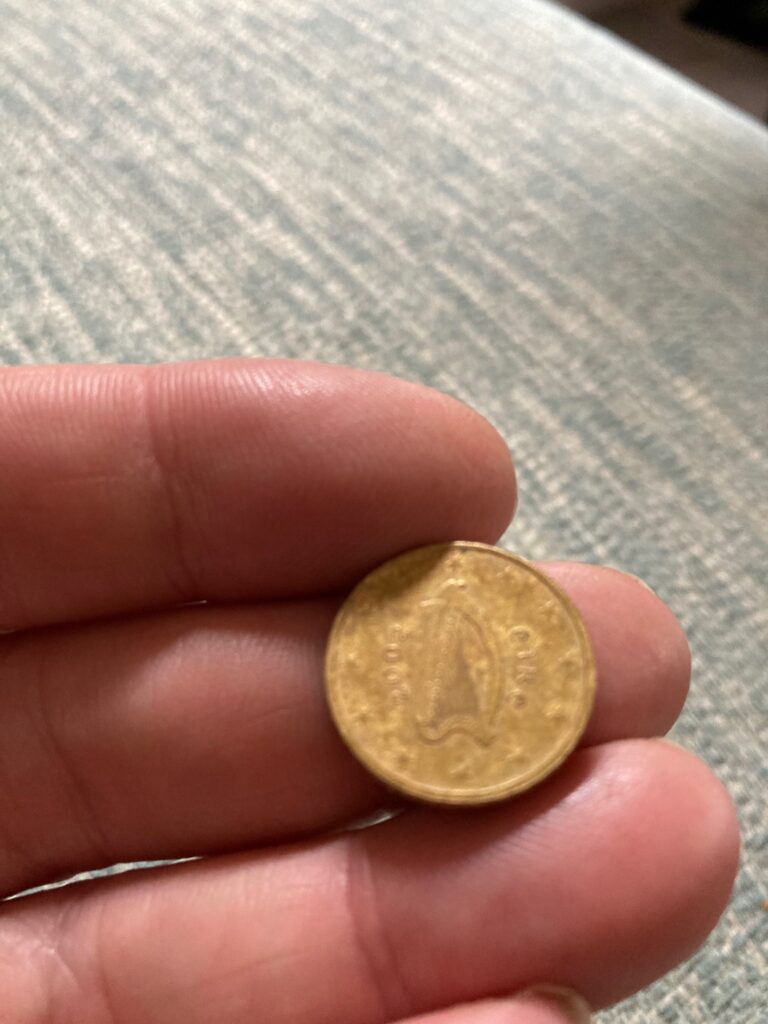
Euro — Twenty-First Century

A ten-cent piece.

Light. Exact. Identical to millions of others.

The harp stands alone now. No monarch. No crown.

For a time Ireland held its own currency again. Small. Distinct. Entirely national.

Then came another choice.

Not conquest.
Not invasion.
Alignment.

Monetary authority sits elsewhere now — in institutions beyond the shoreline. Policies shaped in distant rooms. Interest rates determined far from this stretch of shingle.

It is not empire in red coats and ships.

It is coordination. Framework. Structure.

Shared stability when things hold. Shared exposure when they don’t.

Allegedly. The Irish are the largest per capita contributors to the new empire.

The coin feels neutral in the hand. Efficient. Designed for movement across borders that once required flags and cannons.

But the structure is still there.

Every coin carries the signature of whoever sets the rules of money.


The Hands

That is what endures.

Five centuries of touch.

Farmers with soil under their nails.
Sailors smelling of tar and salt.
Women counting change at wooden counters.
Men arguing policy without ever seeing the rooms where it was made.
Children sent on errands, gripping a single coin like responsibility.

Copper.
Silver.
Bronze.
Alloy.

Crown.
Harp.
Stars in a circle.

Authority rearranges itself.

The metal changes its design.

The human exchange remains constant.

Standing there with the Irish Sea behind me, coins lined against the wind in my palm, I felt no outrage and no nostalgia.

Only continuity.

Power shifts form.
People adapt.
The beach waits.

And sometimes, after centuries, it returns what was dropped.

Bad Money Travels Well

I awoke early, determined to enjoy a full rain-free day for once, and took the first train available. It was late — no surprise, given the flooding — and I was the only passenger boarding at that particular station. That suited me. Trains are better when they’re half-empty, running slightly off schedule, moving through a landscape that has already started its day without you.

The journey fitted my travel instinct perfectly. Closed stations slipped past, now converted into houses where platforms still exist but purpose has drained away. I recognised stretches of line where I’d walked before, and others where I suspected the ground nearby would hold small, forgotten things — places worth returning to, should I ever get time to reconnoitre this route properly. Travel like this isn’t about arrival. It’s about observation and accumulation.

Next, there was a walk by the sea. Wind off the water, the familiar rhythm of scanning, listening, pacing. Metal detecting is never just about finding things. It’s a discipline of attention. Most days you come back with nothing more than distance covered and salt on your jacket. Occasionally, the ground answers.

This time it did — quietly.

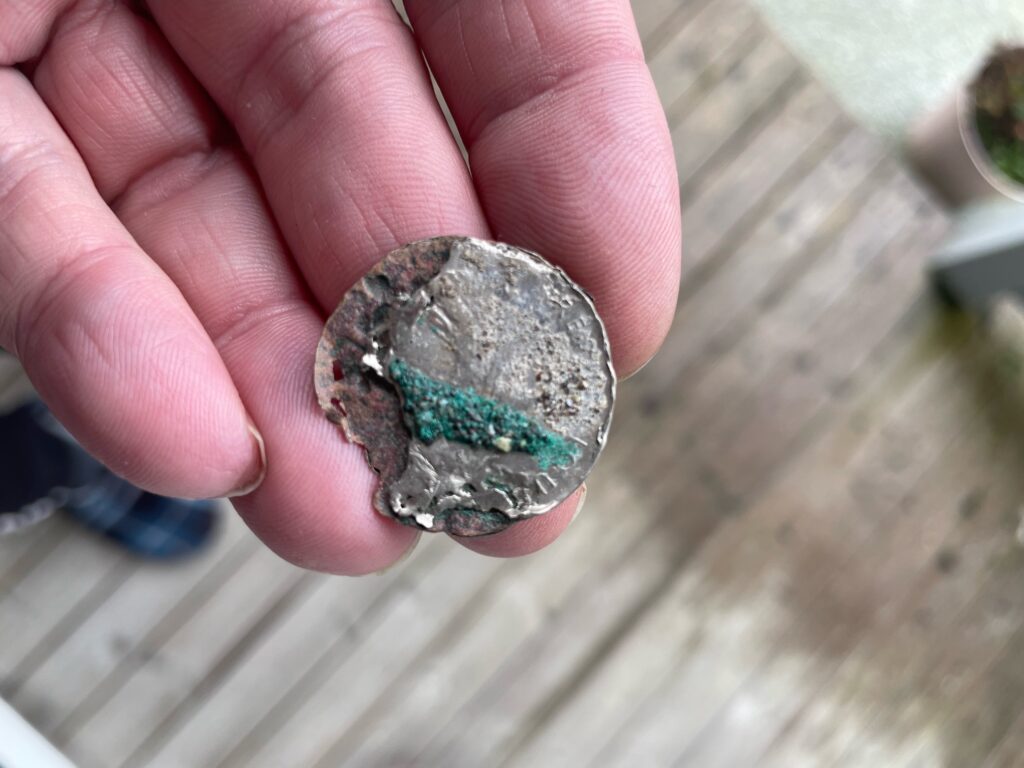
What turned up was the remains of a forged silver coin. Late eighteenth century. French in origin, from a period when bad money was common enough that imitation became an industry. At a glance, it would once have passed. That was the point. A thin skin of silver over a copper core, made deliberately, not accidentally. This wasn’t decay masquerading as fraud; it was fraud, designed to circulate.

The timing matters. The later 1700s were a poor period for trust in money. War finance, repeated debasements, uneven minting, and collapsing confidence created the perfect conditions for forgery. Coins like this didn’t need to endure. They needed to move — quickly — from hand to hand, before anyone stopped to weigh them or listen too closely.

Time and saltwater eventually did what markets often don’t. The thin coating failed. The copper showed. The deception stopped working.

These pieces rarely survive. When discovered, they were pulled from circulation, melted down, or discarded — and the forgers themselves often paid far more dearly. The penalties ranged from execution to transportation to remote colonies. Official forgers, it turns out, have never been fond of unofficial competition.

The sea is one of the few places that keeps such things without judgement. Even in this condition, the forgery may have value. Counterfeit always does, once it has crossed fully into history.

That’s fine with me. It goes straight into my collection.

I like how the day brought several long-running interests together without effort: travel, movement, a walk by the water, history underfoot, and the mechanics of money stripped back to their simplest form. Silver, but only just. Trust doing the work authority failed to do.

The day ended in a Georgian pub, which felt entirely appropriate. Same century. Same worn surfaces. Different transaction.

Instead of a copper halfpenny, the ale cost seven euros.

Hawick — An Unexpected Day of Financial and Economic History

It was simply a family day out, prompted by nothing more than curiosity — and a shared sense that we were being drawn somewhere specific. None of us had been to Hawick (pronounced Hoick) before. There was no inherited story, no prior familiarity, no practical reason to choose it over anywhere else. Except perhaps the Tweed, both the river and the fabric. And yet the pull was unmistakable.

From the moment we arrived, that instinct made sense. Hawick is rich in Georgian and Victorian architecture — serious, functional buildings that speak to confidence, permanence, and an era when towns were constructed around purpose rather than appearance. This was not a place that had grown accidentally or decoratively. It had been built to last.

What revealed itself over the course of the day was not nostalgia or heritage tourism, but something more precise: the physical remains of a town that once sat squarely inside Britain’s productive and financial system. Textile mills, commercial streets, river infrastructure, banks, clubs — all still legible if you know what to look for.

Hawick was not peripheral by accident. It was connected because it produced. Capital, labour, goods, and credit moved through it with enough volume to justify national integration. Today, much of that system has thinned or gone, but the evidence remains embedded in stone, layout, and institutional residue.

Part of that story is what no longer exists. Hawick was once a mainline railway stop, linking Edinburgh and Glasgow south through England to London. That level of connectivity does not arrive by sentiment or policy — it follows volume, output, and economic justification. The line is gone now. Not dramatically removed, just rendered unnecessary. As production declined and capital withdrew, infrastructure followed. The loss of the railway was not the cause of Hawick’s change, but a confirmation of it.

This post records what can still be read in the landscape: a small town that explains, in physical form, how money once worked — and what changed when production ceased to anchor it.


Scottish Banknotes and the Survival of Issuing Power

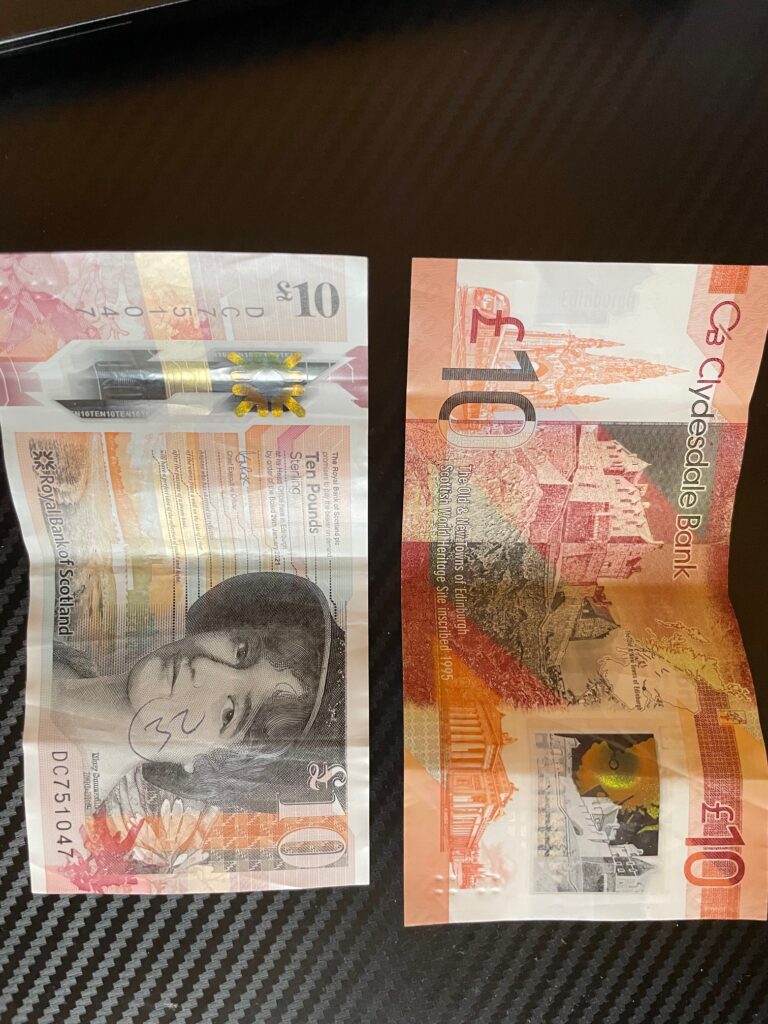
The notes are not issued by the British state. They are issued by private banks.

Scotland remains one of the few places in the developed world where commercial banks still issue their own currency — a legacy arrangement that survived political union and centralisation. Different banks issue different notes, all denominated in sterling, all circulating as money.

Whether this privilege was explicitly negotiated at the Union of 1707 or merely tolerated as a practical necessity is still debated. What is not debated is the outcome: Scotland retained a degree of monetary autonomy that England did not extend elsewhere.

Each note is today backed one-for-one by Bank of England reserves, yet the issuing identity remains private. That distinction matters. It reflects a time when money emerged from institutions embedded in trade, reputation, and locality — not exclusively from the state.

Seen together, the notes are not curiosities. They are surviving fragments of an older monetary settlement: loose, constrained, but not accidental.


Frugality Institutionalised: The Savings Bank Model

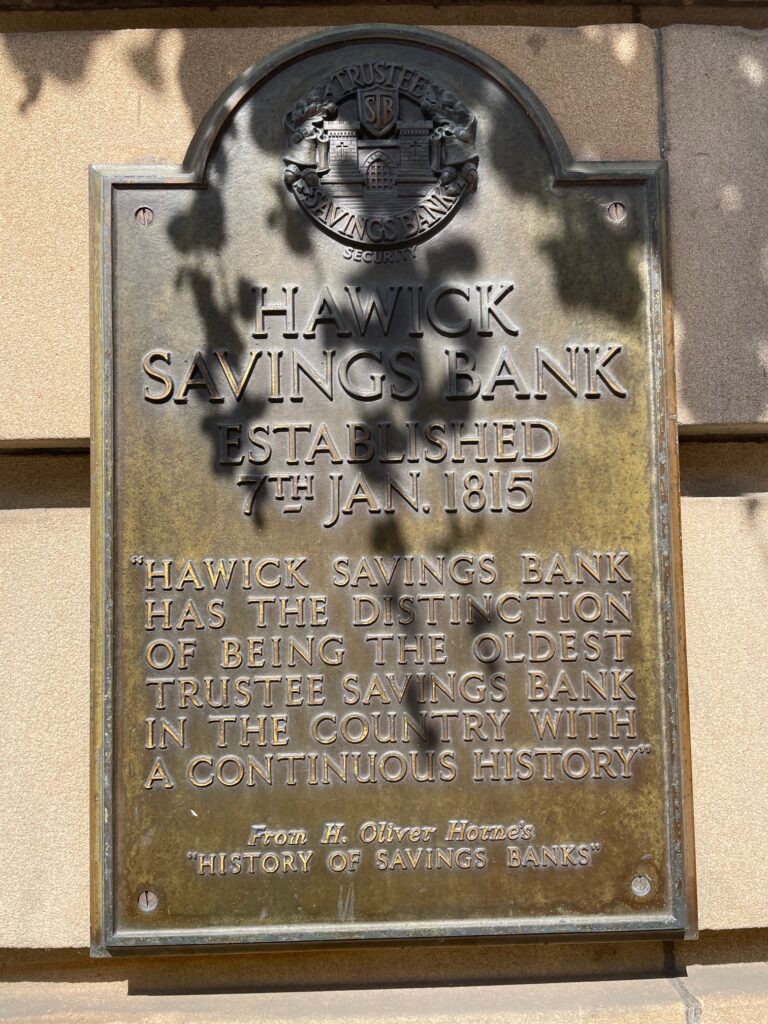
Hawick Savings Bank, established in 1815, was not a commercial bank in the modern sense. It was a trustee savings bank — part of an early movement to formalise thrift, restraint, and deferred consumption among working people.

This was not about growth. It was about preservation.

In an industrial town with cyclical income and narrow margins, security depended on behaviour. Savings banks assumed that capital should be accumulated slowly, custody mattered more than yield, and trust was local and personal.

The language carved into the stone is revealing: trustee, security, continuous history. These are not modern financial slogans. They describe a system designed to endure rather than impress.

Hawick produced surplus. Surplus required safekeeping. Safekeeping demanded credibility. The savings bank completed that loop.


Banking After Hours: When Cash Was Physical

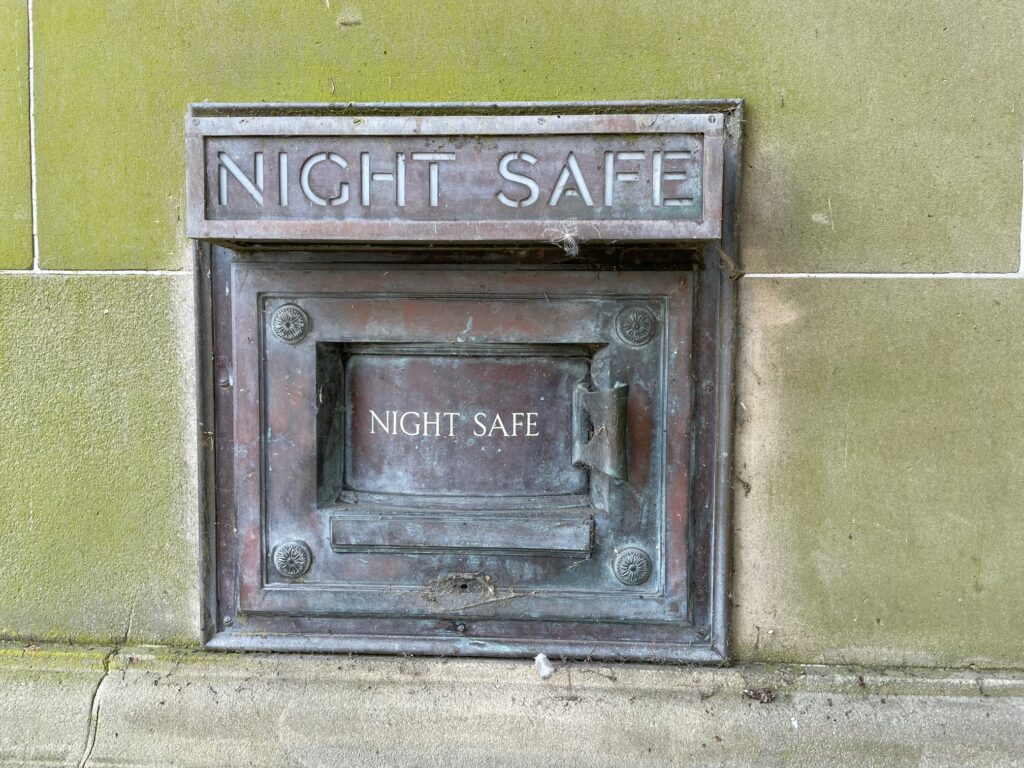
The night safe is easy to miss, but it tells you exactly how money once moved.

Before electronic settlement, takings were physical. Cash accumulated during the day had to be secured immediately. Businesses deposited after closing. Banks collected later. Risk was managed mechanically, not abstractly.

The design assumes distrust, not convenience. Heavy construction. One-way entry. No street-side access.

This was a world where money was earned, counted, deposited, and reconciled. Responsibility sat with the individual and the institution, not with “the system.”


The ATM Hut: Automation as a Holding Pattern

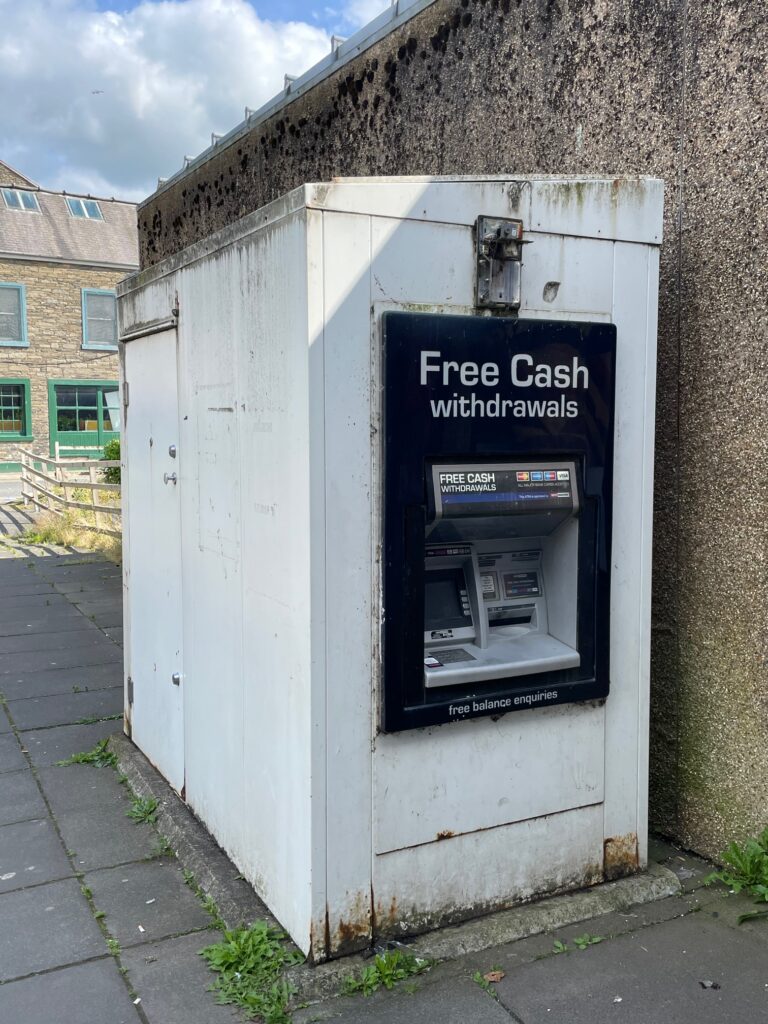
The ATM hut belongs to a different era.

Where the night safe assumed custody, the ATM assumed access. Banking shifted from deposit to withdrawal, from relationship to convenience, from staff to machines.

For decades, this infrastructure spread everywhere. And now it is quietly retreating.

The hut remains not because it is valued, but because removal costs more than neglect. It is a transitional artefact — neither enduring like the savings bank nor central like earlier banking institutions.

Built for convenience, not discipline, it was never meant to last.


From Local Industry to Imperial Circulation

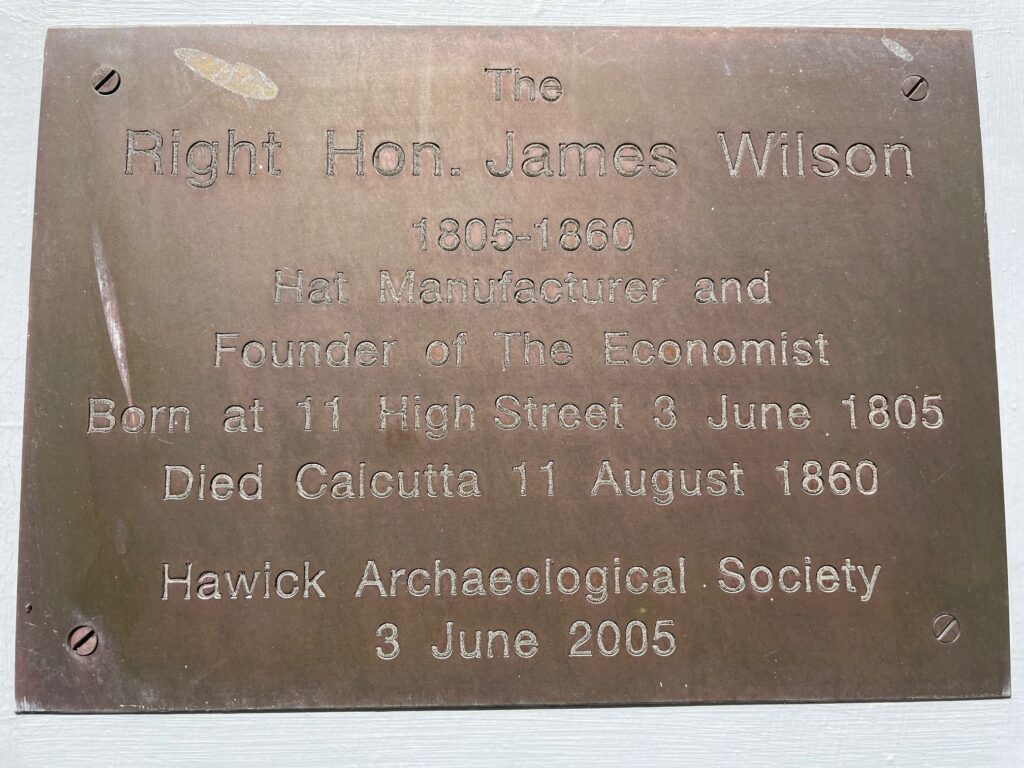
James Wilson was born in Hawick and died in Calcutta.

A manufacturer first, a publisher later, his trajectory mirrors Britain’s nineteenth-century expansion. Local production created surplus. Surplus demanded wider markets. Wider markets required predictable rules, currency stability, and commentary to bind them together.

Calcutta was not a romantic outpost. It was a financial hub — where imperial trade, taxation, and administration converged.

Hawick was not peripheral to empire. It was one of its starting points.


The Club, the Ale, and the Imperial Mindset

The day ended in a former Conservative Club, now a Wetherspoons, with a solid local ale.

These clubs were not leisure spaces. They were institutional rooms where trade, politics, and empire were discussed practically — as logistics rather than ideology.

Markets. Shipping. Currency. Risk.

Empire was not a theory. It was an operating system.


Border Reivers: Movement Under Pressure

The Borders were never stable territory. They were pressure zones — politically weak, economically exposed, repeatedly raided.

The Border Reivers were not romantic outlaws. They were an economic response.

When authority overstepped or failed and agriculture could not sustain life, people reorganised around mobility, kinship, and force. Independence was not ideological. It was practical.

My own ancestors were part of that world.

That matters because the instinct to move when conditions deteriorate is not new. It appears repeatedly in border populations, trading families, and merchant cultures. When systems stop working, people leave.

Sometimes by choice.
Sometimes by force.


When People Leave, They’re Voting

Hawick’s population loss is not sudden, but it is decisive. Over time, enough people reached the same conclusion: the town no longer sat at the centre of opportunity.

Other places grew. Hawick thinned.

That is not cultural drift. It is economic sorting.

People stay while systems reward effort. They leave when the future becomes narrower than the past. The decision is rarely ideological and almost never announced. It is executed quietly, family by family, job by job.

Depopulation is not failure. It is judgement.

And it always arrives after the systems that once justified staying have already gone.


Closing

Hawick explains something modern finance and planning repeatedly misunderstand.

Money once followed production. Savings followed discipline. Movement followed pressure. When those relationships weakened, people adapted — first locally, then geographically. Infrastructure did not fail first; it followed capital and people out.

There is now periodic talk of relinking Hawick to Edinburgh by rail. If it happens, it will likely bring commuters. Property demand may rise. The town may become better connected once again.

But commuters are not the same as local productivity.

A commuter economy imports income and exports time. It does not recreate mills, workshops, or locally anchored capital. It changes the function of a town without restoring its purpose.

Hawick has already lived through the difference between being connected because it produces and being connected because it is accessible. Those are not interchangeable states.

The buildings remain.
The systems do not.
What survives is not nostalgia, but evidence.

© 2026 The Dunwiddie Post

Theme by Anders Norén — Up ↑