Last year, in Malaysia, a Chinese fortune teller informed me with the calm certainty of a man announcing tomorrow’s weather that a visit to China formed an essential part of my future.
Prophecy is generally improved by practical assistance. In 2026, a direct flight began operating from Dublin to Shanghai. Soon afterwards, I discovered that British visitors no longer required a visa for a stay of up to thirty days. Fate, aviation and Chinese immigration policy had reached an unusual degree of agreement.
It would have been almost superstitious not to go.
And so I flew to Shanghai to inspect the colony.
There was, officially, no British colony of Shanghai. This is one of those statements which is accurate without being especially informative. The British merely secured a concession, dominated a great part of the trade, erected banks and clubs of imperial confidence, raced horses and conducted themselves for the better part of a century as though the distinction were a technical one.
The terminology was delicate. The masonry was not.
Along the Bund stand the great commercial temples of the old order. None is grander than the former headquarters of the Hong Kong and Shanghai Banking Corporation: a building constructed with the confidence of men who expected their accounts to outlive governments. Around it, the riverfront still carries the weight of the trade which made Shanghai one of the great cities of the world.
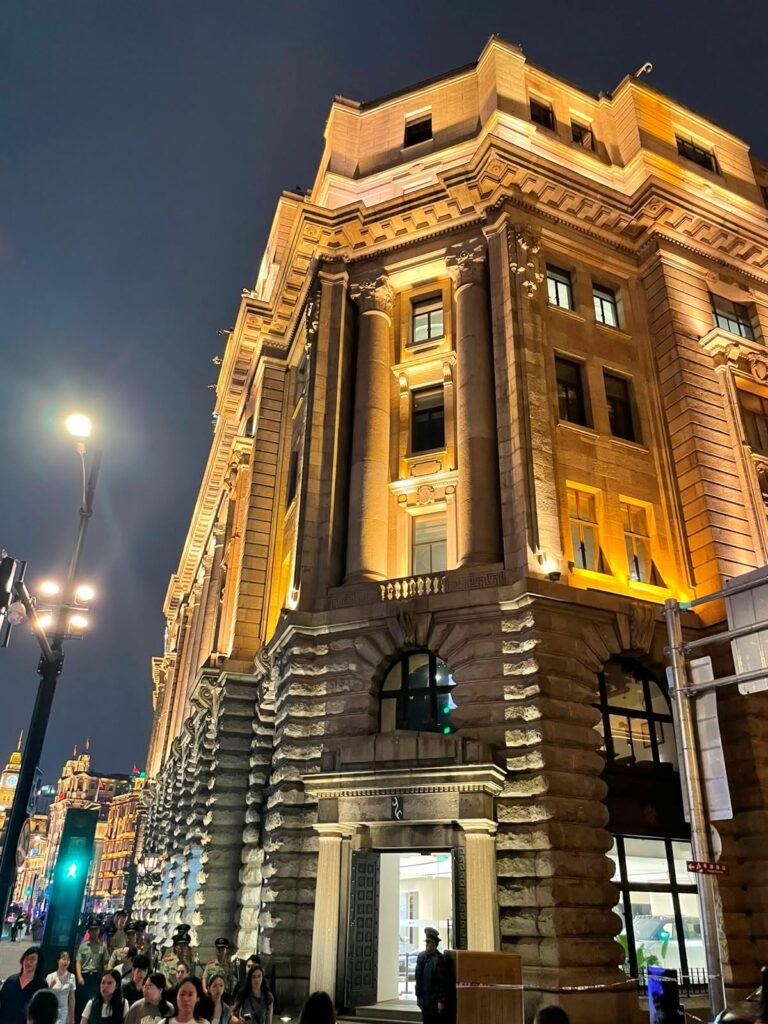
Then there was the Shanghai Race Club. What could be more British than arriving in a foreign city and deciding that what it chiefly required was horse racing?
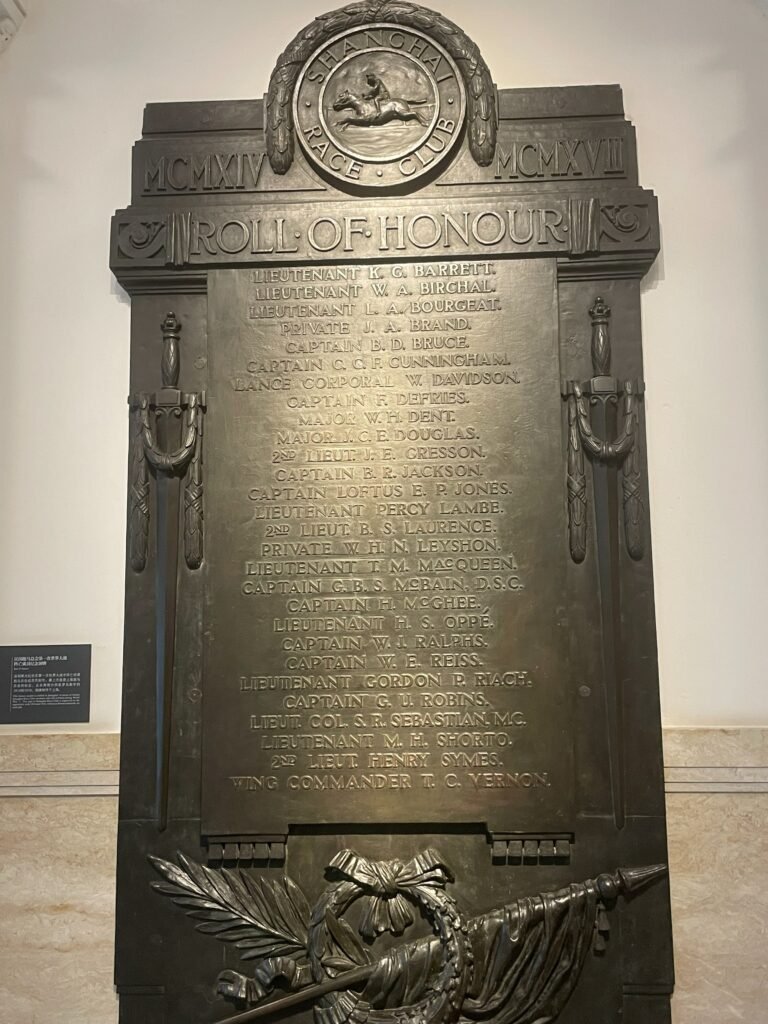
The racecourse has gone. Its great oval became People’s Square and People’s Park, while the surviving clubhouse now contains the Shanghai History Museum. The horses will trot no more. Yet inside the old building there remains a First World War memorial to twenty-eight members of the Race Club who left Shanghai to fight and did not return.
Revolution had cleared the course, changed the name and filled the grounds with the people. It had not quite managed to remove the dead.
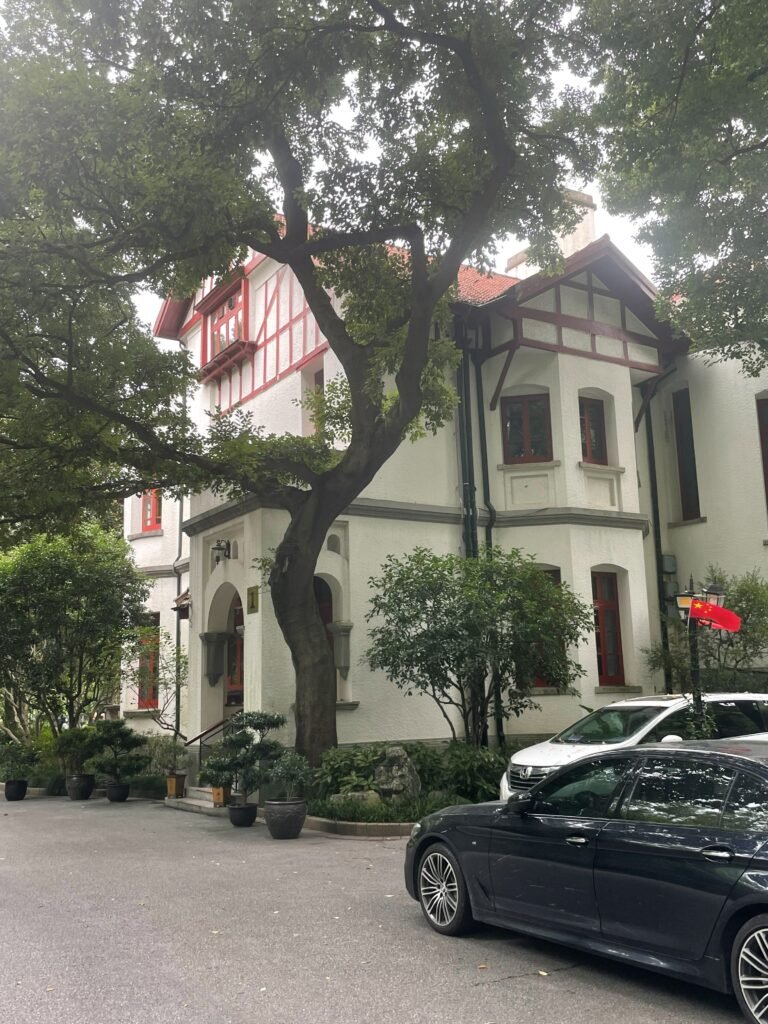
The French maintained their own concession and left behind something rather different. It is still one of the loveliest parts of Shanghai in which to walk: long avenues, old houses, guarded gardens and buildings which retain the privacy of another age. The French architecture does not announce itself with the weight of the Bund. It hides behind walls and trees and waits to be discovered.
But the European remains are not confined to the recognised historic quarters. A random walk may suddenly produce an English Victorian building, an Art Deco villa or a piece of 1930s mock Tudor which would not look entirely out of place in a suburban street in England. Shanghai contains architectural encounters which seem implausible until one is standing in front of them.
These houses carry their lost stories silently. It is easy to imagine a European family living comfortably in an Art Deco house in the early 1930s, believing that the arrangements of life were permanent. Then came the Japanese attacks, the great battle of 1937, the isolation of the foreign settlements and finally their occupation in 1941. Many foreigners fled. Others were later interned. A house which had represented confidence and continuity became a witness to how quickly both could disappear.
The buildings survived their owners. Buildings often do.
Shanghai, however, is no museum. It is alive, immense and commercially ravenous. It may yet become the financial capital of the world. It already possesses the world’s largest purely physical spot gold exchange, a distinction which naturally interested me rather more than another avenue of designer shops.
The colonial merchants would have understood the modern city perfectly. The flags have changed, the language of government has changed and the scale has become almost unimaginable. The appetite for trade remains.
Shanghai has also produced what might be called Shallowhai.
This is the Shanghai of conspicuous wealth, where possession seems incomplete until it has been placed before an audience. Perhaps this is inevitable in a country where large private fortunes are still comparatively young, and in a city built upon finance and trade. Whatever the explanation, Shanghai is filled with malls, luxury brands and immense modern temples to Huawei, Apple and Samsung. I had never seen mobile telephone shops on such a scale. They possessed the lighting, proportions and solemnity once reserved for banks and churches.
One afternoon, a man drove past me in a pink open-top Bentley with music announcing his arrival several streets in advance. He may have intended to project success. Unfortunately, he reminded me chiefly of Mr Chow in The Hangover.
The mobile telephone governs the streets. People navigate with it, pay with it, order with it, photograph themselves with it and occasionally appear to experience the physical world only after it has been converted into an image on the screen. Even by European standards, the level of absorption is extraordinary.
Some of the younger women dress as anime characters or in elaborate mutations of Victorian costume. The empire has vanished, but Victorian dress has returned in China as a fashion accessory, photographed on a Chinese telephone and uploaded through a Chinese network. History does not always come back in the form expected.
Then there is Scamhai.
On my first day, nobody hassled me. I concluded that Shanghai was a remarkably safe and orderly city. Shanghai allowed me twenty-four hours to enjoy this conclusion.
The following day, I walked towards the Bund through rain of monsoon proportions, carrying a large umbrella borrowed from the hotel. The streets were unusually quiet. There were few pedestrians and consequently very few available targets.
I was approached constantly.
During that walk I was offered an extensive catalogue of goods, services and activities, the details of which need not detain us. Several approaches ended when I told the person to leave before discovering what was being proposed. Persistence appears to increase in inverse proportion to the number of alternative victims in sight. On a crowded day, I might have passed unnoticed. In an empty street beneath a hotel umbrella, I had evidently become the market.
There was also a restaurant where I strongly suspected that a menu carrying higher European prices had appeared for my benefit. I could not prove it. I could observe that the prices bore little relation to what food had cost elsewhere. I left them to their enterprise having paid a toll and abandoned further restaurant experimentation in this city.
Scamhai is not a separate city. It inhabits the same commercial instinct as the banks and boutiques, operating at the scale of the lone foreigner. Wherever money, strangers and appetite gather in sufficient concentration, somebody establishes a secondary market in the inattentive.
The visit lasted longer than intended. It was a national holiday week, trains were difficult to obtain and Shanghai became, for several additional days, less a destination than a position from which I was temporarily unable to advance.
There are cities which improve with enforced intimacy. Shanghai is better taken at speed. Its scale is exhilarating, its surviving history remarkable and its human theatre inexhaustible, but after a time the malls repeat themselves, the telephone screens glow with the same blue light and even imperial architecture ceases to surprise.
Eventually a seat became available. At Hongqiao Station, the long white bullet train waited to carry me 1,329 kilometres north to Qingdao.
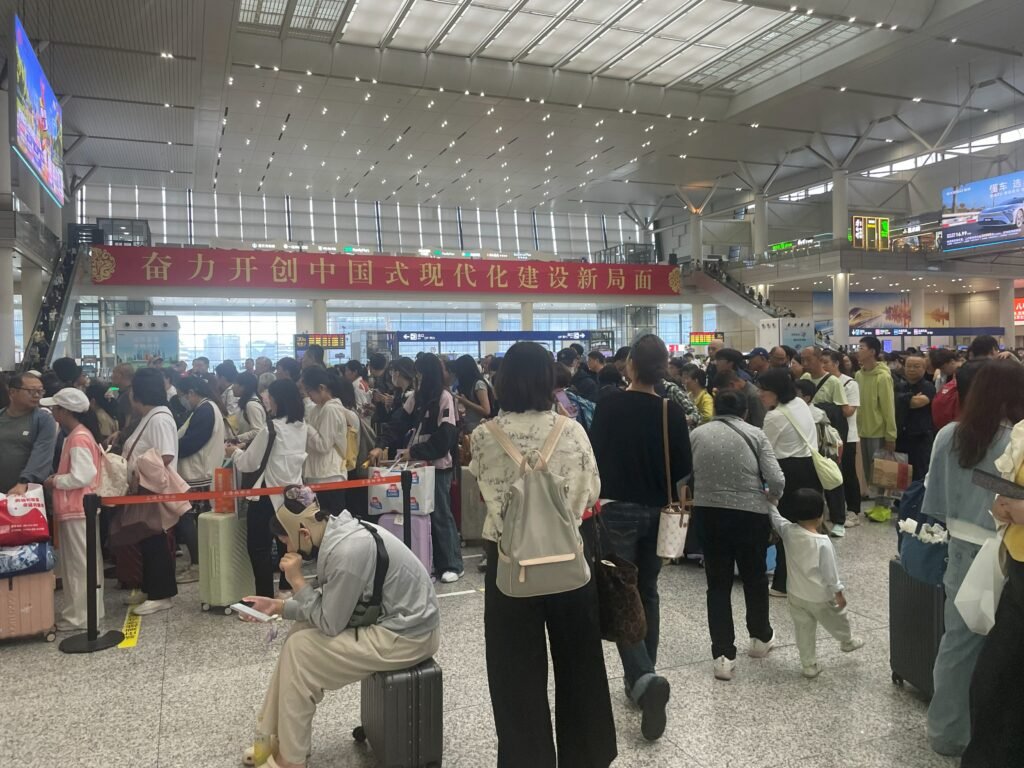
The horses would trot no more. Shanghai now had faster animals.