I went out metal detecting yesterday.
The sea had reclaimed the beach. After the recent storms, the shingle had come back in and covered the sand again, resetting the ground as if nothing had passed before. It wasn’t one of those rare, generous days like the bumper outing back in early December, but it was finally dry — and that was reason enough to go.
Everything they say about Irish weather at this time of year is true. You learn to move when the window opens.
What struck me most wasn’t the number of finds, but the number of conversations.
On an almost deserted beach, people wanted to talk. In fact, I probably spent a quarter of the trip standing still, leaning on the detector, chatting with strangers who were curious, cheerful, and entirely unguarded.
One couple had opportunistically decided to collect scallops that had been washed ashore by the tide. Another pair were searching for sea glass. They didn’t find much, but they were perfectly content — happy simply to be there, pockets light, spirits not.
Further along, on the long walk back, I met a man who stopped to ask about the detector. He turned out to be a long-time Time Team viewer and had always fancied having a go himself. That opened the door to stories — him gold prospecting in the mountains, the patience it demands, the silence, the feeling of working ground that doesn’t yield easily. Add that to the list.
He mentioned he had a four-year-old son.
That stayed with me.
It reminded me how I returned to metal detecting as an adult after a childhood moment that never quite left me — the wild excitement of finding an Edwardian penny, green with age, still carrying the authority of its era. It’s still in a tin somewhere.
My son may no longer be part of these walks. That chapter has closed. But years later, here I am again — this time finding Edwardian silver, a sixpence lifted cleanly from the Irish sand.
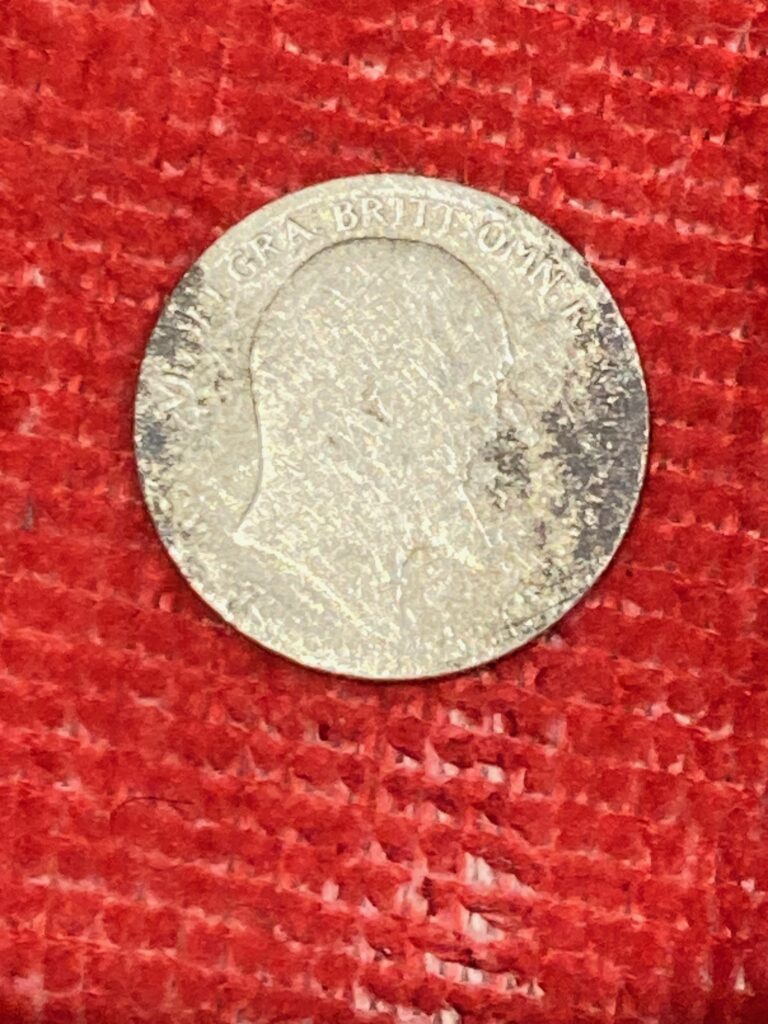
Sound Money Unearthed
Hold a coin like that and you feel something modern life rarely offers: density.
Not symbolic value. Actual weight.
The British pound sterling was once exactly that — a pound of sterling silver. This Edwardian sixpence now carries around four pounds’ worth of silver by weight alone. A figure I suspect is heading higher, given the modern appetite for silver — AI infrastructure, solar panels, electrification, and weapons all competing for the same finite metal. The beer pint index (BPI) agrees with me. This sixpence would’ve bought 3-4 pints back in 1905, now it doesn’t even buy one most places.
Fiat erodes quietly, daily, through mechanisms designed to go unnoticed. This coin has endured wars, resets, empires, and ideologies — and still holds value simply by existing.
No promises.
No counterparty.
No narrative required.
Just metal.
Sovereign Parallels
Metal detecting mirrors the nomadic path.
You move steadily. You ignore the noise. You dig where the signal rings true. Most swings yield nothing. Then, occasionally, the ground gives something back — a quiet confirmation that patience still works.
Ireland’s beaches reset every day. The tides erase tracks, cover ground, and rearrange the surface. But history persists beneath your feet, indifferent to policy cycles or opinion.
That man’s curiosity — and his young son — felt like a reminder. Cycles renew. People come and go. Systems rise and decay. But the hunt endures.
Next rain-free day, I may follow those mountain prospecting leads.
Sound assets over fiat traps.
Weight over promises.
Ground truth over abstraction.
Always.