Lüshun was somewhere I had wanted to visit for years.
I first discovered it as Port Arthur while reading about the Russo-Japanese War: a conflict almost forgotten in Britain and much of Europe, but certainly not forgotten here, in Japan or in Moscow.
The war announced the arrival of Japan as a modern great power. Much of the world expected Russia to win. Russia was a vast European empire with seemingly limitless reserves of men. Japan had emerged from feudal isolation only a few decades earlier.
Japan went for it and won.
At the centre of the struggle was one of the finest natural harbours in northern China. The Qing government had begun developing Port Arthur as a naval base in the nineteenth century. Russia leased it in 1898, expanded the harbour and fortifications, and connected it to the Chinese Eastern Railway and the wider Trans-Siberian system.
Then Japan attacked.
The siege of Port Arthur anticipated the industrial slaughter of the First World War. Trenches, concrete forts, barbed wire, machine guns, mines and heavy artillery turned hills into killing grounds. Infantrymen were repeatedly sent against positions designed to destroy them.
The figures vary, but the scale does not. The Japanese Third Army suffered about 58,000 battle casualties during the siege, while roughly 34,000 more men became sick. Russian land casualties ran above 30,000, and tens of thousands of survivors entered captivity when the fortress surrendered in January 1905.
It was victory by industrial attrition.
More than a century later, I arrived at Lüshun station and immediately knew that I had entered minor tourist territory. A man intercepted me outside and began trying to sell me a taxi tour.
I declined.
It must be getting difficult for the traditional guides. A foreign visitor can now arrive in an unfamiliar Chinese town having already used artificial intelligence to identify every site, place them in order and obtain their Chinese names. A taxi-hailing application will then summon a private driver directly to the pavement.
Mine carried me to the East Jiguanshan battlefield for 9.5 yuan.
The visitor centre had a large car park, so the place must become busy at certain times of year. On that particular day, beautifully, it was almost empty. I bought my ticket and walked uphill towards the North Fort, one of the positions around which the final destruction of the Russian defence took place.
The Chinese have done a good job of maintaining the site without polishing the life out of it. Essential work has been completed, paths made safe and several Russian guns preserved. Yet much of the fort has simply been left where the battle abandoned it, slowly ageing on the hillside.
That is as it should be.
The concrete remains pocked with bullet and shell damage. Underground passages lead into ruined chambers. The Japanese mined their way through the defences and blew open a breach before forcing an entrance. Walking through the place where they broke in, with almost nobody else present, conveyed more than another immaculate military museum ever could.
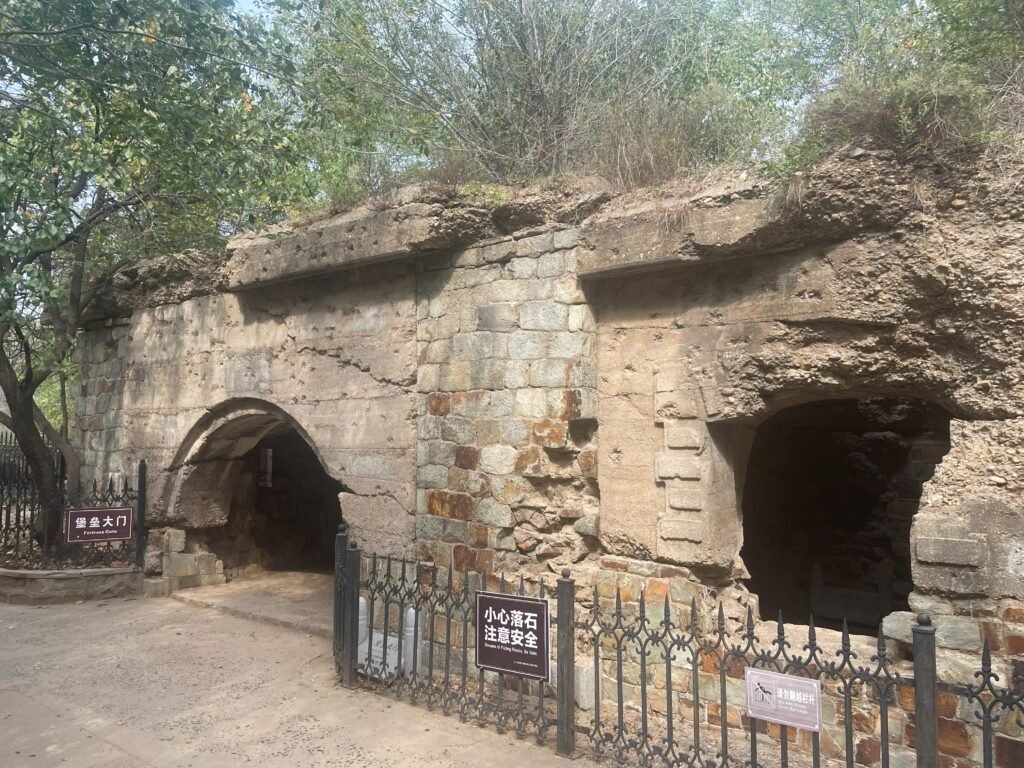
The most sombre point was the casemate where a Japanese 280-millimetre howitzer shell made a direct hit on 15 December 1904. General Roman Kondratenko, regarded as the heart of the Russian defence, was killed there with members of his staff. Port Arthur surrendered eighteen days later.
The Japanese later erected a granite monument at the place where he died.
It is still standing.
I was also surprised to find that the main Japanese war monument within the fort was still standing and appeared to be well maintained.
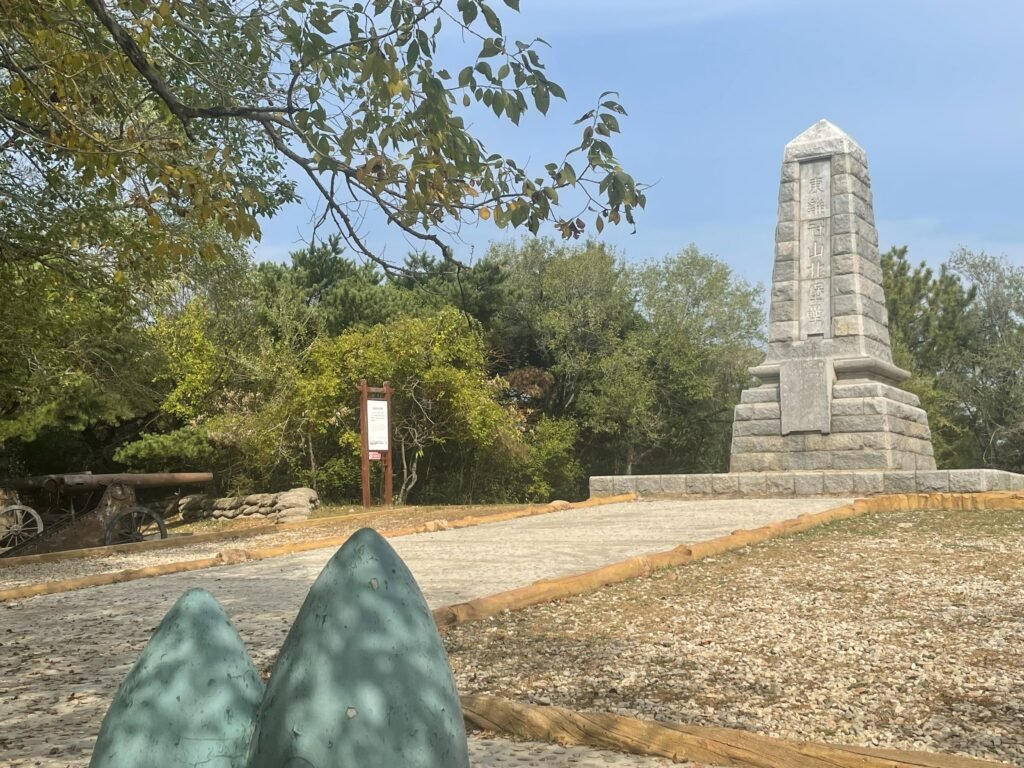
That surprised me. China and Japan do not enjoy the easiest historical relationship, and I have repeatedly noticed that Japanese buildings in China tend to meet a more brutal fate than Russian or European ones. Yet here the Chinese had retained not only the Russian fort, but the monuments erected by the Japanese victors—including their memorial to a respected Russian enemy.
Most of the time I wandered alone. I encountered one small group of Russians who had evidently come to inspect their own country’s imperial remains. They were the first white people I had seen for several days. Then they moved on and the fort became quiet again.
The sun appeared briefly. From the high ground, the military logic of the place became obvious. Russia had invested heavily in these forts because they commanded the approaches to a superb harbour. The height, the field of view and the complexity of the defensive system turned the landscape itself into a weapon.
I had intended to continue up to the Wangtai Battery. Unfortunately, an injured ankle made the climb unwise, and the courtesy buses did not appear to be operating. I therefore summoned another private driver for the princely sum of about ten yuan and continued into central Lüshun.
The ordinary streets contained another layer of the old Japanese city. Houses from the 1920s and 1930s were still being used, but not appreciated. They remained recognisable beneath later additions, neglect and decay. I did not photograph them. They were not exhibits. They were simply old buildings being consumed by ordinary life.
The grander Japanese architecture had fared better. Several Art Deco buildings remained around the centre, including former Japanese banks which had become Chinese banks. Empires departed. Banking survived.
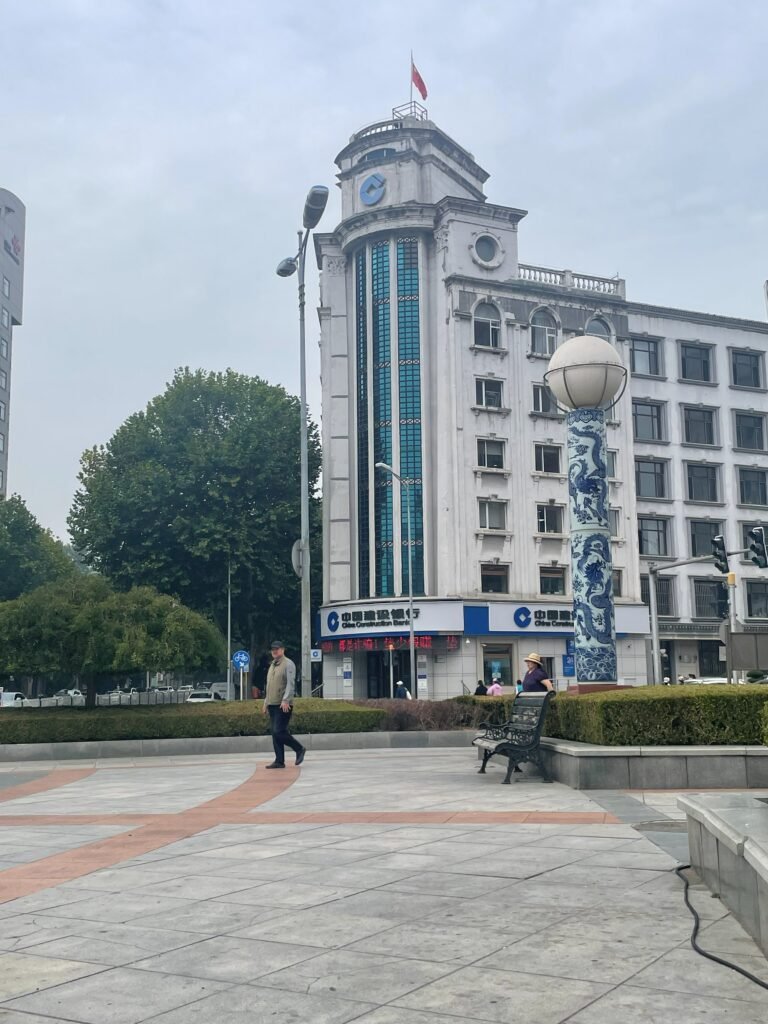
I bought some lunch and sat in the square. Two Chinese women approached and began a conversation through translation applications. One told me that she was sixty-five. Her friend appeared to be about the same age.
They asked where I was from.
Then they asked my age.
Then whether I had ever been married.
Then whether I had children.
At first I assumed that this was ordinary curiosity. By the time they asked whether I would like to marry again, I realised that I was being assessed.
Chinese marriage markets are famously direct. Years of the one-child policy concentrated the future of many families into a single son or daughter, watched by two parents and four grandparents. Public matchmaking became family business. Age, education, property, occupation and income are not treated as mysterious matters to be discovered after six months of courtship. They are market information.
The women informed me that they could find me a good Chinese woman.
Then came the decisive question.
What was my monthly income?
My God. I had been placed on the Lüshun matchmaking circuit.
It was one of the few times in my life that I had encountered women who stated the market mechanism openly instead of hiding its terms behind words such as “romance”, “love” and “security”. In this respect, China is light years ahead of the West, where men have yet to wake up to the truth.
I had learned long ago that when women began asking about a man’s income and assets, it was never a good move for the man.
By now the conversation had become hilarious because it was proceeding exactly like the Chinese marriage-market videos I had watched before the trip. The only sensible course was to destroy my own valuation before somebody produced a suitable candidate.
I explained that five children had been expensive. So had the divorce. I had also just quit my job.
“Oh. What a shame.”
Their interest evaporated. Fortunately, I had finished my lunch. We smiled, I thanked them for the conversation, and I left the market with my freedom intact.
There was one more imperial monument to inspect.
Another private driver carried me up Baiyu Mountain to the great Japanese tower overlooking the harbour. Originally called the Tower in Honour of Loyalty, it was completed in 1909 to commemorate the Japanese dead of the siege.
It is an extraordinary imperial structure: 66.8 metres of stone, concrete, columns and calculated vertical power. Like so many imperial monuments, it reaches backwards into the architectural language of Greece and Rome while proclaiming the arrival of something aggressively modern.
The official explanation is that the tower resembles a memorial candle, with its pointed summit modelled on a 280-millimetre howitzer shell. Perhaps. The distinctly phallic alternative hardly requires a trained eye. Victorious empires do not normally choose their vertical symbols by accident.
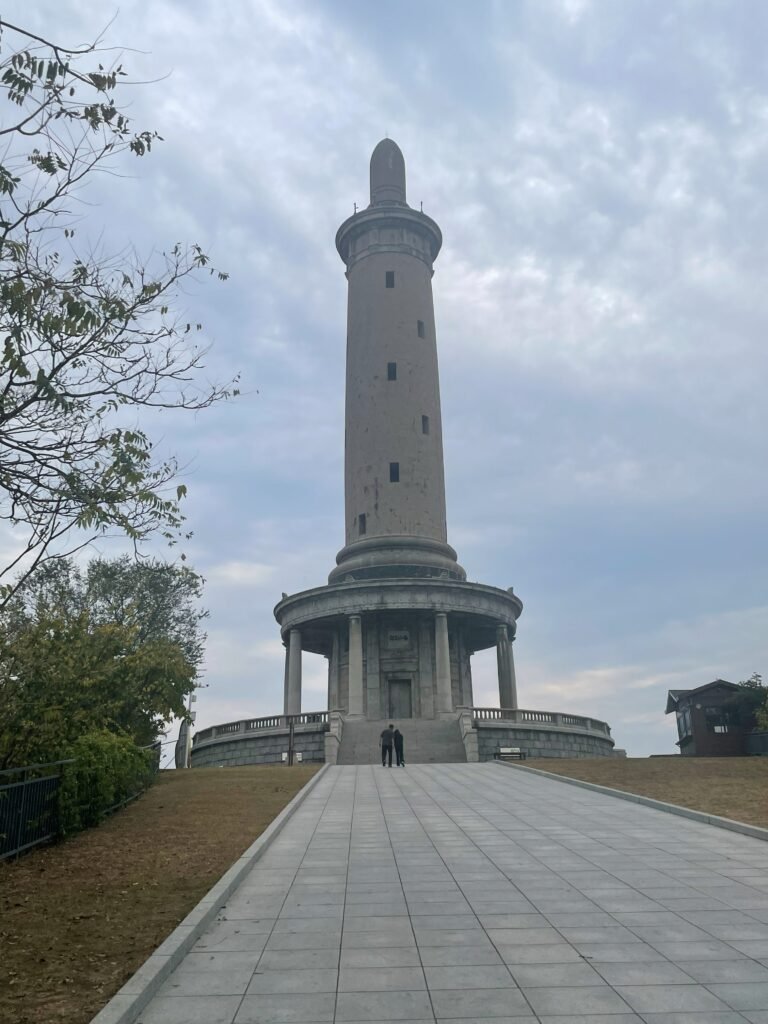
Whatever its symbolism, the monument is magnificent. So is the view. From the summit, the harbour, naval base and surrounding coastline are laid out below. The strategic importance of Lüshun becomes undeniable. It controls a superb natural port near the approaches to the Bohai Sea, with the Korean peninsula and Japan beyond. The flags have changed, but the geography has not. The Chinese Navy has every reason to value the position as highly as the Russians and Japanese did.
Again, I was amazed that the tower had survived. A large fortress-like Japanese building beside it had not been treated so well. Its entrances had been bricked up and the structure was being left to decay. The monument remained dominant over the town while part of the complex beside it quietly rotted away.
I ordered another private driver for the descent and entered what I believed was the local railway station as my destination.
It was the wrong station.
This proved to be the best navigational error of the day.
The car deposited me at the old Lüshun railway station, a beautiful Russian-style building of yellow walls, white timbering, green roofs and a domed tower. Passenger services ended in 2014, but the building has been restored and remains one of the finest surviving stations of the old imperial railway system.
Lüshun was the southern terminus of the Russian-built branch of the Chinese Eastern Railway, connected northwards into the Trans-Siberian network. The line joined the port directly to the machinery of Russian expansion across Asia.
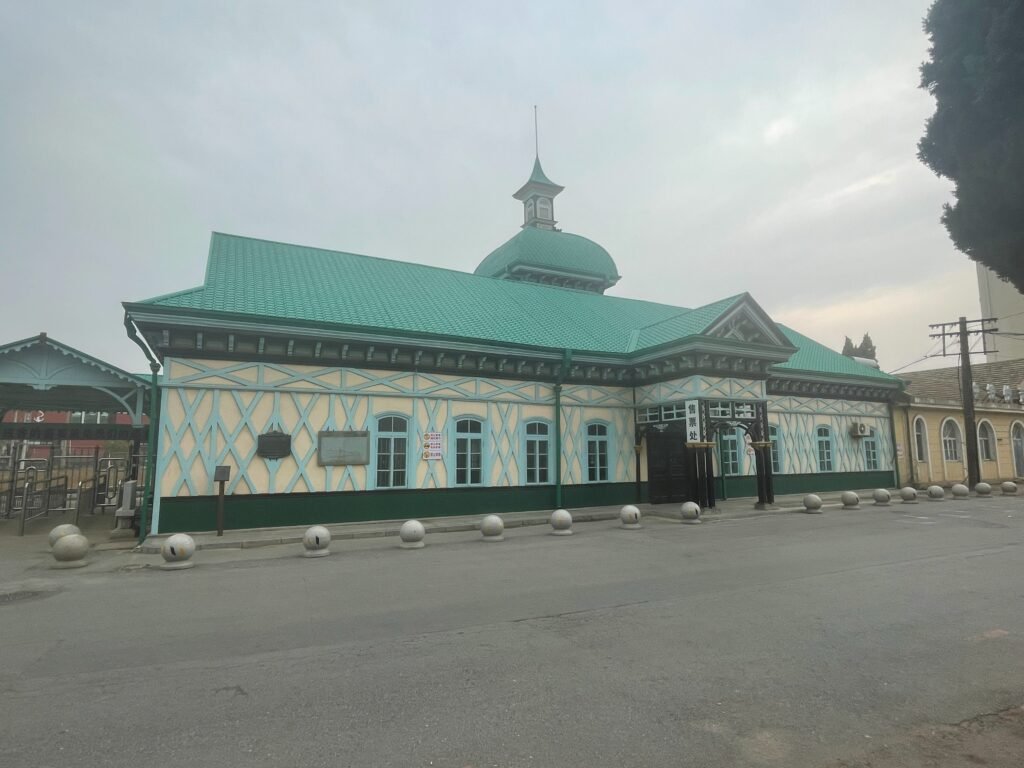
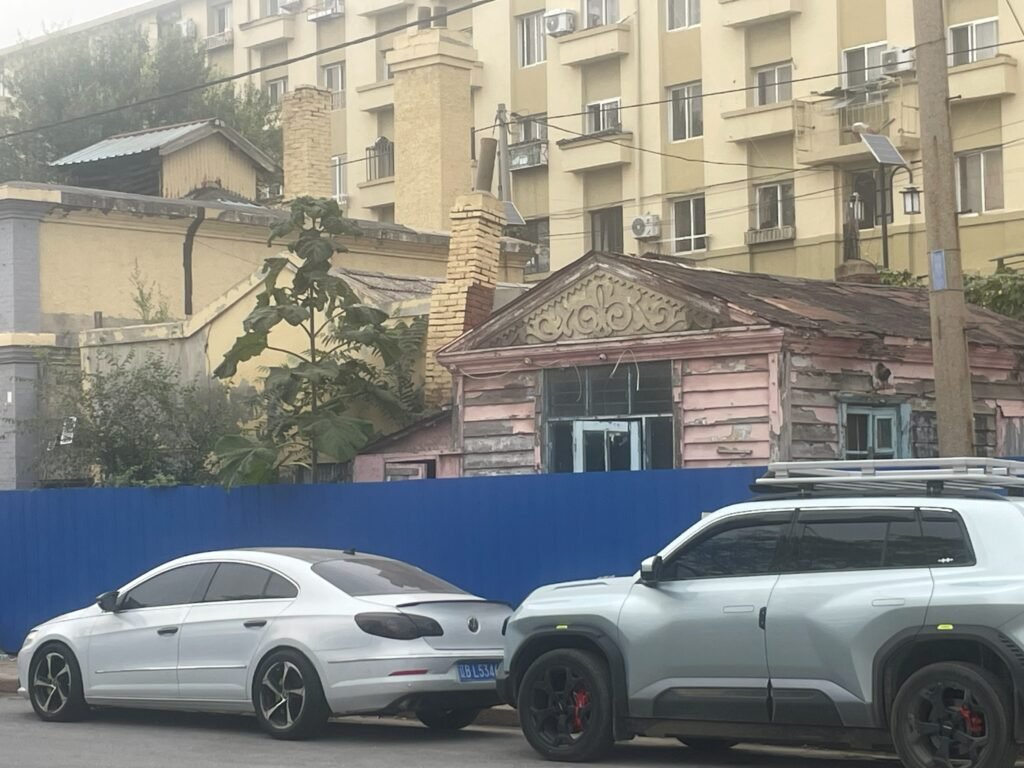
Then I noticed a much smaller boarded wooden building on the opposite side. I assumed that it had been a temporary shop from the period when the grand station was built. Its survival seemed extraordinary amid the high-rise apartments surrounding it.
The truth was even better.
That modest building appears to have been the original Russian station, opened when the railway reached Lüshun in 1903 and later used by the railway police. The elegant station opposite was begun from a Russian design but completed under Japanese rule after the war.
The temporary building was the original. The building which looked perfectly Russian had been finished by Japan. Lüshun had compressed the transfer of empire into two structures facing one another across a road.
I had meant to find the railway station. By selecting the wrong one, I had found both.
After a few photographs, I summoned one final private driver to the correct modern station and took the metro back to central Dalian.
I returned to the hotel exhausted and deeply contented. Lüshun had existed in my mind for years as a place in history books: Port Arthur, the great siege, the moment Japan announced itself and the industrial battlefield which warned Europe what was coming.
Now I had walked through the breach, stood where Kondratenko died, looked down upon the harbour, been assessed by the local matchmakers and discovered the remains of two empires because I entered the wrong destination.
The wrong station had been the right ending.