I had wanted to see Harbin for a very long time. Ever since reading its history, the idea of a Russian colony in China had lodged itself in my imagination. Eventually, I was going to have to inspect it.
At its peak in the 1920s, Harbin had at least 120,000 Russians, probably more. Schools, churches, businesses, families and a cultural life of their own. An entire Russian city had grown up in Manchuria.
The railway explained it. From 1898, the Chinese Eastern Railway brought Russian imperial ambition across northern China, connecting the Siberian system towards Vladivostok, with a southern branch towards Port Arthur. Harbin became the junction and administrative centre.
A railway requires workshops, offices and people willing to live beside it. Those people then require rather more than a platform.
They built a city.
Railway employees, merchants and families from across the Russian Empire established themselves alongside Chinese workers. Revolution and civil war supplied another wave of inhabitants, with considerably more urgent reasons for being outside Russia. Harbin offered a familiar language, familiar institutions and somewhere to begin again.
I had worked my way north through Shanghai, Qingdao, Yantai, Dalian and Port Arthur. The great Russian railway colony was next.
My ankle, which had been restricting imperial inspections since Dalian, would have preferred somewhere smaller.
I strolled out of Harbin station after an early-morning arrival on the overnight train and went straight to the hotel. It was pleasant and comfortable. Its Russian credentials were less convincing, but I could live with that for the sake of a decent stay.
Today seemed a good day for Unit 731. For those not in the know, the secret Japanese experimentation centre of the 1930-1940s, for biological warfare, frostbite effects and other associated experiments on human beings that would be unlikely to be agreed to outside of coercion on threat of death. I would go there first, return to the hotel, then take an afternoon stroll and begin finding the city.
I turned up with my passport and was surprised to be admitted free of charge.
I had expected a grim place. I had not expected to become quite so conscious of the people arranging my response to it.
The museum felt like a theme park. The film, the tightly defined route and the emotionally charged plaques explaining each set scene left very little for the visitor to do independently.
Had I been about twelve, I would have come out demanding a machine gun to kill Japanese people and avenge the spilled blood of my ancestors.
I felt thoroughly instructed.
“If something is free, you are the product.” The application was becoming clearer. Admission cost nothing. The desired return appeared to be a visitor carrying away the prescribed history and the appropriate hostility.
Then came the railway-line installation.
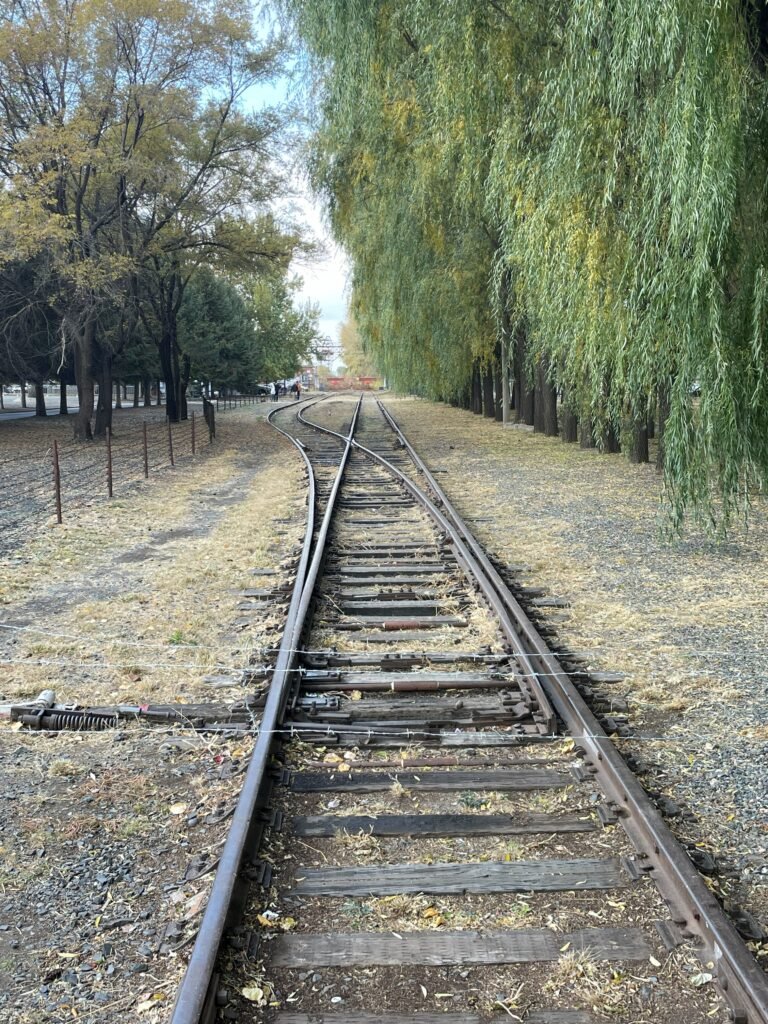
I dislike emotional railway theatre in Poland too. A line of track is a powerful image, and this one seemed to be working considerably harder than a line of track ought to. The visitor was being invited to complete the scene, supply the associations and arrive at the required feeling.
After the film, route and plaques, the railway struck me as the final check that I had received the message.
It felt fake. Whatever the history of the original railway, the presentation had the quality of a theme-park set. I wanted more of the surviving place. The production was getting in the way.
There was another difficulty. Much of the place had gone.
Clues at the site suggested that a good deal of the destruction might belong to the 1950s onwards. The Japanese had blown up their camp in 1945, but demolition had continued after they left. Historical research records further dismantling of the ruins during the Great Leap Forward and the Cultural Revolution.
That made the surviving emptiness rather more complicated than an illustration of Japanese destruction. Chinese rule had contributed its own losses.
Preservation had arrived after several other priorities.
The Russians were another awkward part of the story. From the presentation I encountered, I could have come away thinking the victims were ninety-nine per cent Chinese, with an occasional Korean or Russian around the edges.
The Japanese writer and investigator Seiichi Morimura estimated that up to 30 per cent of the prisoners experimented on at Pingfang were Russian. Close to a third. People from Harbin’s Russian community, as well as Soviet captives.
Accounts describe victims being rounded up from Harbin’s streets. Testimony identifies Russian women and children among those used for experiments. Soviet prisoners were also transferred to the unit.
The people whose buildings I had come to find had been taken into this place too. Their part in it deserved rather more than a walk-on appearance.
In the version presented to me, the Chinese state emerged spotless. I left wondering about the history which had failed to make the production. Where I could agree to some extent, was the anger towards how the perpetrators walked free and the whole thing was hushed up. Fine to say that now, but back then the experiment results and knowledge were considered way too valuable. Generally, there was huge denial for many years that this place even existed. The museum, mysterously enough for the naive, doesn’t question this enough. I would suggest the complicity in keeping this quiet and using the knowledge gained was very valuable to many people, regardless of nationality.
Back at the hotel, I rested before going out for my first afternoon stroll.
It was cold. I was tired. Harbin initially did little to reward the effort. Russian remnants stood alone, detached from the streets and neighbours which might once have explained them. Too much had been obliterated.
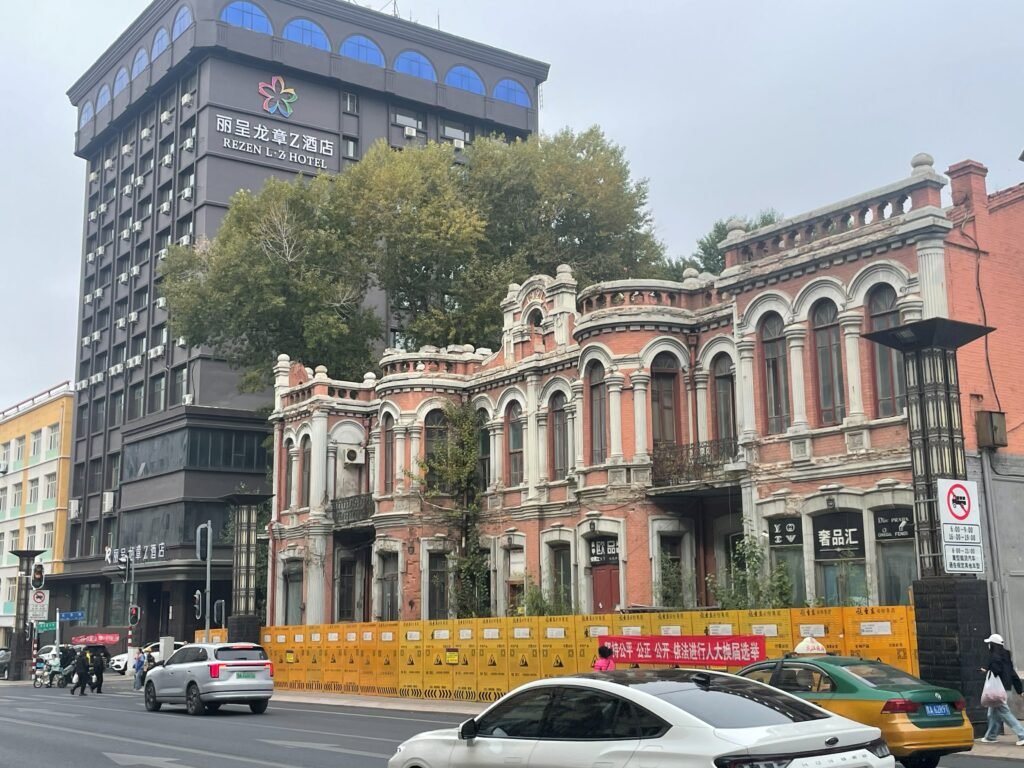
Even the station proved to be a modern building wearing an older one’s clothes. Opened in 2018, it was an enlarged recreation of the demolished Russian-built station.
I had arrived in the Russian colony through a reconstruction of its railway station. Finding the originals was going to take some walking.
Further exploration improved matters. Old Russia was still there, but it had to be sought out. The remains extended well beyond the obvious tourist streets. Farther out, away from the cathedral and the presentation arranged around it, I kept finding relics of the city I had read about.
That mattered. A population of 120,000 had occupied rather more ground than a convenient photographic backdrop.
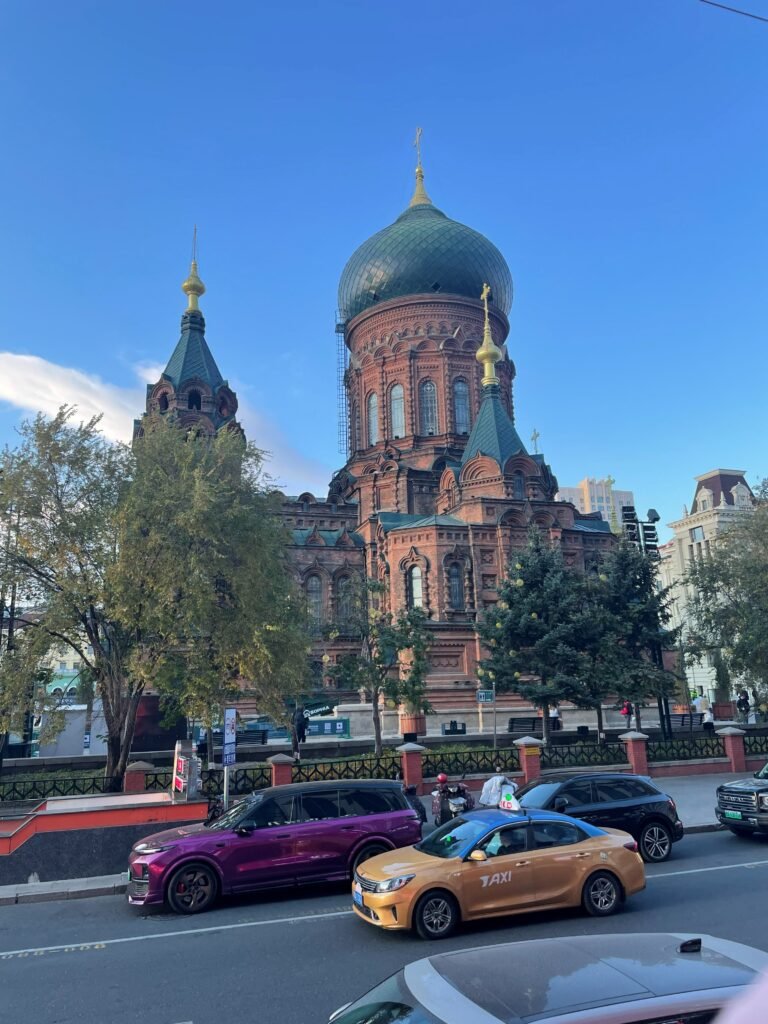
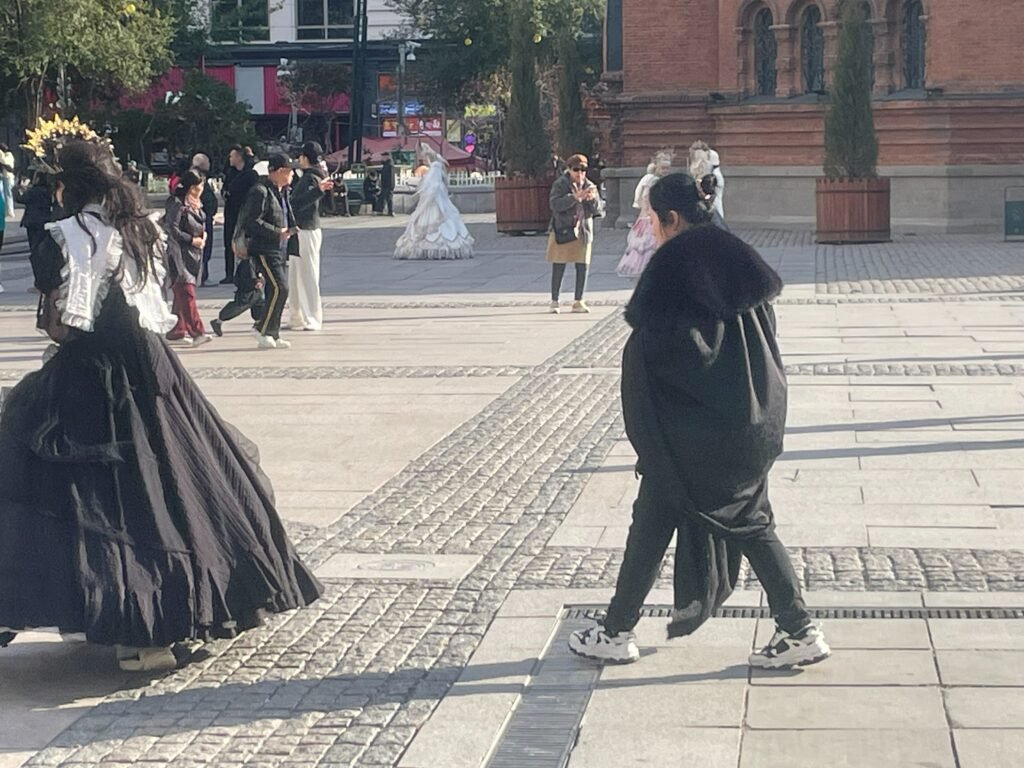
The cathedral had acquired women posing in Baroque costumes. History’s dressing-up department was doing its best. Apparently, the fall of an empire need not interfere with a good photograph.
Out in Majiagou, in Nangang, St Alexis—Alekseyev—was a genuine Russian church. Its parishioners had paid for the brick building, which was consecrated in 1935.
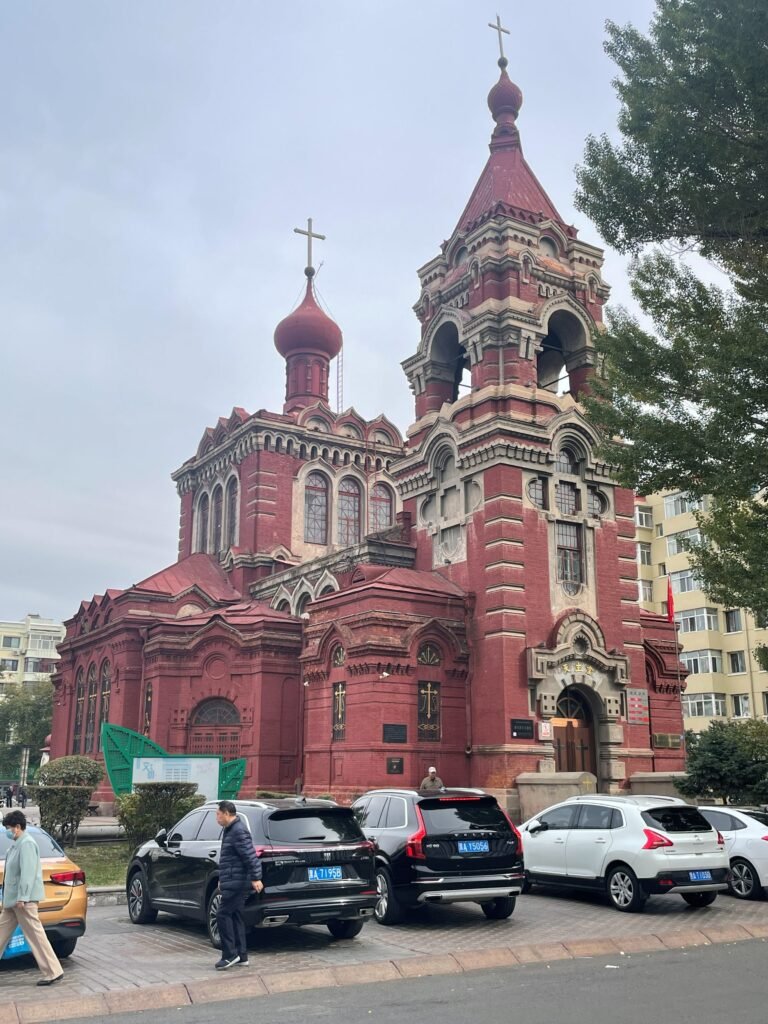
The date doesn’t necessarily fit established narratives and raises questions about how quickly populations and their long term investments can get smashed by subsequent events.
Harbin was already under Japanese rule. Here was a Russian congregation finishing a Russian Orthodox church inside Japanese-controlled Manchukuo. Architecture, nationality and political control refused to arrange themselves into one simple story.
The parishioners had been carrying on with their lives. Governments might change; there was still a church to finish.
The railway workers had encountered a less accommodating version of that arrangement. The 1924 Sino-Soviet agreement specified equal representation between Chinese and Soviet nationals in railway employment. Russians who remained stateless found their livelihoods under pressure. Some registered as Soviet citizens to preserve their jobs. Others had to find work elsewhere.
An early exercise in “diversity”. The wrong sort of Russian could discover how little his “white privilege” was worth.
In 1935, the Soviets sold their railway interest to Japanese-controlled Manchukuo. More upheaval. More departures. The buildings could remain while the arrangements supporting the people inside them were dismantled.
The railway bridge was a much happier discovery.
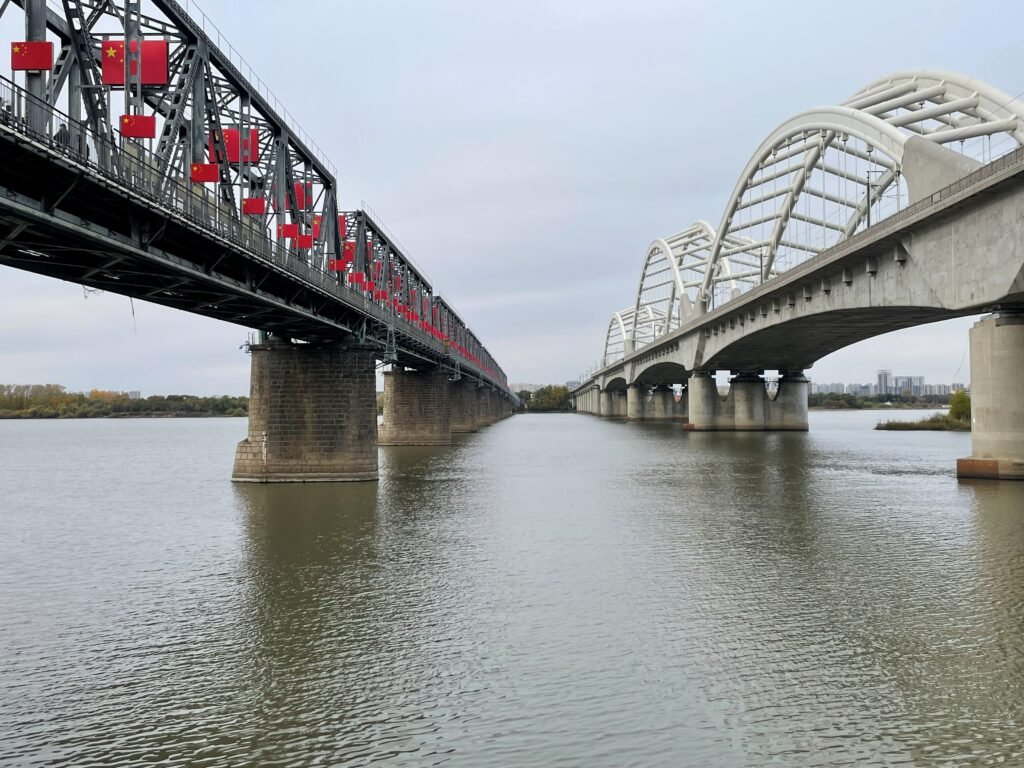
Beautiful engineering. I walked its full length.
Completed in 1901, the old bridge across the Songhua gave the whole enterprise its proper scale. These men had intended to move trains across a great river and connect an empire through northern China. Standing on what they had built made the ambition considerably easier to appreciate.
The bridge earned the walk. My ankle was entitled to its own opinion.
Harbin reminded me of Ipoh.
I had encountered a similar sadness there: buildings carrying traces of people whose lives were no longer readily visible. Here, the gaps were particularly difficult to ignore. Houses survived, but too much of the world around them had disappeared.
There was pain in the place. I also sensed relief. People had reached Harbin after leaving something worse. They had found work, made homes and begun relationships. There must have been happy children in those houses, and days when the great political catastrophe was somebody else’s business.
The residents had not spent every morning waiting to become history.
There had been good days too.
More had been lost long after Japan’s defeat. Russian-era buildings were damaged or demolished, including St Nicholas Cathedral during the Cultural Revolution. Later, the surviving foreignness became useful again, this time as heritage and an attraction.
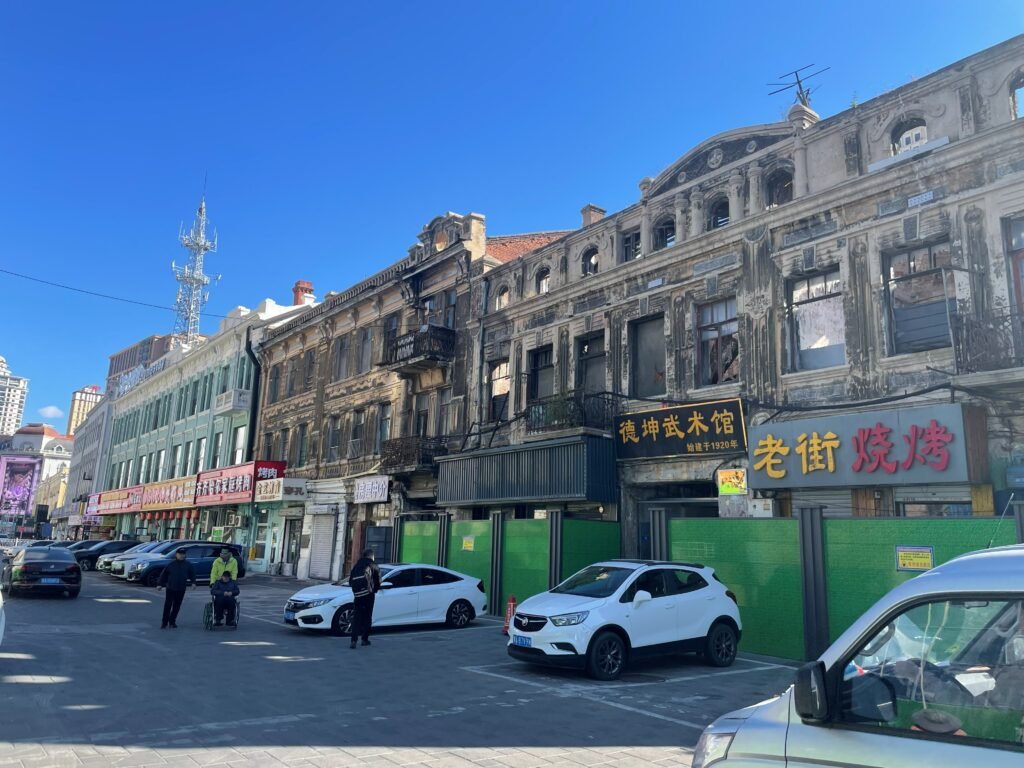
The sequence was familiar by now. Remove much of the old city, then discover a market for what it used to look like.
Still, enough remained to justify looking. Cobbled streets. The Chinese Art Deco area. Buildings which rewarded the walk out to find them. Smoked sausage on sticks and Harbin beer supplied a more agreeable form of historical continuity.
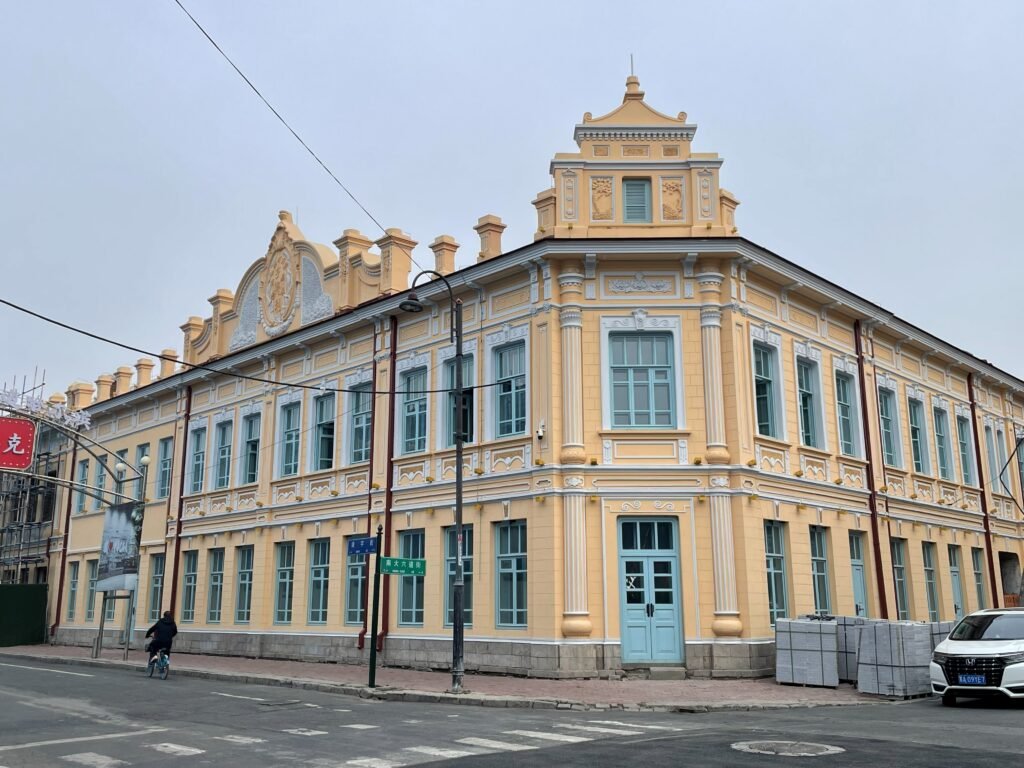
I had finally found something of the Russian heart of the city.
On 16 October, I left on the 16:15 sleeper to Tianjin. Sixteen hours south. By five it was already getting dark, and the landscape was changing beyond the train.
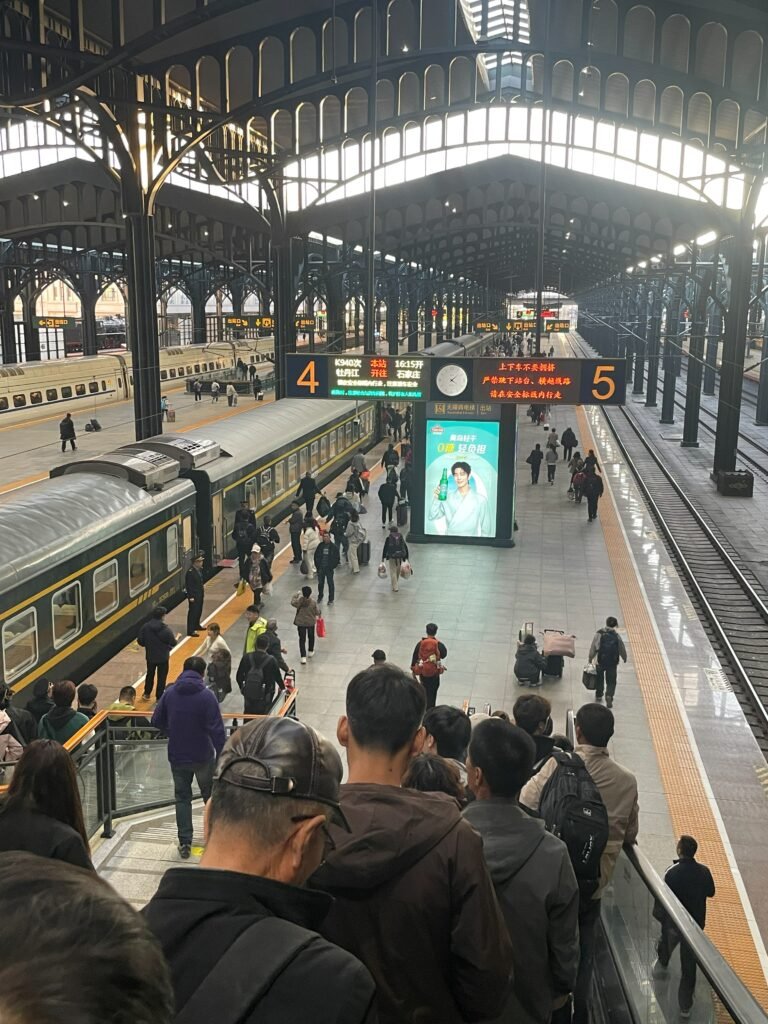
Harbin went into the notebook. Tianjin was next.
There were still colonies to inspect before Ireland.