I watched Europe discuss its trade deficit with China. Then I went to Yantai Port and saw the answer.
This morning, before leaving my hotel in Yantai, I watched Euronews discussing the latest round of trade talks between China and the European Union.
The central figure was almost too large to absorb.
In 2025, the European Union imported €559.4 billion of goods from China and exported €199.6 billion in return. The deficit was €359.8 billion.
Almost one billion euros a day.
The discussion was about what China might concede, what Europe might restrict and how the relationship could be “rebalanced”. There was talk of subsidies, market access and unfair competition. All of these may form part of the calculation.
But nobody appeared willing to ask the more dangerous question.
What has Europe done to its own ability to produce?
The Cost of Making Things
Europe has spent years making reliable energy expensive.
Germany closed its last nuclear power stations. Coal was burdened before dependable replacements were ready. Cheap Russian gas disappeared. Taxes, carbon costs, regulation and political indecision accumulated on top of one another. The result is not theoretical. The International Energy Agency estimates that electricity for energy-intensive industry in the European Union cost more than 50 per cent more than in China in 2025.
Then Europe expresses surprise when energy-intensive production moves elsewhere.
China is not sentimental about the energy required to run a civilisation. It burns coal, builds nuclear power stations, dams rivers, covers enormous areas with solar panels and erects wind turbines at scale. The energy source may change. The governing principle does not.
The power must exist.
Europe increasingly treats energy as a moral performance. China treats it as an industrial input.
The same difference appears in labour.
Europe has made work expensive and non-participation viable. It pays people to be useless, sometimes for generations.
At the same time, it imports large numbers of people from dubious countries without regard to intelligence, usefulness or cultural fit. Many become useless drains on the society that admitted them, consuming more in welfare, housing, healthcare, policing and public services than they produce in tax or useful work. That is not labour supply. It is parasitic immigration.
Europe taxes the productive economy twice: first to support non-contribution, and again to absorb the damage produced by bad selection.
Several Chinese people I spoke to were genuinely baffled by this.
“Why are you doing this?” they asked. “We would never accept it.”
They were not presenting an elaborate political theory. They simply could not understand why a civilisation would penalise the industries and people that sustain it while subsidising those who do not.
It is a fair question.
At Yantai Port
Then I switched off the television and went to the port.
The answer was waiting there in steel.
Yantai Port was full of ships: cargo vessels, ferries and working craft of every size. Cranes moved above them. Goods were being loaded, passengers processed and routes maintained across the Bohai Sea and beyond.
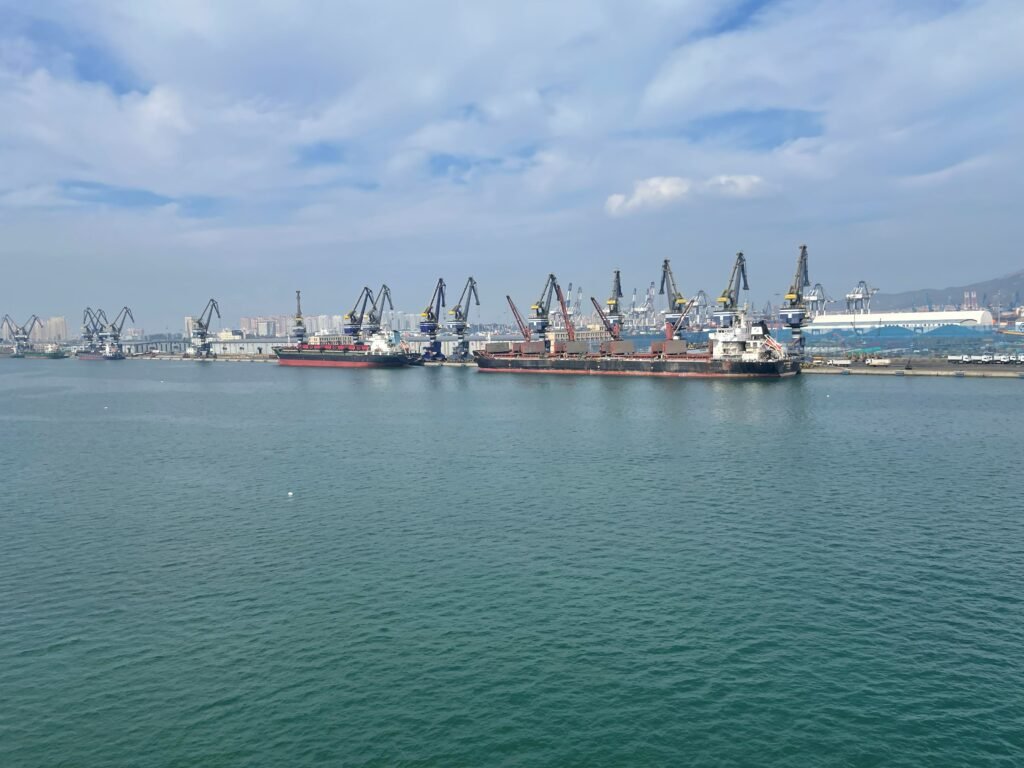
This was commerce. Not commerce as a paragraph in an EU communiqué. Not commerce as a political slogan. Goods, machinery, labour and capital were physically moving.
Yet the great ships were only half the scene. Along the water were smaller oyster and shellfish beds, tended by ordinary people operating at an entirely different scale.
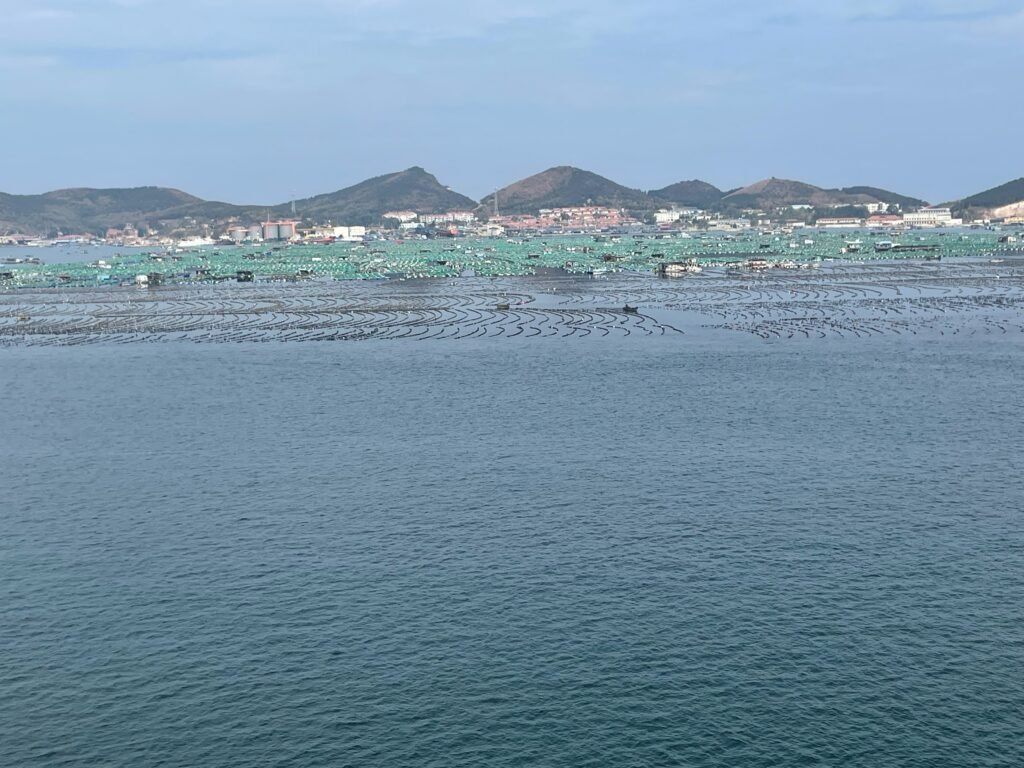
The port contained both ends of a functioning economy: immense industrial capacity and small productive enterprise sharing the same stretch of water.
The sea was not scenery. It was working.
A Cabin to Dalian
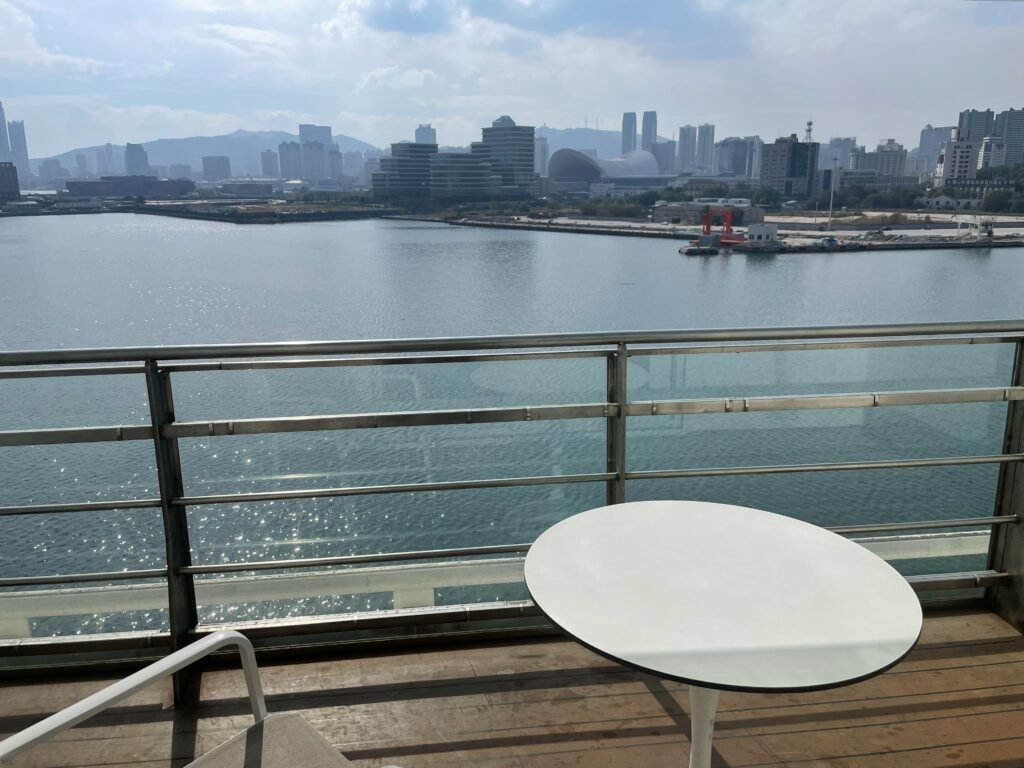
My own place in this machinery was a first-class private cabin on the ferry to Dalian.
It was clean, comfortable and mine for the six-hour crossing. I could close the door, lie down and sleep while the ship carried me across the water. The equivalent in Europe would either not exist or would be priced at a level I would refuse to pay.
China is not frictionless. The procedures can be opaque. The ticketing can be peculiar. Translation can become an expedition of its own. The efficiency is not always polished.
But it works.
When a practical problem appears, somebody usually tries to solve it. The passenger is moved, the cargo is loaded and the ship leaves. The Chinese system can be clumsy at the edges and formidable at the centre.
Europe has become increasingly skilled at the opposite: polished presentation surrounding declining capacity.
The Wrong Negotiation
China certainly supports its industries. It protects parts of its market, directs credit, builds infrastructure and uses the power of the state to advance national production. Europe may reasonably respond to those things.
But they are not the whole explanation.
A subsidy cannot load a ship. A tariff cannot manufacture competence. Political protection cannot substitute indefinitely for abundant energy, trained labour, functioning ports, industrial scale and a culture which still expects systems to produce a result.
Europe wants China to buy more European goods while steadily making European goods harder and more expensive to produce. It wants Chinese prices without Chinese scale, Chinese infrastructure or Chinese seriousness. It wants the output while rejecting many of the inputs.
So the officials fly to Beijing and ask China to rebalance the result.
The imbalance was also made in Europe.
Tariffs may slow the ships. Regulations may obstruct their cargo. Trade negotiations may purchase time. None of them will make energy cheaper, rebuild a closed factory or turn subsidised non-participation into productive work.
By evening, this ferry will reach Dalian. Six hours across the water, with a private cabin in which I can sleep. Beyond the port waits the Russian and Japanese history of the city. Behind me, Yantai will continue loading ships and tending shellfish beds.
Brussels will continue talking about China.
The real question is not why China sells so much to Europe. It is why Europe chose to make itself so expensive, so administratively heavy and so tolerant of non-contribution that buying from China became the rational decision.
The deficit is not merely something China did to Europe.
It is the invoice Europe writes to itself one billion Euros at a time.